Quick Answer
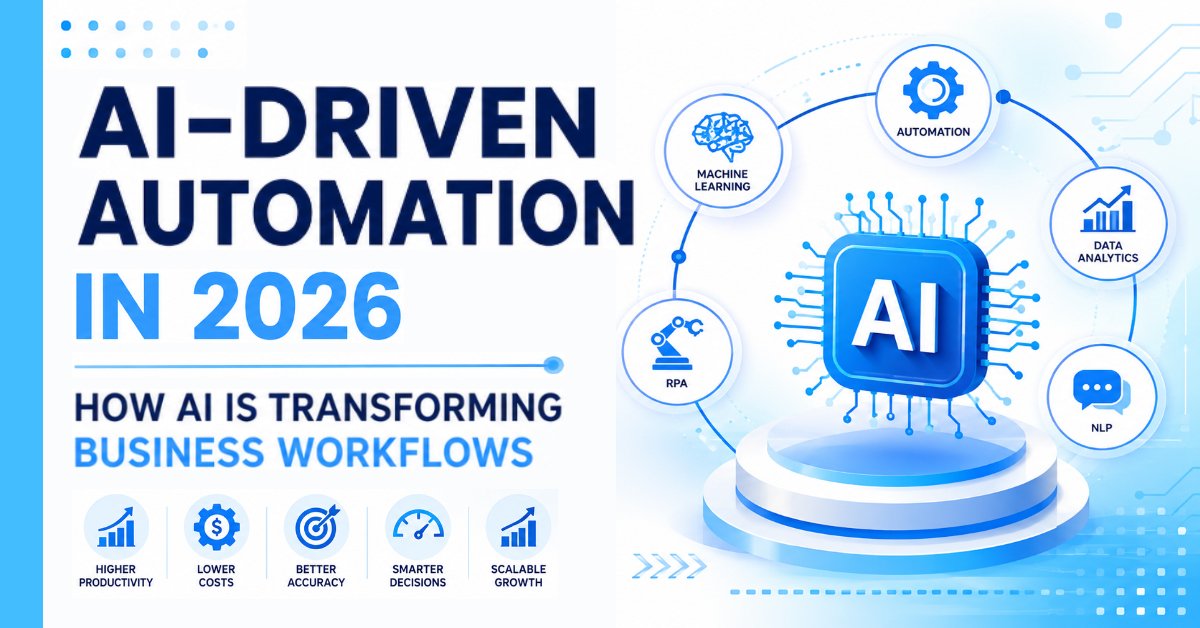
AI-driven automation combines artificial intelligence (AI) technologies such as machine learning, natural language processing (NLP), and predictive analytics with automated workflows to perform tasks with minimal human intervention. Unlike traditional automation, AI-driven automation can learn from data, adapt to changing conditions, and make intelligent decisions, helping businesses improve efficiency, reduce costs, and scale operations more effectively.
Key Takeaways
- AI-driven automation uses artificial intelligence to automate tasks, decisions, and workflows.
- Unlike traditional automation, it can learn, adapt, and improve over time.
- Businesses use AI automation to increase productivity, reduce errors, and improve customer experiences.
- From healthcare and finance to retail and manufacturing, organizations are rapidly implementing AI-driven automation to optimize workflows, reduce costs, and improve operational performance.
- AI agents represent the next evolution of automation, enabling systems to complete complex tasks with greater autonomy.
- Successful implementation requires quality data, clear objectives, and ongoing monitoring.
Introduction
Imagine managing a business where routine tasks run automatically, customer inquiries are handled within moments, inventory levels remain optimized without constant oversight, and operational issues are detected before they turn into expensive problems.
A few years ago, this level of automation sounded futuristic. Today, it is becoming a reality for organizations of all sizes.
Businesses generate enormous amounts of data every day. At the same time, customers expect faster responses, employees expect smarter tools, and competition continues to intensify. Traditional automation systems can help with repetitive processes, but they often struggle when situations change or decisions become more complex.
This is where AI-driven automation transforms the way businesses operate.
By combining artificial intelligence with workflow automation, organizations can move beyond simple rule-based processes and create systems capable of analyzing information, recognizing patterns, making recommendations, and even taking action independently.
From detecting fraudulent financial transactions to predicting equipment failures in manufacturing facilities, AI-powered automation is transforming how work gets done across industries.
In this guide, you’ll learn:
- What AI-driven automation is
- How it works
- How it differs from traditional automation
- The business benefits it delivers
- Real-world examples of AI automation in action
- How AI agents are shaping the future of intelligent workflows
Whether you’re a business owner, technology leader, marketer, developer, or simply curious about the future of work, understanding AI-driven automation is becoming increasingly important in today’s digital economy.
What Is AI-Driven Automation?
AI-driven automation is the use of artificial intelligence technologies to automate tasks, processes, and decision-making activities that traditionally required human involvement.
Rather than simply executing predefined rules, AI-driven automation can analyze information, learn from past experiences, and adapt its actions as conditions change.
For example, a traditional automated system might send an email whenever a customer submits a form. It follows a fixed rule and performs the same action every time.
An AI-driven system, however, can go much further. It can analyze the customer’s behavior, determine their level of interest, personalize the message, prioritize leads, and even recommend the next best action for a sales team.
In other words, traditional automation focuses on executing instructions, while AI-driven automation focuses on making smarter decisions.
Core Technologies Behind AI-Driven Automation
Several technologies work together to make intelligent automation possible.
Artificial Intelligence (AI)
Artificial intelligence enables machines to perform tasks that typically require human intelligence, such as reasoning, problem-solving, and decision-making.
AI acts as the brain behind automated systems, helping them interpret information and respond appropriately.
Machine Learning (ML)
Machine learning allows systems to learn from data and improve performance over time without being explicitly programmed.
For example, a fraud detection system can continuously learn from new transaction patterns and become more accurate at identifying suspicious activity.
Natural Language Processing (NLP)
Natural language processing empowers machines to comprehend, interpret, and generate human language, enabling more natural interactions between people and technology.
This technology powers:
- AI chatbots
- Virtual assistants
- Sentiment analysis tools
- Automated customer support systems
NLP enables businesses to automate communication while maintaining a more natural user experience.
Robotic Process Automation (RPA)
Robotic Process Automation uses software bots to handle repetitive, rule-based tasks such as:
- Data entry
- Invoice processing
- Report generation
- Form filling
When RPA is combined with artificial intelligence, automation becomes significantly more powerful because bots can make informed decisions rather than simply following fixed instructions.
Why AI-Driven Automation Matters
Organizations today face a difficult challenge: doing more with limited resources while maintaining speed, quality, and customer satisfaction.
AI-driven automation helps solve this challenge by enabling businesses to:
- Process information faster
- Reduce manual workloads
- Improve operational efficiency
- Enhance decision-making
- Scale without proportionally increasing costs
Consider a customer support team handling thousands of inquiries daily. Without automation, agents may spend hours answering repetitive questions.
AI-driven automation can efficiently manage routine requests, allowing human teams to focus on complex challenges that require creativity, empathy, and strategic insight.
This shift doesn’t simply improve efficiency—it changes how organizations allocate talent and resources.
As AI technology continues to evolve, automation is moving beyond task execution toward intelligent decision-making, creating entirely new opportunities for innovation and growth.
AI-Driven Automation vs Traditional Automation
Although the terms are often used interchangeably, AI-driven automation and traditional automation are fundamentally different.
Traditional automation relies on predefined rules and structured workflows. It performs the same action every time a specific condition is met.
AI-driven automation, on the other hand, can analyze information, adapt to new situations, and continuously improve through learning.
| Feature | Traditional Automation | AI-Driven Automation |
| Decision-Making | Rule-based | Data-driven and adaptive |
| Learning Ability | None | Learns from data and experience |
| Flexibility | Limited | Highly adaptable |
| Data Processing | Structured data only | Structured and unstructured data |
| Problem Solving | Fixed responses | Context-aware responses |
| Scalability | Moderate | High |
| Continuous Improvement | No | Yes |
Example: Customer Support
A traditional automation system might direct all customer inquiries to predefined categories using fixed rules.
An AI-driven automation platform can:
- Understand customer intent
- Analyze previous interactions
- Detect sentiment
- Prioritize urgent requests
- Suggest or generate responses
The result is a faster and more personalized customer experience.
Example: Financial Services
Traditional systems can flag transactions based on predefined thresholds.
AI-powered systems can identify unusual behavior patterns, detect emerging fraud techniques, and continuously improve detection accuracy over time.
This ability to learn and adapt is what makes AI-driven automation one of the most significant technological shifts in modern business operations.
The Evolution of Business Automation
To understand why AI-driven automation is transforming industries, it’s helpful to see how automation has evolved over the years.
Business automation didn’t begin with artificial intelligence. It started with simple systems designed to reduce manual effort and improve efficiency. As technology advanced, automation became smarter, more flexible, and increasingly capable of handling complex tasks.
Today, organizations are entering a new era where AI-powered systems can not only execute tasks but also make decisions and adapt to changing conditions.
Traditional Automation
Traditional automation focuses on repetitive, rule-based activities.
These systems follow predefined instructions and perform the same action every time specific conditions are met.
Examples include:
- Automatic email responses
- Payroll processing systems
- Inventory alerts
- Manufacturing assembly lines
Traditional automation offers consistency and efficiency, but it has significant limitations.
If circumstances change or an unexpected scenario occurs, the system cannot adapt without human intervention.
For example, a traditional customer support workflow may automatically route tickets based on keywords, but it cannot understand context, urgency, or customer sentiment.
Robotic Process Automation (RPA)
As businesses sought greater efficiency, Robotic Process Automation (RPA) emerged as a powerful solution.
RPA uses software bots to mimic human interactions with digital systems.
These bots can:
- Transfer data between applications
- Process invoices
- Generate reports
- Fill out forms
- Perform administrative tasks
RPA significantly reduces manual workloads and improves operational accuracy.
However, RPA still relies heavily on predefined rules.
If a process changes unexpectedly or requires judgment, the bot may fail or require reprogramming.
This limitation created demand for more intelligent automation systems.
AI-Driven Automation
AI-driven automation represents the next major leap forward.
Instead of simply following instructions, AI-powered systems can:
- Analyze large volumes of data
- Identify patterns
- Learn from historical outcomes
- Make recommendations
- Adapt to changing conditions
For example, an AI-powered fraud detection system can continuously learn from new transaction data and identify suspicious activities that traditional rule-based systems might miss.
Similarly, an AI-enabled customer service platform can understand customer intent, detect emotions, and provide personalized responses.
This ability to learn and improve over time makes AI-driven automation significantly more valuable than conventional automation approaches.
Agentic AI and Autonomous Workflows
The newest stage in automation evolution is often called Agentic AI.
Rather than automating individual tasks, AI agents can pursue objectives, make decisions, coordinate actions, and complete multi-step workflows with limited supervision.
Imagine a business owner asking an AI agent:
“Assess this month’s sales performance, identify key challenges, recommend appropriate solutions, and generate a comprehensive summary report.”
Instead of handling one isolated task, the AI agent can:
- Gather relevant data
- Analyze trends
- Identify performance issues
- Generate recommendations
- Create a report
- Deliver findings
This shift moves automation from task execution toward goal-oriented outcomes.
Many technology experts believe AI agents will become one of the most important developments in workplace productivity during the next decade.
For businesses, this means automation is no longer just about reducing repetitive work—it is becoming a strategic tool for decision support, operational efficiency, and innovation.
How AI-Driven Automation Works
At first glance, AI-driven automation may seem complex, but most systems follow a relatively straightforward process.
The combination of artificial intelligence and automation allows machines to gather information, analyze it, make decisions, and take action with minimal human involvement.
To see how AI-driven automation operates in practice, let’s walk through the process step by step.
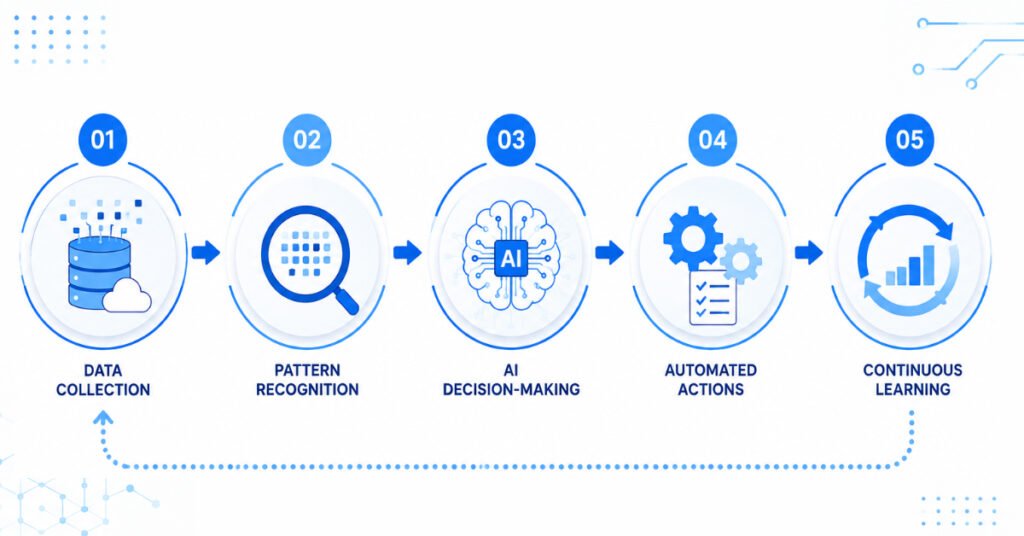
1. Data Collection
Everything begins with data.
AI systems collect information from various sources, including:
- Customer interactions
- Business applications
- Sensors and IoT devices
- Emails and documents
- Databases
- Website activity
The more relevant and accurate the data, the better the system can perform.
For example, an online retailer can leverage customer browsing patterns, purchase history, and product preferences to generate more accurate and personalized recommendations.
2. Pattern Recognition
Once data is collected, machine learning models analyze it to identify trends and patterns.
These patterns help systems understand relationships that may not be obvious to humans.
Examples include:
- Detecting fraudulent transactions
- Predicting customer churn
- Forecasting demand
- Identifying equipment failures
This stage transforms collected data into valuable insights that can be used to drive smarter decisions and actions.
3. Intelligent Decision-Making
After recognizing patterns, AI systems evaluate possible actions and determine the most appropriate response.
Unlike traditional automation, decisions are not always based on fixed rules.
Instead, AI considers:
- Historical outcomes
- Current conditions
- Contextual information
- Predicted results
For example, an AI-powered inventory management system may automatically adjust stock levels based on seasonal demand patterns and real-time sales data.
4. Automated Actions
Once a decision is made, automation tools execute the necessary actions.
These actions may include:
- Sending emails
- Updating records
- Approving requests
- Scheduling appointments
- Generating reports
- Triggering business workflows
This eliminates manual intervention and accelerates business processes.
5. Continuous Learning and Improvement
One of the most valuable characteristics of AI-driven automation is its ability to learn.
As systems process more data, they refine their models and improve performance.
Over time, they become:
- More accurate
- More efficient
- Better at predicting outcomes
- Better at handling exceptions
This creates a cycle of continuous optimization that traditional automation cannot achieve.
Key Benefits of AI-Driven Automation
Organizations across industries are investing in AI-powered automation because it delivers measurable business value.
Although the impact of AI-driven automation differs by industry, several key benefits are consistently seen across successful implementations.
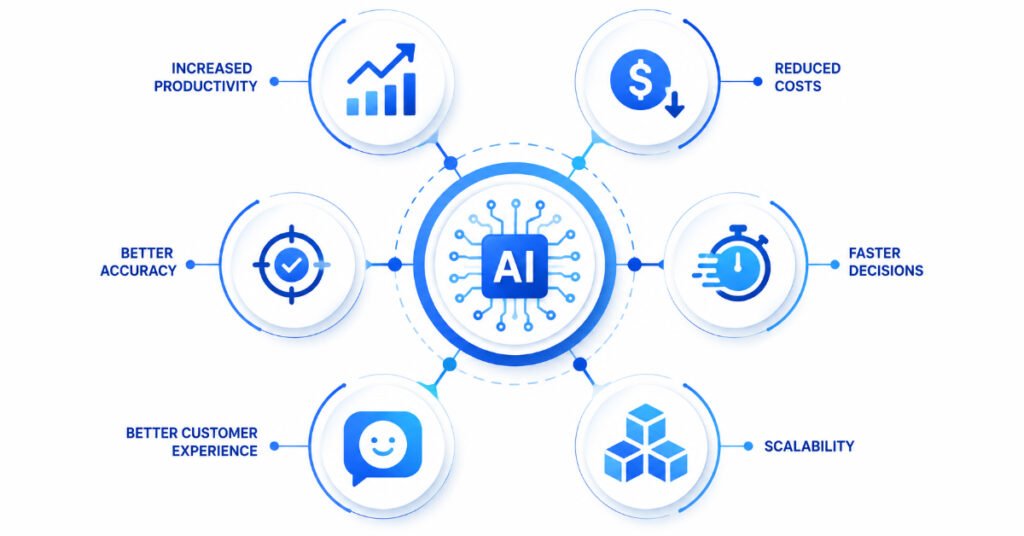
Increased Productivity
Employees often spend significant portions of their workday on repetitive administrative tasks.
AI-driven automation handles these activities automatically, allowing teams to focus on higher-value work.
Examples include:
- Data entry
- Report generation
- Customer support inquiries
- Appointment scheduling
As a result, organizations can accomplish more without increasing workforce size.
Reduced Operational Costs
Manual processes frequently lead to higher costs, slower execution, and unnecessary operational inefficiencies.
AI automation helps businesses reduce costs by:
- Minimizing repetitive labor
- Streamlining workflows
- Reducing process delays
- Improving resource utilization
Even small efficiency improvements can generate substantial savings when applied across large operations.
Improved Accuracy
Human errors can increase operational risks, leading to financial losses, compliance complications, and diminished customer satisfaction.
AI-driven systems perform tasks consistently and can identify anomalies that humans may overlook.
Examples include:
- Financial transaction monitoring
- Data validation
- Inventory management
- Quality assurance processes
Improved accuracy leads to better business outcomes and stronger customer trust.
Faster Decision-Making
In today’s competitive environment, speed matters.
AI systems can analyze large amounts of information within seconds and generate recommendations almost instantly.
This enables businesses to:
- Respond quickly to market changes
- Improve operational agility
- Make data-driven decisions
- Reduce delays in critical workflows
Better Customer Experiences
Modern consumers expect fast, personalized, and convenient interactions.
AI-driven automation helps businesses meet these expectations through:
- Intelligent chatbots
- Personalized recommendations
- Automated customer support
- Predictive service delivery
The result is higher customer satisfaction and stronger brand loyalty.
Enhanced Scalability
As business operations expand, manual processes can become increasingly difficult to manage effectively.
AI automation enables organizations to scale operations without proportionally increasing costs or staffing requirements.
Whether handling hundreds or millions of transactions, AI-powered systems can maintain consistent performance while supporting business expansion.
This scalability is one of the key reasons organizations increasingly view AI-driven automation as a long-term competitive advantage.
Real-World AI Automation Examples
The true value of AI-driven automation becomes clear when we examine how organizations use it to solve real business problems.
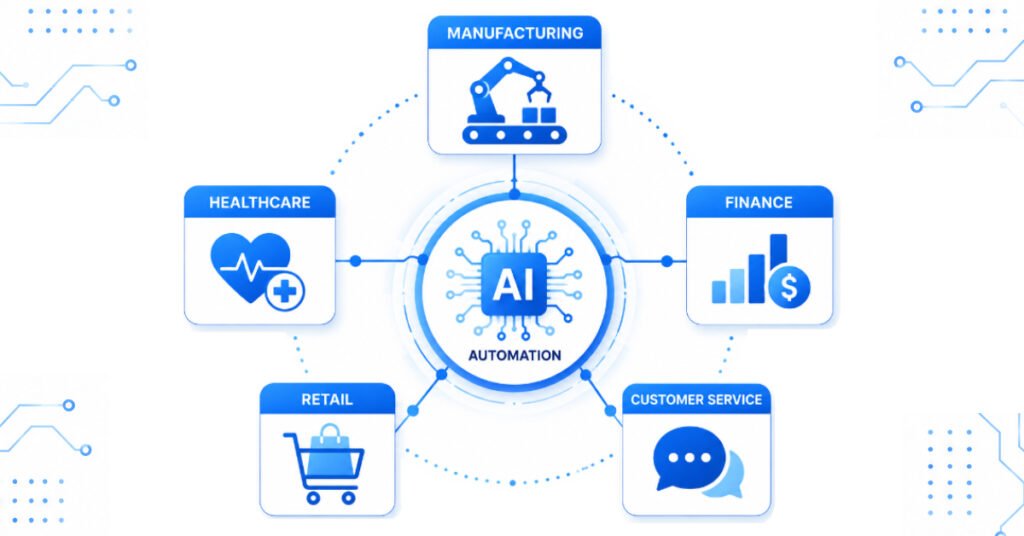
Across industries, AI-powered systems are helping companies improve efficiency, reduce costs, enhance customer experiences, and make smarter decisions.
To see AI-driven automation in action, let’s explore several of its most impactful and widely used applications.
Manufacturing
Manufacturing has been one of the earliest adopters of automation, but artificial intelligence is taking efficiency to a new level.
Predictive Maintenance
Traditional maintenance schedules often rely on fixed timelines, which can lead to unnecessary servicing or unexpected equipment failures.
AI-driven automation continuously monitors machine performance and analyzes sensor data to predict potential failures before they occur.
Benefits include:
- Reduced downtime
- Lower maintenance costs
- Improved equipment lifespan
- Increased production efficiency
Quality Control
Computer vision systems can inspect products in real time and identify defects with remarkable accuracy.
Instead of relying solely on manual inspections, manufacturers can automate quality assurance processes while improving consistency and reducing waste.
Healthcare
Healthcare organizations generate enormous volumes of data and face constant pressure to improve patient outcomes while controlling costs.
AI-driven automation is helping address these challenges.
Medical Imaging Analysis
AI systems can analyze X-rays, MRIs, and CT scans to help healthcare professionals identify abnormalities more quickly.
These tools assist clinicians by highlighting potential issues and supporting diagnostic decisions.
Administrative Automation
Hospitals and clinics use AI-powered systems to automate:
- Appointment scheduling
- Insurance verification
- Patient record management
- Billing workflows
Reducing administrative burdens allows healthcare professionals to spend more time focusing on patient care.
Financial Services
The financial industry depends heavily on speed, accuracy, and risk management.
AI automation helps financial institutions process vast amounts of information while improving security and compliance.
Fraud Detection
AI systems analyze transaction patterns and detect unusual activities that may indicate fraud.
Unlike traditional rule-based systems, machine learning models continuously adapt to emerging threats.
Risk Assessment
Banks and financial organizations use AI to evaluate creditworthiness, identify potential risks, and support lending decisions.
This enhances decision accuracy while significantly reducing the burden of manual review tasks.
Retail and E-Commerce
Modern consumers expect personalized experiences, fast service, and seamless shopping journeys.
AI-driven automation helps retailers meet these expectations.
Personalized Product Recommendations
AI analyzes customer behavior, purchase history, and browsing patterns to recommend relevant products.
This improves customer engagement while increasing conversion rates.
Inventory Management
Retailers use predictive analytics to forecast demand and optimize stock levels.
Benefits include:
- Reduced overstocking
- Fewer stock shortages
- Better inventory turnover
- Improved customer satisfaction
Customer Service
Customer support is one of the most visible applications of AI-driven automation.
Businesses increasingly use AI-powered systems to provide faster and more efficient service.
Intelligent Chatbots
Modern AI chatbots can:
- Answer common questions
- Resolve routine issues
- Guide users through processes
- Escalate complex cases when necessary
Unlike earlier chatbot technologies, AI-powered assistants can understand context and maintain more natural conversations.
Smart Ticket Routing
AI systems automatically categorize support requests and direct them to the appropriate teams.
This reduces response times and improves overall customer satisfaction.
How Leading Companies Use AI Automation
Many of the world’s most successful organizations have integrated AI-driven automation into their operations.
While implementation strategies vary, the underlying goal remains the same: improve efficiency, reduce complexity, and create better outcomes.
The following examples illustrate how AI automation is delivering measurable business value.
Amazon: Optimizing Operations at Scale
The Challenge
Managing one of the world’s largest e-commerce ecosystems requires coordinating inventory, logistics, warehousing, customer service, and delivery operations.
Manual decision-making alone would be insufficient to handle this level of complexity.
The Solution
Amazon uses AI-driven automation throughout its operations.
Examples include:
- Demand forecasting
- Inventory optimization
- Warehouse robotics
- Route planning
- Customer recommendations
Machine learning systems continuously analyze large volumes of operational data to support business decisions.
Business Impact
AI automation helps Amazon:
- Improve fulfillment efficiency
- Reduce operational delays
- Enhance customer experiences
- Optimize supply chain performance
The company’s ability to operate at massive scale demonstrates the power of combining artificial intelligence with automation.
IBM: Intelligent Business Operations
The Challenge
Large enterprises often struggle with complex workflows, fragmented data, and inefficient business processes.
Organizations need systems capable of handling growing operational complexity while supporting informed decision-making.
The Solution
IBM has invested heavily in AI-driven automation technologies that help organizations streamline operations and automate business processes.
Its solutions combine:
- Artificial intelligence
- Machine learning
- Workflow automation
- Data analytics
These technologies enable businesses to automate repetitive activities while improving operational visibility.
Business Impact
Organizations using intelligent automation solutions can:
- Improve productivity
- Reduce process bottlenecks
- Accelerate decision-making
- Enhance operational efficiency
IBM’s approach highlights how AI automation can support enterprise-wide transformation rather than isolated tasks.
Siemens: Smart Manufacturing and Industrial Automation
The Challenge
Manufacturing companies must maintain production quality while minimizing downtime and controlling costs.
Unexpected equipment failures can significantly impact productivity.
The Solution
Siemens integrates AI-driven automation into industrial operations through predictive maintenance, process optimization, and intelligent monitoring systems.
Through ongoing analysis of operational data, these systems can proactively identify inefficiencies and performance risks before they affect business operations.
Business Impact
Benefits include:
- Improved operational reliability
- Reduced downtime
- Enhanced production efficiency
- Better resource utilization
Siemens demonstrates the ability of AI-driven automation to produce measurable improvements in industrial environments where efficiency, productivity, and reliability are top priorities.
Key Lessons From These Examples
Although these organizations operate in different industries, several common themes emerge.
Successful AI automation initiatives typically focus on:
Solving Specific Business Problems
The most effective projects begin with clear objectives rather than implementing AI for its own sake.
Leveraging High-Quality Data
Data quality directly influences the effectiveness of AI systems.
Organizations that invest in data governance often achieve stronger results.
Combining Human Expertise With Automation
AI automation works best when it enhances human capabilities rather than attempting to replace them entirely.
Continuously Improving Processes
Leading organizations treat automation as an ongoing journey rather than a one-time project.
As AI models learn and business needs evolve, workflows can be refined to deliver even greater value.
These lessons provide a strong foundation for understanding where automation is heading next—and why AI agents may represent the next major evolution in intelligent business operations.
AI Agents and the Future of Automation
For years, automation focused primarily on executing repetitive tasks faster and more efficiently. Businesses automated data entry, invoice processing, report generation, and other routine activities to save time and reduce costs.
However, a new phase of automation is emerging.
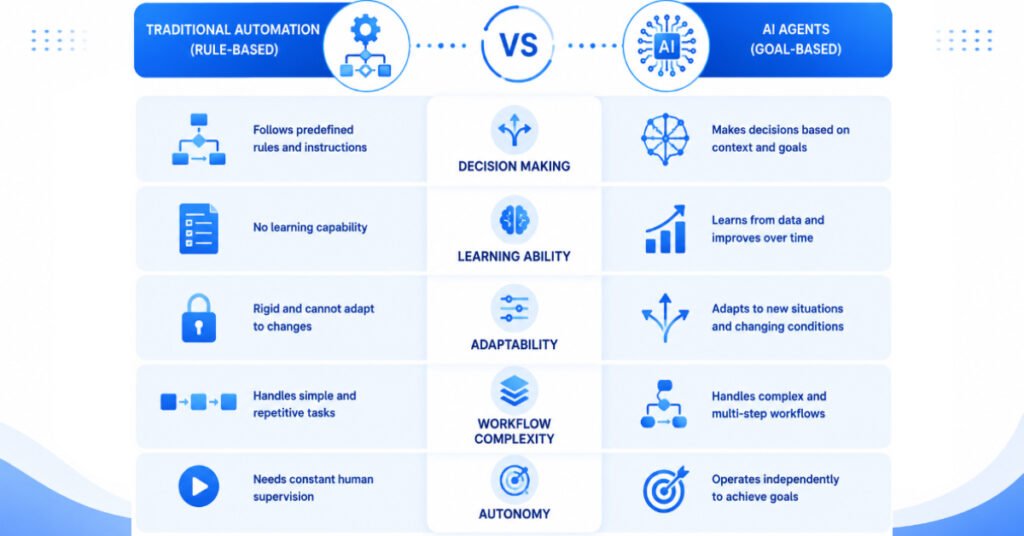
Instead of simply following instructions, modern AI systems are becoming capable of understanding goals, making decisions, and carrying out complex workflows with minimal human supervision.
This shift is being driven by AI agents.
Many industry experts believe AI agents will become one of the most important developments in business technology during the coming decade, transforming how organizations operate and compete.
What Are AI Agents?
An AI agent is an intelligent software system designed to perform tasks, make decisions, and pursue objectives on behalf of a user or organization.
Unlike traditional automation solutions that execute predefined workflows, AI agents can:
- Understand context
- Analyze information
- Plan actions
- Solve problems
- Learn from outcomes
- Adapt to changing situations
Think of traditional automation as a machine following a checklist.
An AI agent behaves more like a digital assistant that can understand the goal and determine the best way to achieve it.
For example, instead of simply sending a scheduled email, an AI agent could:
- Analyze customer behavior
- Identify the most promising prospects
- Generate personalized messages
- Schedule follow-ups
- Track responses
- Adjust future outreach strategies
All within a single workflow.
This capability represents a significant step forward in business automation.
AI Agents vs AI Automation
Although the terms are often used together, AI agents and AI-driven automation are not exactly the same.
| Feature | AI-Driven Automation | AI Agents |
| Primary Purpose | Automate tasks and workflows | Achieve goals and outcomes |
| Decision-Making | Limited to specific workflows | Broader autonomous decisions |
| Adaptability | Moderate | High |
| Multi-Step Planning | Limited | Advanced |
| Learning Capability | Yes | Extensive |
| Human Supervision | Often required | Reduced over time |
AI-driven automation focuses on making existing workflows more intelligent.
AI agents take this concept further by coordinating multiple actions and making decisions independently to achieve desired results.
In many cases, AI agents will eventually work alongside automation systems rather than replacing them.
What Are Agentic Workflows?
Agentic workflows combine AI agents, automation tools, and business systems to complete complex tasks from start to finish.
Instead of automating individual steps, the entire process becomes outcome-focused.
Consider a recruitment example.
A traditional workflow might:
- Receive applications
- Store resumes
- Notify recruiters
An agentic workflow could:
- Review resumes
- Evaluate candidate qualifications
- Compare applicants against job requirements
- Schedule interviews
- Generate summaries
- Recommend top candidates
The difference is significant.
Rather than automating isolated activities, agentic workflows help automate decision-making across entire business processes.
Why Businesses Are Paying Attention
Organizations are increasingly interested in AI agents because they can help address challenges that traditional automation cannot solve effectively.
Managing Complex Workflows
Many business processes involve multiple departments, systems, and decision points.
AI agents can coordinate activities across these environments while maintaining efficiency and consistency.
Improving Productivity
Employees often spend valuable time gathering information, analyzing data, and performing administrative work.
AI agents can handle much of this workload, allowing teams to focus on strategic activities.
Supporting Faster Decisions
By analyzing information in real time, AI agents can generate recommendations and actions much faster than traditional processes.
Enhancing Customer Experiences
Businesses can use AI agents to deliver more personalized and responsive customer interactions.
This helps improve satisfaction while reducing operational costs.
The Future of AI-Driven Automation
Over the next several years, automation is expected to become increasingly intelligent, adaptive, and autonomous.
Future systems will likely:
- Understand business objectives
- Coordinate multiple applications
- Perform complex reasoning
- Collaborate with human teams
- Continuously optimize workflows
Rather than replacing employees, many organizations are using AI to augment human capabilities.
The goal is not simply to automate work but to create more efficient, productive, and innovative workplaces.
Businesses that proactively explore AI-driven automation today may be better equipped to leverage emerging opportunities as the technology continues to evolve.
Common Mistakes Businesses Make With AI Automation
Although AI-driven automation offers significant benefits, implementation challenges can prevent organizations from achieving their desired outcomes.
Understanding these common mistakes can help businesses avoid costly setbacks.
Automating Inefficient Processes
One of the biggest mistakes organizations make is attempting to automate processes that are already inefficient.
Automation can accelerate workflows, but it cannot fix fundamentally broken processes.
Before implementing AI, businesses should first evaluate and optimize existing workflows.
Ignoring Data Quality
AI systems rely heavily on data.
Poor-quality data often leads to inaccurate predictions, unreliable recommendations, and disappointing results.
Organizations should prioritize:
- Data accuracy
- Data consistency
- Data governance
- Data security
High-quality data is often the foundation of successful AI initiatives.
Setting Unrealistic Expectations
While AI is a powerful tool, its success depends on proper implementation, quality data, and clear business objectives.
Some organizations expect immediate transformation after deploying AI-powered tools.
In reality, successful implementation typically requires:
- Careful planning
- Testing and refinement
- Employee training
- Ongoing monitoring
Businesses that approach AI strategically tend to achieve better long-term outcomes.
Neglecting Employee Adoption
Technology alone does not guarantee success.
Employees need to understand how AI systems work and how they can support day-to-day responsibilities.
Without proper training and communication, adoption rates may remain low.
Companies with successful AI initiatives frequently focus on demonstrating how AI can augment employee capabilities instead of being perceived as a threat to jobs
Overlooking Security and Compliance
AI systems often process sensitive information.
Businesses must ensure compliance with relevant regulations while protecting customer and organizational data.
Key considerations include:
- Data privacy
- Cybersecurity
- Regulatory compliance
- Access controls
Strong governance practices help reduce risks while building trust.
AI Automation Readiness Checklist
Before implementing AI-driven automation, organizations should evaluate whether they are prepared for success.
The following checklist provides a useful framework for getting started with AI-driven automation.
Strategic Planning
✔ Define clear business objectives
✔ Identify measurable success metrics
✔ Prioritize high-impact use cases
✔ Align automation goals with business strategy
Process Assessment
✔ Identify repetitive and time-consuming tasks
✔ Document existing workflows
✔ Eliminate unnecessary process complexity
✔ Determine where AI can create the greatest value
Data Readiness
✔ Assess data quality
✔ Improve data accuracy and consistency
✔ Establish governance policies
✔ Ensure compliance requirements are met
Technology Evaluation
✔ Select appropriate AI and automation tools
✔ Review integration requirements
✔ Evaluate scalability needs
✔ Consider future AI agent capabilities
Workforce Preparation
✔ Train employees on AI technologies
✔ Communicate expected benefits
✔ Address adoption concerns
✔ Create change management plans
Ongoing Optimization
✔ Monitor performance metrics
✔ Review automation outcomes regularly
✔ Update models and workflows
✔ Continuously improve processes
Organizations that approach AI automation with a clear strategy, strong data foundations, and realistic expectations are typically better positioned to achieve sustainable long-term success.
As automation technologies continue to evolve, businesses that build these capabilities today will be better prepared for the intelligent, agent-powered workplaces of tomorrow.
Frequently Asked Questions (FAQs)
What is AI-driven automation?
AI-driven automation is the use of artificial intelligence technologies such as machine learning, natural language processing, and predictive analytics to automate tasks, workflows, and decision-making processes. Unlike traditional automation, AI-powered systems can learn from data, adapt to changing conditions, and improve performance over time.
How does AI-driven automation work?
AI-driven automation typically follows five key steps:
- Collecting data from various sources
- Analyzing data using AI models
- Identifying patterns and insights
- Making intelligent decisions
- Executing automated actions
As the system processes more information, it continuously learns and becomes more effective.
What is the difference between AI automation and traditional automation?
Traditional automation relies on predefined rules and performs the same action whenever specific conditions are met.
AI-driven automation can analyze data, recognize patterns, learn from experience, and adapt to new situations. This allows AI systems to handle more complex tasks and make smarter decisions.
What industries benefit most from AI-driven automation?
AI-driven automation can provide value across many industries, including:
- Manufacturing
- Healthcare
- Financial services
- Retail and e-commerce
- Logistics and supply chain management
- Customer service
- Marketing
- Human resources
Any industry with repetitive processes, large amounts of data, or complex workflows can benefit from intelligent automation.
Will AI-driven automation replace human jobs?
AI automation is more likely to transform jobs than eliminate them entirely.
Many repetitive and administrative tasks can be automated, allowing employees to focus on strategic, creative, and relationship-based work.
Organizations that successfully adopt AI often combine automation with human expertise to improve productivity and innovation.
What are AI agents?
AI agents are intelligent digital systems capable of pursuing goals, making autonomous decisions, and managing multi-step processes with minimal human oversight.
Unlike traditional automation tools that operate according to predefined workflows, AI agents can analyze contexts, make informed decisions, adapt to evolving conditions, and orchestrate complex business processes.
They reflect the continued evolution of business automation toward greater autonomy, intelligence, and adaptability.
Is AI-driven automation expensive?
The cost of AI automation varies depending on the complexity of the project, required technologies, and organizational goals.
Many cloud-based AI tools and automation platforms now offer affordable solutions for small and medium-sized businesses.
Organizations often start with a single use case and expand as they achieve measurable results.
How can small businesses use AI automation?
Small businesses can use AI-driven automation for a wide range of tasks, including:
- Customer support chatbots
- Email marketing automation
- Lead qualification
- Appointment scheduling
- Social media management
- Inventory tracking
- Data analysis
Modern AI tools make automation more accessible than ever, even for organizations with limited technical resources.
Conclusion
Artificial intelligence is changing the way businesses operate, compete, and grow.
While traditional automation helped organizations reduce manual effort, AI-driven automation takes efficiency to a new level by enabling systems to learn, adapt, and make intelligent decisions.
From predictive maintenance in manufacturing to fraud detection in finance and personalized experiences in retail, AI-powered automation is already delivering measurable value across industries.
However, the future extends beyond intelligent workflows.
The rise of AI agents and agentic automation is transforming automation from task execution into goal-oriented problem solving. Instead of simply following instructions, modern systems are beginning to understand objectives, coordinate actions, and support increasingly complex business operations.
For organizations exploring automation, success depends on more than technology alone. Clear goals, high-quality data, employee readiness, and continuous improvement remain essential factors.
Businesses that begin building AI automation capabilities today will be better positioned to take advantage of the next generation of intelligent systems tomorrow.
Whether you’re a startup looking to improve efficiency or an enterprise pursuing digital transformation, AI-driven automation is no longer just a competitive advantage—it is rapidly becoming a core component of modern business strategy.
As AI technology continues to evolve, one thing is becoming increasingly clear: the future of work will not simply be automated. It will be intelligent, adaptive, and increasingly powered by AI.