Introduction: The Technology Behind ChatGPT, Smart Devices, and the Future of AI
A decade ago, the idea of computers writing human-like content, recognizing faces instantly, understanding human speech, or helping doctors detect diseases sounded like science fiction.
Today, these technologies are already part of our daily lives.
When you unlock your smartphone using facial recognition, ask an AI assistant a question, receive personalized recommendations on Netflix, or use tools like ChatGPT to create content and solve problems, you are experiencing the power of Deep Learning.
Deep Learning has become one of the most important technologies behind modern Artificial Intelligence (AI), with organizations such as Google DeepMind advancing research in intelligent systems and AI capabilities.
Businesses across industries are also adopting this advanced method to improve efficiency and decision-making. Healthcare companies use it to analyze medical images, financial organizations use it to detect fraud, and businesses use AI systems to automate repetitive tasks.
But what exactly is Deep Learning?
How does it work?
How is it different from Machine Learning?
And why is it becoming so important in 2026?
In this guide, we will explore:
- What Deep Learning means in simple words
- How Deep Learning works
- Deep Learning vs Machine Learning
- Real-world examples
- Industry applications
- Benefits and challenges
- Future trends
Let’s understand the technology that is shaping the next generation of intelligent systems.
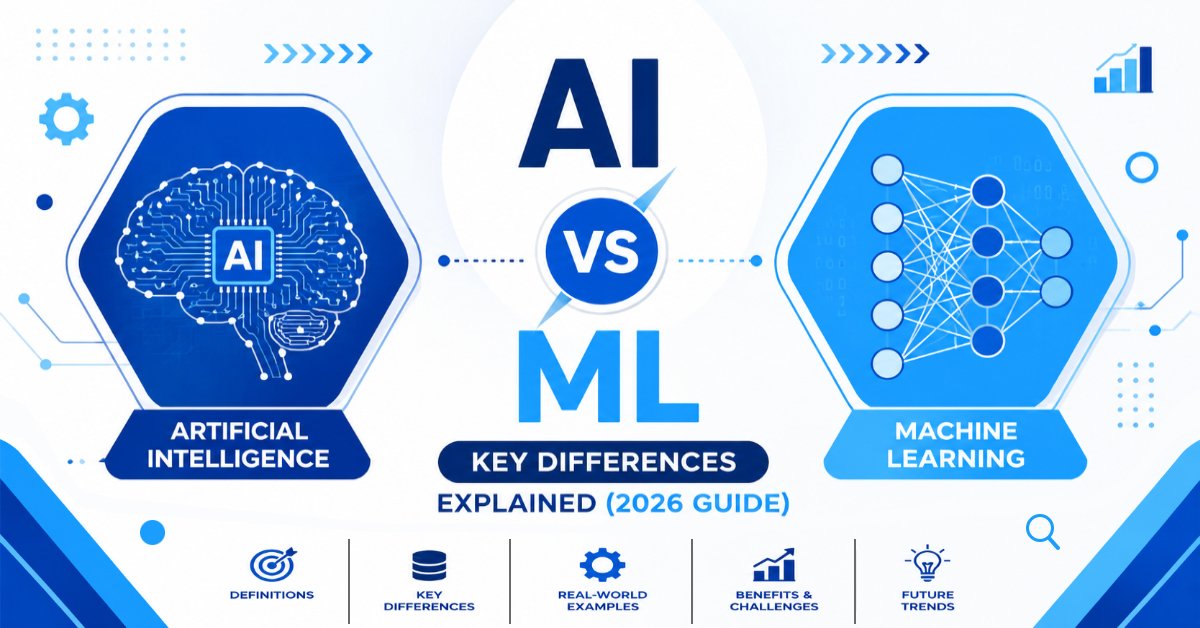
Before comparing Machine Learning and Deep Learning, it is important to understand how Machine Learning differs from the broader concept of Artificial Intelligence. You can explore this topic in our detailed guide on Machine Learning vs Artificial Intelligence.
Quick Answer
This technology is a branch of Artificial Intelligence that uses artificial neural networks with multiple layers to learn from large amounts of data. It enables computers to recognize patterns, understand information, make predictions, and perform complex tasks such as image recognition, natural language processing, and autonomous decision-making.
What Is Deep Learning?
Deep Learning Explained in Simple Words
This advanced method is a technology that allows computers to learn from examples instead of depending only on manually written instructions.
You can explore a detailed technical explanation of Deep Learning concepts through IBM’s educational resources.
Traditional software works by following predefined rules created by programmers.
For example:
A simple spam filter may use rules like:
- If an email contains certain words, mark it as spam.
- If a message comes from a suspicious sender, block it.
This technology works differently.
Instead of receiving thousands of fixed rules, a this technology system studies large amounts of data and learns patterns automatically.
Imagine teaching a computer to recognize a dog.
A traditional program may need instructions about:
- Shape
- Size
- Fur
- Ears
- Appearance
But a this advanced method can analyze millions of images and discover these patterns on its own.
After training, it can identify whether a new image contains a dog.
This ability to learn complex patterns is what makes AI models powerful.
Understanding AI, Machine Learning, and Deep Learning
Many people confuse Artificial Intelligence, Machine Learning, and Deep Learning.
Although they are closely related, each one represents a different concept and plays a unique role in the world of AI.
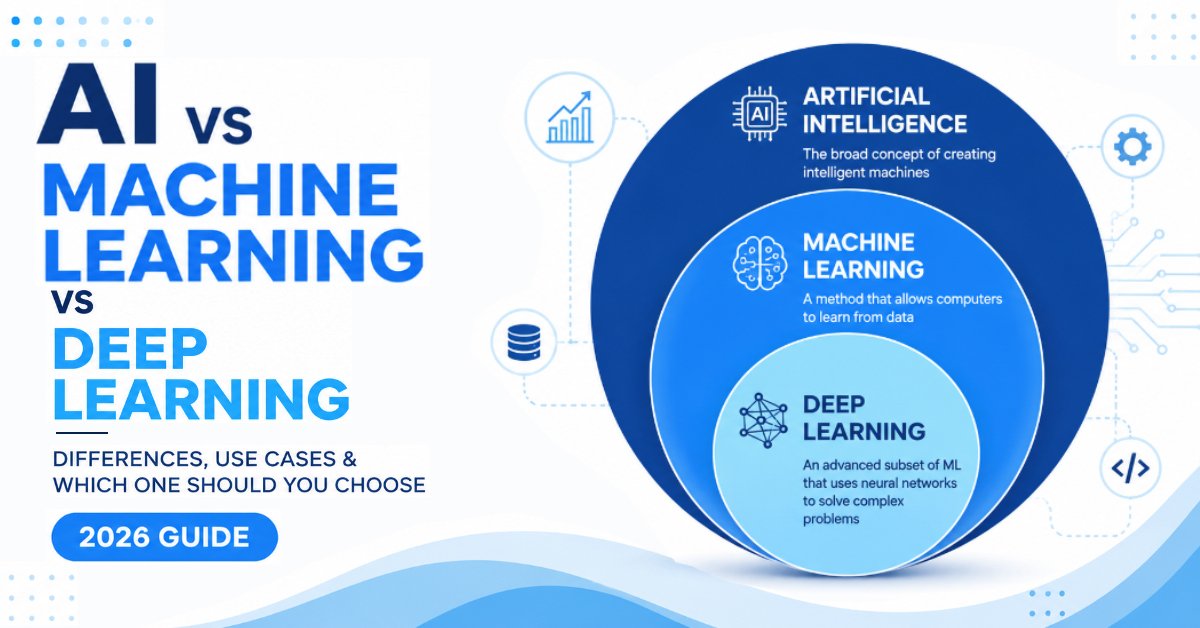
Think of them as a hierarchy:
The relationship between these technologies can be understood as a hierarchy: Artificial Intelligence is the broader field, Machine Learning is a method within AI, and this technology is an advanced approach within Machine Learning.
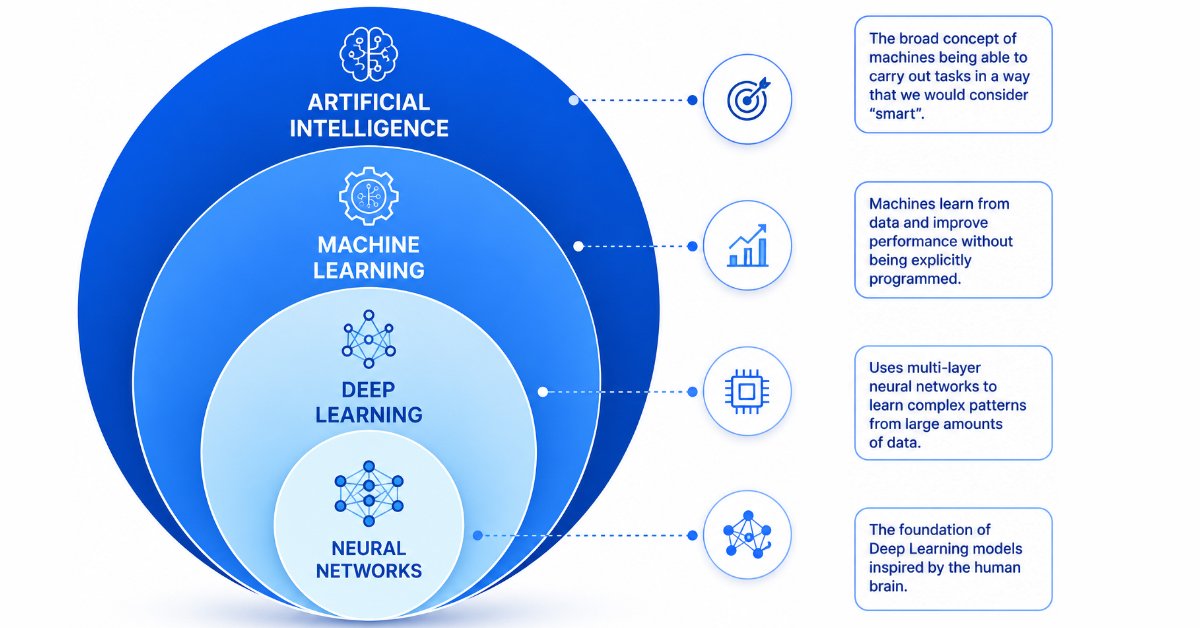
These technologies are connected but represent different levels of intelligence and learning approaches. For a complete breakdown of their relationship, read our guide on AI vs Machine Learning vs Deep Learning.
Artificial Intelligence (AI)
Artificial Intelligence is the broad concept of creating machines that can perform tasks requiring human-like intelligence.
Examples:
- Understanding language
- Solving problems
- Making decisions
- Recognizing objects
AI is the overall goal of creating intelligent machines.
Machine Learning (ML)
Machine Learning is a branch of AI that allows computers to learn from data and improve performance over time.
Google also explains Machine Learning fundamentals as a way for computers to learn patterns from data without being explicitly programmed.
Unlike traditional programming, where every action is explicitly defined, Machine Learning systems learn by analyzing examples and identifying patterns in data.
Examples:
- Email spam detection
- Product recommendations
- Fraud detection
Deep Learning
This technology is an advanced form of Machine Learning that uses artificial neural networks with multiple layers.
It is especially useful for handling complex information such as:
- Images
- Videos
- Speech
- Text
- Large datasets
In simple terms:
AI is the overall idea.
Machine Learning serves as one of the major approaches for creating intelligent systems that can learn, adapt, and make decisions.
These models represents a more advanced branch of Machine Learning, using neural networks to solve complex problems and extract meaningful insights from data.
Why Deep Learning Became So Important in 2026
These models has existed for decades, but recent technological progress has made it extremely powerful.
Three major factors contributed to its growth.
1. Massive Amounts of Data
Modern technology produces enormous amounts of information every day.
Examples include:
- Images
- Videos
- Text
- Customer behavior data
- Sensor information
This technology models become more effective when they have high-quality data to learn from.
2. Powerful Computing Hardware
Training advanced AI models requires significant computing power.
Modern processors and specialized AI hardware allow companies to build and train complex Deep Learning systems faster than before.
Companies such as NVIDIA AI provide specialized hardware platforms designed for AI and this advanced method workloads.
Without these improvements, technologies like modern Generative AI would not be possible.
3. Growth of Generative AI
Generative AI has brought Deep Learning into everyday conversations.
AI systems can now help create:
- Text
- Images
- Videos
- Software code
- Business content
This has made millions of people experience the practical power of AI models
How Does Deep Learning Work?
The foundation of this advanced method is a technology called Neural Networks.
Neural networks are computing systems inspired by the structure of biological neural networks.
However, they do not work exactly like the human brain.
They are mathematical models designed to process information and identify patterns.
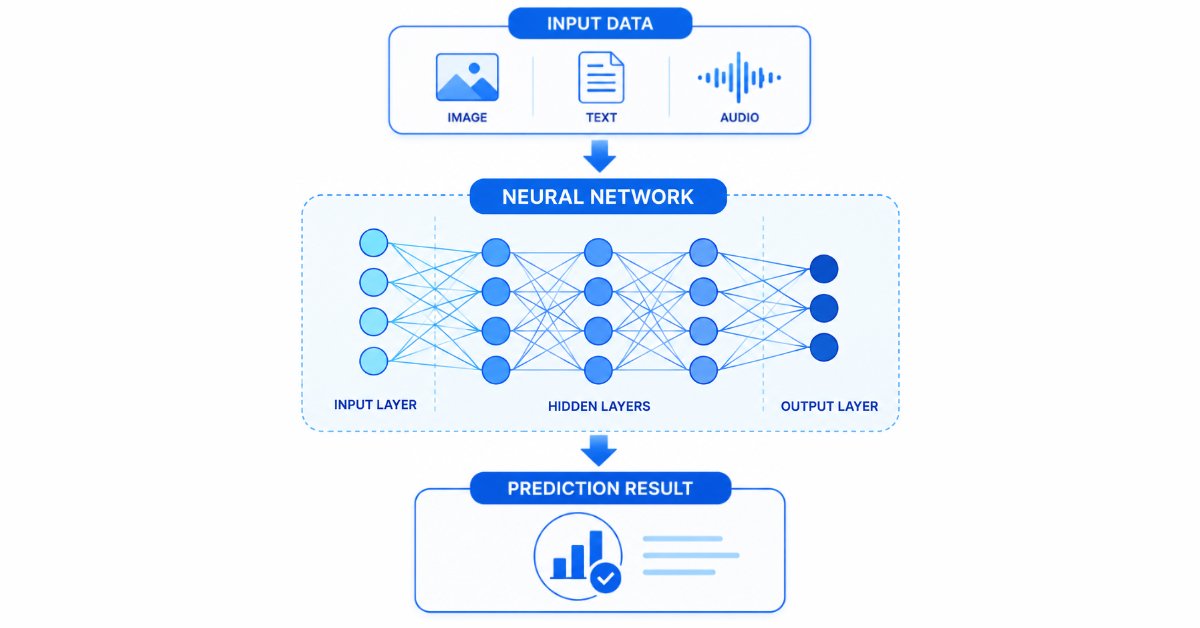
Understanding Neural Networks
A neural network receives information, processes it through different layers, and produces an output.
For example, consider a facial recognition system.
Input:
A photograph
The system analyzes:
- Shapes
- Edges
- Facial features
- Patterns
Output:
The system identifies the face.
Layers of a Deep Learning Model
The word “deep” refers to the multiple layers inside a neural network.
These layers allow computers to understand information step by step.
Input Layer
The input layer receives raw information.
Examples:
- Images
- Text
- Audio
- Numbers
For example, an image recognition system receives image pixels as input.
Hidden Layers
Hidden layers perform the main learning process.
Different layers identify different levels of information.
Example:
First layer:
Detects simple patterns like lines and edges.
Second layer:
Recognizes shapes.
Third layer:
Identifies complex features.
Final layers:
Understand the complete object or meaning.
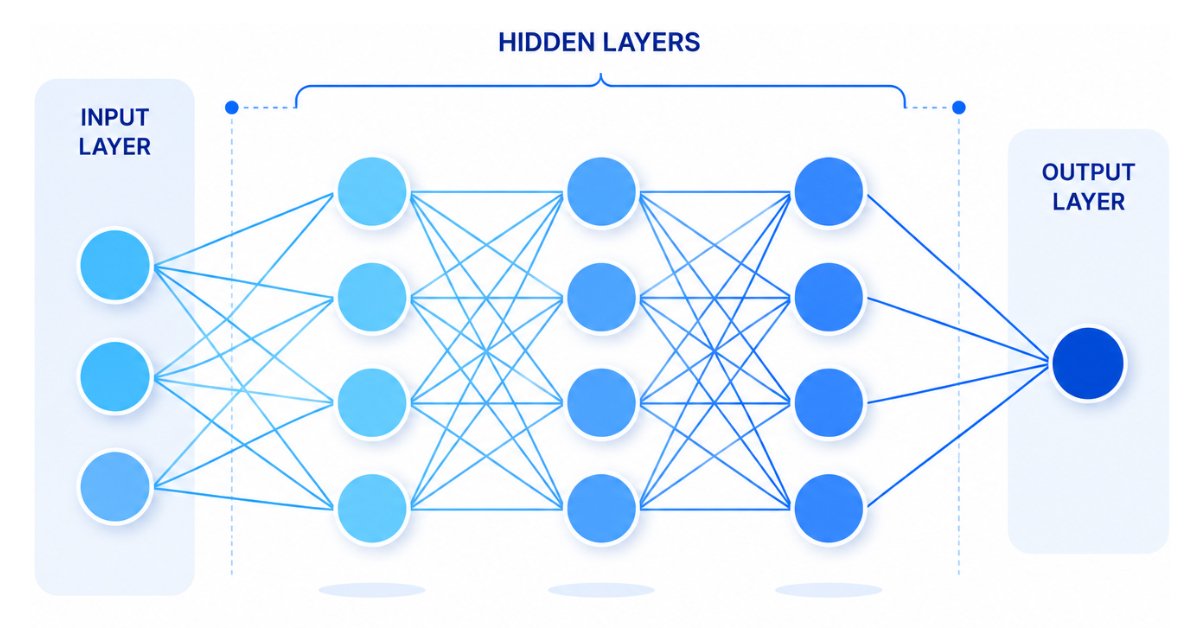
Output Layer
The output layer provides the final result.
Examples:
Image AI:
“This is a car.”
Language AI:
“This sentence means…”
Healthcare AI:
“Possible abnormality detected.”
How Deep Learning Learns
This technology models learn through a training process.
Step 1: Data Collection
The model receives large amounts of information.
Examples:
- Images
- Text documents
- Audio files
- Customer records
The quality of training data strongly affects the final result.
Step 2: Finding Patterns
The model analyzes information and discovers relationships.
For example, a shopping platform may analyze:
- What users search
- What products they purchase
- What similar customers prefer
By analyzing this information, the model identifies patterns and uses them to make informed predictions.
Step 3: Improving Accuracy
The model compares its results with expected answers.
When mistakes occur, it adjusts its internal parameters and improves over time.
This process may happen millions of times during training.
Deep Learning vs Machine Learning: Key Differences
| Feature | Machine Learning | Deep Learning |
| Definition | Systems learning from data using algorithms | Advanced ML using neural networks |
| Data Requirement | Works with smaller datasets | Usually requires large datasets |
| Feature Selection | Often requires human guidance | Learns features automatically |
| Complexity | Good for many traditional problems | Better for complex tasks |
| Computing Power | Lower requirements | Requires more powerful hardware |
| Examples | Spam detection, predictions | ChatGPT, image recognition, AI vision |
AI vs Machine Learning vs Deep Learning: Key Differences Explained
Understanding the difference between AI, Machine Learning, and Advanced AI techniques helps you see where each technology fits.
| Technology | Meaning | How It Works | Example |
| Artificial Intelligence | The field of creating machines that can simulate human intelligence and complete complex tasks. | Creates systems that can solve problems and make decisions | AI assistants |
| Machine Learning | A method where computers learn from data | Uses algorithms to identify patterns and improve | Recommendation systems |
| Advanced AI techniques | An advanced form of Machine Learning | Uses multi-layer neural networks to process complex information | ChatGPT, image recognition |
In simple terms:
AI is the goal. Machine Learning is a method. AI models is a more advanced approach inside Machine Learning.
Types of Deep Learning Models
This technology includes different types of neural network models. Each model is designed for specific tasks.
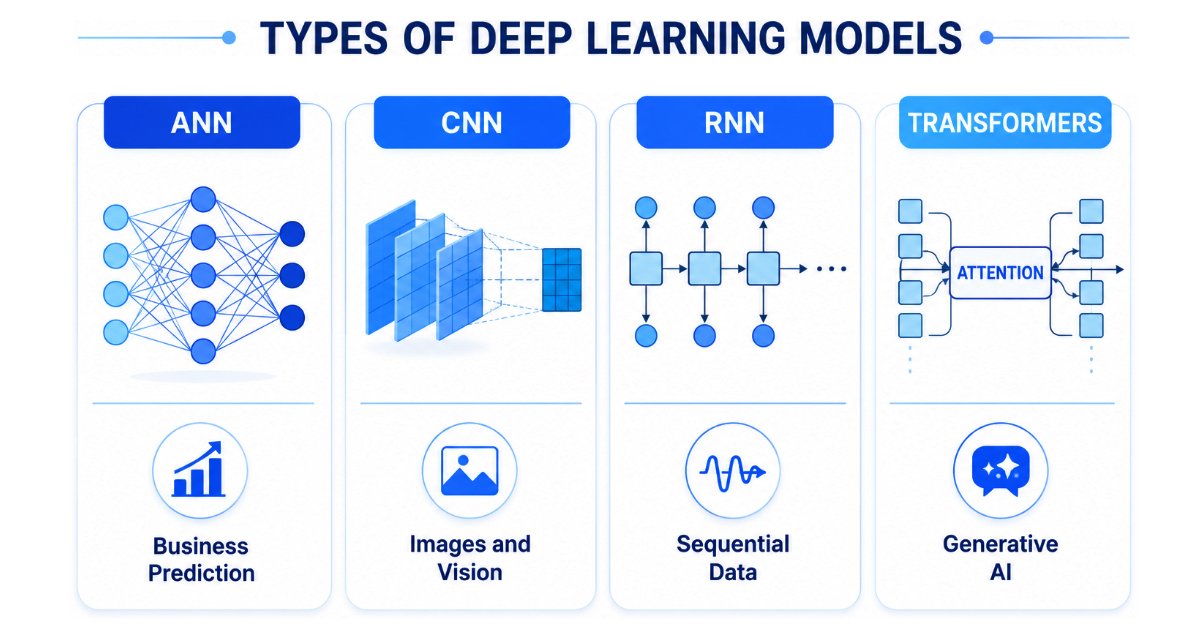
1. Artificial Neural Networks (ANN)
Artificial Neural Networks are the basic foundation of AI models.
They are made of connected artificial neurons that process information and identify patterns.
ANNs are commonly used for:
- Predictions
- Classification
- Data analysis
- Business forecasting
Example:
A company can use an ANN model to predict future sales based on previous customer behavior.
2. Convolutional Neural Networks (CNN)
Convolutional Neural Networks are mainly designed for visual data.
They are highly effective for:
- Image recognition
- Object detection
- Video analysis
- Medical image processing
Example:
When your smartphone recognizes your face, CNN-based systems help analyze facial patterns.
In healthcare, CNN models can assist doctors by analyzing medical images such as X-rays and scans.
3. Recurrent Neural Networks (RNN)
Recurrent Neural Networks are designed for sequential information where previous data affects future results.
They have been used for:
- Speech recognition
- Language processing
- Time-series prediction
However, many modern AI language systems now use Transformer-based models because they handle large-scale language tasks more effectively.
4. Transformers
Transformers are one of the biggest breakthroughs in modern this AI approach.
Popular AI frameworks like PyTorch are widely used for developing and experimenting with Deep Learning models.
They are the foundation behind many Generative AI systems.
Transformers help AI models understand relationships between different parts of information.
They are used in:
- ChatGPT-style systems
- AI writing tools
- Translation systems
- AI assistants
This technology is a major reason modern AI can generate human-like responses.
Real-World Examples of Deep Learning
This technology is already powering many technologies people use every day.
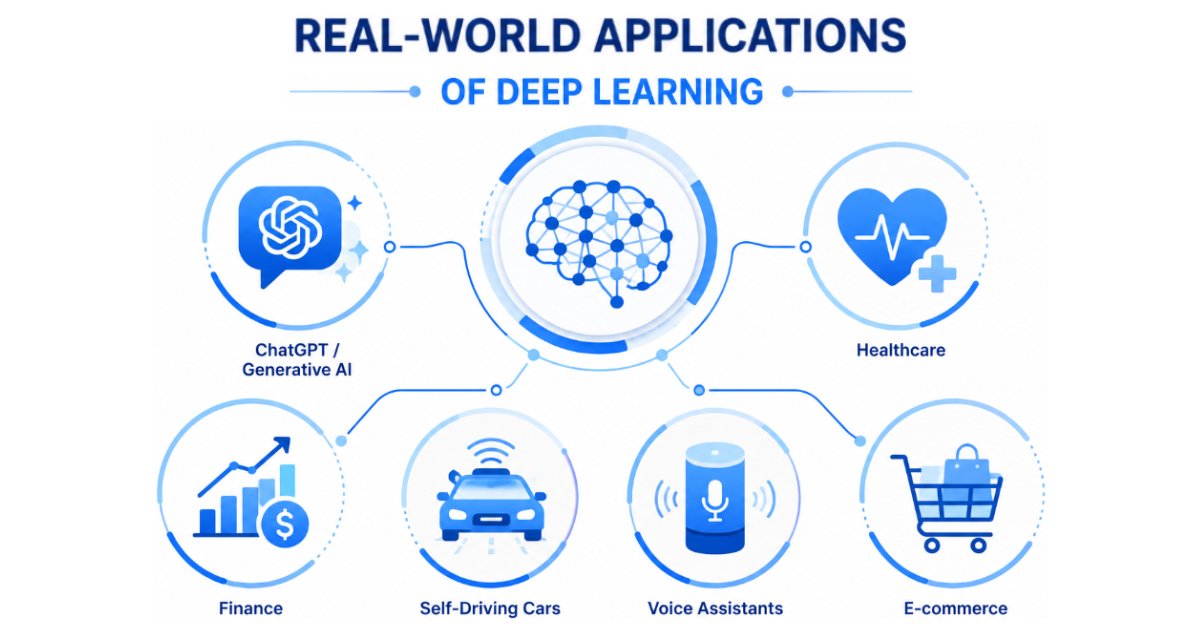
1. ChatGPT and Generative AI
Generative AI is one of the most popular examples of AI models.
Modern AI systems use large neural networks trained on huge amounts of data.
They can:
- Answer questions
- Generate content
- Summarize information
- Help with coding
- Create ideas
Businesses use these systems to improve productivity.
Examples:
A marketing team can generate content ideas.
Customer service teams can use AI-powered systems to handle frequently asked questions and routine customer interactions automatically.
Developers can use AI assistants to speed up coding tasks.
2. Google Search and AI Understanding
Search engines use Machine intelligence to better understand what users are searching for.
Modern search systems analyze:
- Search intent
- Language meaning
- User behavior
- Content relationships
This helps search engines provide more relevant answers.
For example, AI can understand that:
“best AI software for business”
and
“top artificial intelligence tools for companies”
may represent a similar search intent.
3. Netflix Recommendations
Recommendation systems are another common example of Machine intelligence
Platforms analyze:
- Viewing history
- Search behavior
- Watch duration
- User preferences
These insights help recommendation systems identify user preferences and deliver personalized content suggestions.
This creates a more personalized experience.
4. Self-Driving Vehicles
Autonomous vehicles rely heavily on this advanced method.
A self-driving car needs to understand its environment continuously.
AI systems analyze:
- Roads
- Traffic signs
- Pedestrians
- Other vehicles
- Obstacles
This technology helps vehicles make decisions based on real-time information.
5. Healthcare Diagnosis
Healthcare is one of the most promising areas for Intelligent systems.
AI systems can assist professionals by analyzing medical information.
Applications include:
- Medical image analysis
- Disease detection
- Drug discovery
- Patient monitoring
For example, Deep Learning can identify patterns in medical images that may help doctors detect problems earlier.
AI supports healthcare professionals, but human expertise remains essential.
6. Fraud Detection in Finance
Banks and financial organizations use Deep Learning to identify suspicious activities.
AI systems analyze:
- Transaction patterns
- Customer behavior
- Location information
- Historical data
This helps organizations detect potential fraud faster.
7. Voice Assistants
Voice assistants use Deep Learning to understand human speech.
They can:
- Convert speech into text
- Understand commands
- Provide responses
Applications include:
- Voice search
- Smart devices
- Customer service systems
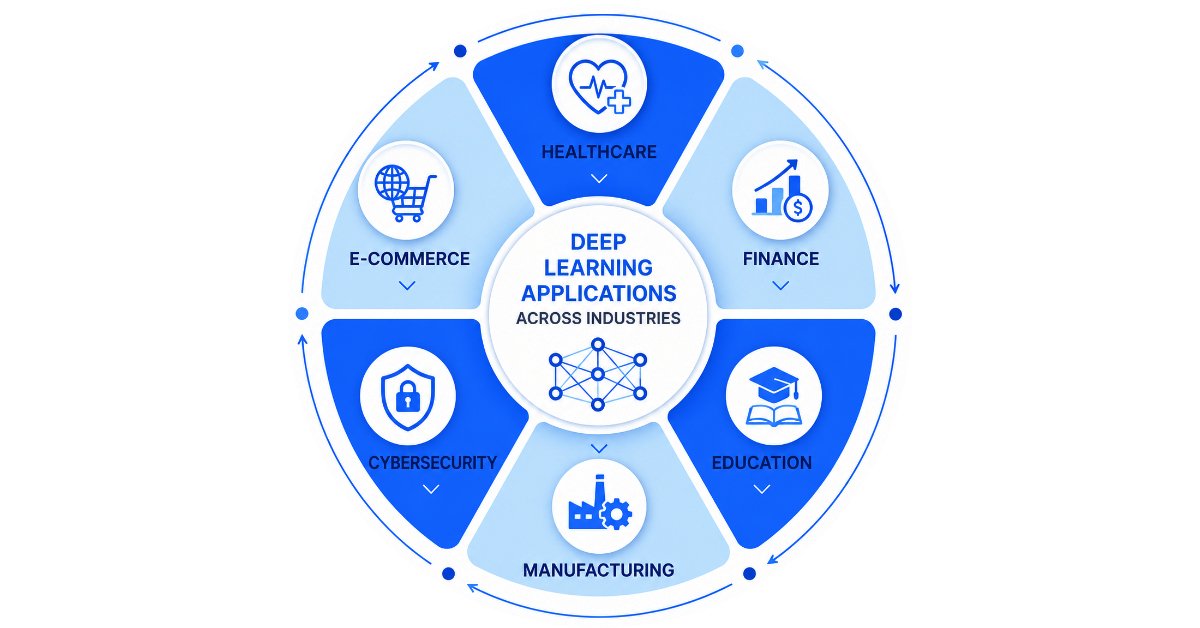
Deep Learning Applications Across Industries
Deep Learning is transforming multiple industries.
Healthcare
Applications:
- Disease detection
- Medical imaging
- Personalized treatment
- Research assistance
Benefits:
- Faster analysis
- Improved decision support
- Better patient care
Finance
Applications:
- Fraud detection
- Risk analysis
- Automated customer support
- Financial predictions
Benefits:
- Better security
- Faster decisions
E-commerce
Online businesses use Deep Learning for:
- Product recommendations
- Customer personalization
- Marketing optimization
- Chatbots
Example:
An online store can suggest products based on previous customer interests.
Similar AI adoption is happening in other industries, including real estate, where professionals use AI tools for customer management, property analysis, and workflow automation. Learn more about these solutions in our guide on AI tools for real estate agents.
Education
Deep Learning is helping create:
- AI tutors
- Personalized learning platforms
- Automated evaluation systems
Students are also using AI-powered writing and learning assistants to improve research, productivity, and content creation. Explore more examples in our guide on AI writing tools for students.
Students can receive learning experiences based on their needs.
Cybersecurity
Security companies use Deep Learning to identify:
- Suspicious behavior
- Malware patterns
- Network threats
AI can analyze huge amounts of security data quickly.
Manufacturing
Manufacturing companies use Deep Learning for:
- Quality inspection
- Predictive maintenance
- Automation
By monitoring patterns and performance data, AI can predict maintenance needs and help prevent costly equipment failures.
Benefits of Deep Learning
Deep Learning offers several advantages for businesses and individuals.
1. Automation
By learning from large amounts of data, Deep Learning systems can perform complex operations and reduce the need for repetitive human effort.
Examples:
- Data analysis
- Customer support
- Image inspection
By reducing repetitive efforts, organizations can help employees concentrate on more meaningful and impactful activities.
2. Better Accuracy
When trained properly with quality data, Deep Learning models can achieve impressive accuracy.
Examples:
- Image recognition
- Speech processing
- Pattern detection
3. Advanced Data Analysis
Businesses collect huge amounts of information.
Deep Learning helps convert this data into useful insights.
Companies can better understand:
- Customer behavior
- Market trends
- Business opportunities
4. Improved Predictions
Deep Learning helps organizations predict future outcomes.
Examples:
- Sales forecasting
- Fraud detection
- Customer preferences
Better predictions lead to smarter decisions.
5. Increased Business Efficiency
By reducing repetitive work, Deep Learning helps companies save time and resources.
By improving processes and analyzing data effectively, it empowers businesses to increase productivity and make strategic decisions with greater confidence.
Challenges and Limitations of Deep Learning
Despite its advanced capabilities and impressive results, Deep Learning also comes with certain challenges and limitations.
1. Requires Large Amounts of Data
Deep Learning systems typically require large amounts of high-quality data to learn patterns effectively and deliver accurate results.
If the data is incomplete or inaccurate, the results may also be unreliable.
2. High Computing Requirements
Advanced Deep Learning models require:
- Powerful hardware
- Large storage
- Significant computing resources
This makes development expensive.
3. Cost
Building Deep Learning solutions may require investment in:
- Data preparation
- AI infrastructure
- Skilled professionals
4. Lack of Explainability
Many Deep Learning models are difficult to interpret.
They can produce accurate results, but understanding exactly how they reached a conclusion can be challenging.
This is especially important in areas like healthcare and finance.
5. Bias Problems
AI systems learn from training data.
If the data contains bias, the model may produce biased results.
Responsible AI development requires careful testing.
Organizations are increasingly using AI governance frameworks to improve transparency, safety, and responsible AI practices.
6. Security and Privacy Concerns
Deep Learning systems may face risks related to:
- Data privacy
- Model attacks
- Security vulnerabilities
Companies must develop AI responsibly.
Deep Learning vs Machine Learning: Which One Should You Learn First?
A common question among beginners is:
Is it better to begin with Machine Learning fundamentals before moving into Deep Learning, or can beginners start with Deep Learning right away?
The right choice depends on what you want to achieve, your current knowledge level, and your learning objectives.
Deep Learning is a powerful technology, but understanding Machine Learning fundamentals will make learning Deep Learning much easier.
For Beginners
If you are new to AI, start with the basics:
- Programming fundamentals
- Data concepts
- Machine Learning basics
- Statistics
- Then move toward Deep Learning
Understanding how machines learn from data will help you understand neural networks better.
For Students
Students who want to build a career in Artificial Intelligence should develop strong skills in the following key areas:
- Python programming
- Mathematics basics
- Data analysis
- Machine Learning concepts
- Neural networks
Deep Learning skills can create opportunities in fields such as:
- AI development
- Data science
- Computer vision
- Natural language processing
For Developers
Developers can use Deep Learning knowledge to build:
- AI-powered applications
- Intelligent software
- Automation systems
- AI assistants
However, developers do not always need to train large AI models from scratch.
Many companies use existing AI platforms and APIs to add intelligent features to their applications.
For Business Owners
Business leaders are not required to build AI systems themselves; their focus should be on identifying opportunities where AI can improve efficiency and decision-making.
Instead, they should understand:
- Where AI can improve operations
- Which tasks can be automated
- How AI can create business value
Examples:
Small businesses can use AI for:
- Customer support
- Marketing assistance
- Data analysis
- Workflow automation
Understanding AI opportunities can help businesses make smarter technology decisions.
Deep Learning Trends and Future Developments Shaping AI in 2026 and Beyond
Deep Learning will continue playing a major role in the future of technology.
The next phase of AI will focus not only on smarter models but also on practical applications that improve human productivity.
1. Growth of AI Agents
One of the biggest trends in AI is the rise of AI agents.
Unlike traditional AI tools that simply answer questions, AI agents can perform multi-step tasks.
They can:
- Understand goals
- Plan actions
- Use tools
- Complete workflows
Businesses may use AI agents for:
- Customer management
- Research
- Data analysis
- Business operations
2. Expansion of Generative AI
Generative AI will continue improving through advanced Deep Learning models.
Future systems will become better at creating:
- Text
- Images
- Videos
- Software code
- Business documents
AI will increasingly become a productivity partner for individuals and companies.
3. Multimodal AI
Future AI systems will understand multiple forms of information together.
This includes:
- Text
- Images
- Audio
- Video
For example, an AI assistant may analyze a document, understand a video, listen to a voice command, and provide a complete response.
4. More Business Automation
Deep Learning will help automate more business processes.
Areas likely to see growth:
- Customer service
- Marketing
- Sales analysis
- Operations
- Reporting
The goal is not simply replacing people, but helping teams work faster and smarter.
5. Human and AI Collaboration
The future of Deep Learning will likely focus on collaboration.
AI is excellent at:
- Processing large amounts of information
- Finding patterns
- Automating repetitive tasks
Humans remain essential for:
- Creativity
- Strategy
- Emotional understanding
- Decision-making
The best outcomes will be achieved when human creativity, experience, and judgment are combined with the advanced capabilities of AI.
Expert Insights: Why Companies Are Investing in Deep Learning
From a business perspective, Deep Learning solves one major modern challenge:
Companies have more data than humans can analyze manually.
Every organization generates valuable information:
- Customer interactions
- Sales records
- Market trends
- User behavior
Deep Learning helps businesses find patterns and turn data into useful decisions.
Companies are investing in Deep Learning because it can improve:
- Efficiency
- Customer experience
- Automation
- Decision-making
How Small Businesses Can Benefit From Deep Learning
Many people believe AI is only useful for large technology companies.
That is no longer true.
Small businesses can use Deep Learning-powered tools without building their own AI models.
Many AI-powered solutions are now helping small businesses automate daily operations, improve productivity, and make smarter decisions. You can explore practical examples in our guide on best AI tools for small businesses in India.
Examples:
Marketing
AI can help with:
- Content ideas
- Customer analysis
- Campaign improvement
Customer Support
AI assistants can handle common questions and provide faster responses.
Business Analytics
AI can analyze:
- Sales performance
- Customer behavior
- Market patterns
Productivity
AI tools can reduce repetitive tasks and help small teams save time.
Frequently Asked Questions About Deep Learning
1. What is Deep Learning in simple words?
Deep Learning is a technology that allows computers to learn from large amounts of data and identify patterns using artificial neural networks.
2. Is Deep Learning a part of AI?
Yes. Deep Learning is a subset of Machine Learning, and Machine Learning is a part of Artificial Intelligence.
3. What is the difference between Deep Learning and Machine Learning?
Machine Learning uses algorithms to learn from data.
Deep Learning uses multi-layer neural networks and is especially effective for complex tasks involving images, language, and large datasets.
4. Is Deep Learning difficult to learn?
Deep Learning can be challenging because it involves programming, mathematics, and data concepts.
However, beginners can learn it step by step.
5. What are real-world examples of Deep Learning?
Examples include:
● ChatGPT
● Image recognition systems
● Voice assistants
● Recommendation engines
● Self-driving technology
● Medical AI systems
6. Why is Deep Learning important?
Deep Learning helps computers understand complex information and automate tasks that require advanced analysis.
7. Can small businesses use Deep Learning?
Yes. Small businesses can use AI-powered tools for automation, marketing, customer service, and data analysis.
8. Which industries use Deep Learning?
Major industries using Deep Learning include:
● Healthcare
● Finance
● E-commerce
● Education
● Manufacturing
● Cybersecurity
Key Takeaways: Deep Learning Explained
- Deep Learning is an advanced branch of Artificial Intelligence.
- It uses neural networks to learn from large amounts of data.
- Deep Learning powers technologies like AI assistants, image recognition, and Generative AI.
- It differs from traditional Machine Learning because it can automatically learn complex features.
- Businesses use Deep Learning for automation, predictions, and better decisions.
- The future of Deep Learning will include AI agents, multimodal systems, and stronger human-AI collaboration.
Final Verdict: Why Deep Learning Matters
Deep Learning has become one of the most important technologies shaping modern Artificial Intelligence.
It allows computers to process complex information, recognize patterns, and perform tasks that were previously difficult for machines.
From AI assistants and recommendation systems to healthcare solutions and business automation, Deep Learning is already changing how people and organizations work.
However, Deep Learning is not a magical solution. It requires quality data, computing power, responsible development, and human oversight.
The future is not simply about machines replacing humans.
The real opportunity is collaboration — where humans use AI to improve creativity, productivity, and decision-making.
For individuals, understanding Deep Learning can open new career opportunities.
For businesses, understanding its possibilities can create a competitive advantage.
As AI continues evolving in 2026 and beyond, Deep Learning will remain one of the key technologies driving innovation.