Quick Answer
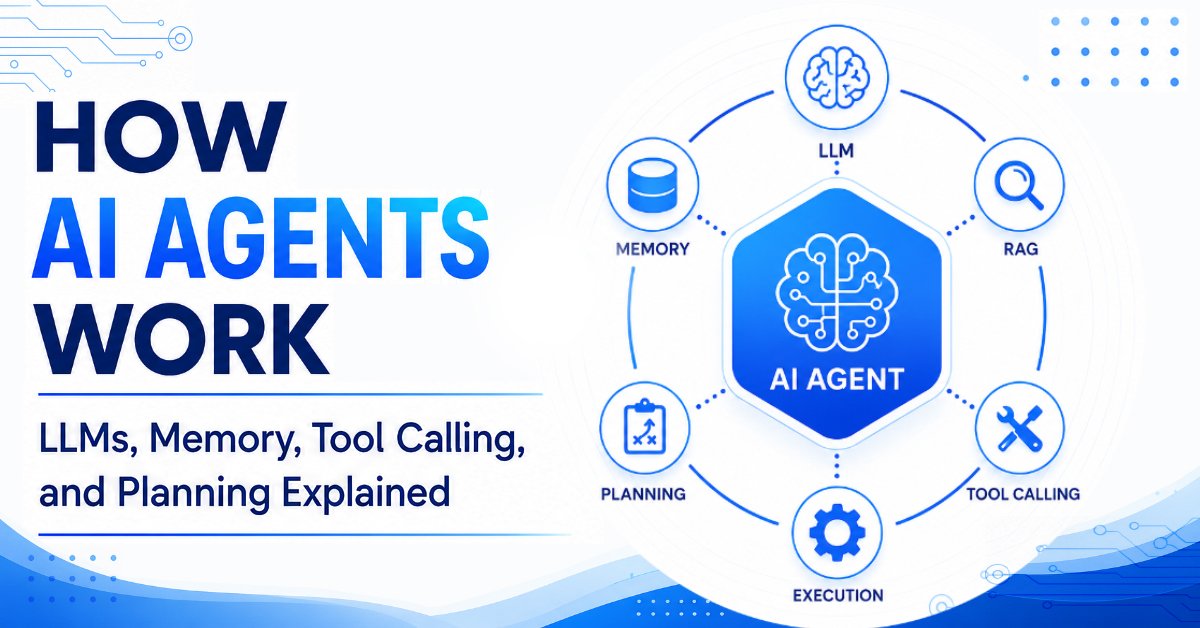
How AI Agents Work: AI agents combine several technologies into a single intelligent system. A Large Language Model (LLM) acts as the reasoning engine, memory systems store context, retrieval systems provide access to external knowledge, planning modules break goals into smaller tasks, and tool-calling capabilities allow the agent to interact with software and services.
AI agents work by combining several technologies into a single intelligent system. A Large Language Model (LLM) acts as the reasoning engine, memory systems store context, retrieval systems provide access to external knowledge, planning modules break goals into smaller tasks, and tool-calling capabilities allow the agent to interact with software and services. Together, these components enable AI agents to complete complex tasks rather than simply generate text responses.
Why Trust This Guide
AI agents have quickly become one of the most discussed topics in artificial intelligence. Unfortunately, many explanations either oversimplify the technology or focus heavily on marketing buzzwords.
This guide takes a different approach.
Rather than discussing AI agents at a surface level, we focus on the actual architecture behind modern agentic systems. The concepts explained here are based on techniques used throughout today’s AI ecosystem, including reasoning models, memory architectures, Retrieval-Augmented Generation (RAG), planning systems, and tool integrations.
The goal is simple: help you understand what happens inside an AI agent from the moment a task is received until a result is delivered.
Introduction
How AI agents work is one of the most important questions in artificial intelligence today. AI is moving beyond chatbots and evolving into systems that can reason, plan, remember information, and perform tasks autonomously.
For years, most people interacted with artificial intelligence through systems that answered questions, generated content, or responded to prompts. While impressive, these tools generally remained reactive. They waited for instructions and produced outputs.
Modern AI agents represent a significant shift.
Instead of simply responding, they can pursue goals.
Imagine asking an AI system:
“Research our competitors, summarize their strengths and weaknesses, and create a presentation for tomorrow’s meeting.”
A traditional chatbot might provide advice on how to perform those tasks.
An AI agent attempts to perform the workflow itself.
To do this successfully, the agent must understand the request, gather information, remember context, create a plan, use external tools, evaluate progress, and generate results.
This combination of reasoning and action is what makes AI agents fundamentally different from conventional conversational systems.
Understanding these internal mechanisms is essential because they are becoming the foundation of next-generation software platforms, enterprise automation systems, and intelligent digital assistants.
How AI Agents Work in 6 Simple Steps
Before diving into the technical details, it helps to understand the overall process.
Most modern AI agents operate through a workflow similar to this:
Step 1: Receive a Goal
The process begins with a user request.
For example:
“Create a report about the top AI startups in healthcare.”
The agent’s objective is now clearly defined.
Step 2: Understand the Request
The AI analyzes the goal and identifies what information is needed.
It determines:
- What the user wants
- What data must be collected
- What actions may be required
- What output format is expected
Step 3: Gather Information
The agent retrieves relevant information from memory systems, databases, documents, APIs, or external knowledge sources.
Step 4: Create a Plan
Complex goals are divided into smaller tasks.
Instead of solving one large problem, the agent creates a sequence of manageable steps.
Step 5: Execute Actions
The agent uses available tools to complete the required work.
This may include:
- Searching the web
- Accessing databases
- Updating software systems
- Analyzing documents
- Creating reports
Step 6: Deliver Results
After completing the workflow, the agent generates the final output and presents it to the user.
Although this process appears simple, each stage involves sophisticated technologies working together behind the scenes.
To fully understand how AI agents work, it helps to examine the core technologies that power modern agent architectures.
The Core Components of an AI Agent
Most modern AI agents are built from six major components.
If you’re new to agentic systems, it may also help to understand the different categories of AI agents before exploring their internal architecture. Our guide on Types of AI Agents explains how various agent designs are used across real-world applications.
1. Large Language Model (LLM)
The reasoning engine that interprets instructions and makes decisions.
2. Memory System
Stores context, preferences, and historical information.
3. Retrieval Layer (RAG)
Provides access to information beyond the model’s built-in knowledge.
4. Planning Module
Breaks complex goals into manageable tasks.
5. Tool Calling Layer
Allows interaction with external applications and services.
6. Execution Framework
Carries out actions and manages workflow completion.
You can think of these components as a team.
The LLM acts as the brain.
Memory provides context.
Retrieval acts as a researcher.
Planning functions like a project manager.
Tools serve as the hands.
Execution ensures the work gets completed.
What Happens Inside an AI Agent After You Click Send?
A simple way to understand how AI agents operate is to trace a single request as it moves through the system.
Suppose a user says:
“Schedule a meeting with Sarah next week.”
The process may look simple from the outside, but internally the agent performs several operations.
Internal Workflow
User Request
↓
Understand intent
↓
Identify Sarah
↓
Retrieve relevant information
↓
Check calendar availability
↓
Generate meeting options
↓
Create calendar event
↓
Send confirmation
↓
Complete task
The user sees only the final result.
Behind the scenes, however, multiple AI systems cooperate to make that result possible.
A major part of understanding how AI agents work involves learning how large language models handle reasoning and decision-making.
How LLMs Function as the Reasoning Engine
Many advanced AI agents use a Large Language Model (LLM) as the core system responsible for reasoning and decision-making.
The LLM serves as the system’s reasoning engine.
Its primary responsibilities include:
- Understanding instructions
- Interpreting intent
- Evaluating context
- Making decisions
- Coordinating actions
Without an LLM, the other components would lack the reasoning ability needed to make informed decisions.
Why LLMs Matter
Consider this prompt:
Organize a three-day business visit to London while keeping the total cost below $2,000.
The LLM must immediately reason about:
- Travel logistics
- Budget constraints
- Accommodation options
- Transportation needs
- Scheduling considerations
The model is not merely generating words.
It is evaluating objectives, identifying requirements, and determining possible actions.
This ability to reason through problems is one of the key innovations behind modern AI agents.
LLMs Are Not the Entire Agent
A common misconception is that AI agents are simply large language models.
They are not.
The LLM is only one component.
Without memory, retrieval systems, planning frameworks, and tools, an LLM remains limited to generating responses based on the information available within its context window.
The surrounding architecture is what transforms a language model into an intelligent agent.
Another essential aspect of how AI agents work is their ability to store and retrieve information through memory systems.
How AI Agent Memory Works
Imagine meeting someone who forgets every conversation immediately after it ends.
Every interaction would feel like starting from zero.
The same problem exists for AI systems.
Without memory, agents cannot maintain continuity across tasks.
Memory allows AI agents to preserve information and use it later when needed.
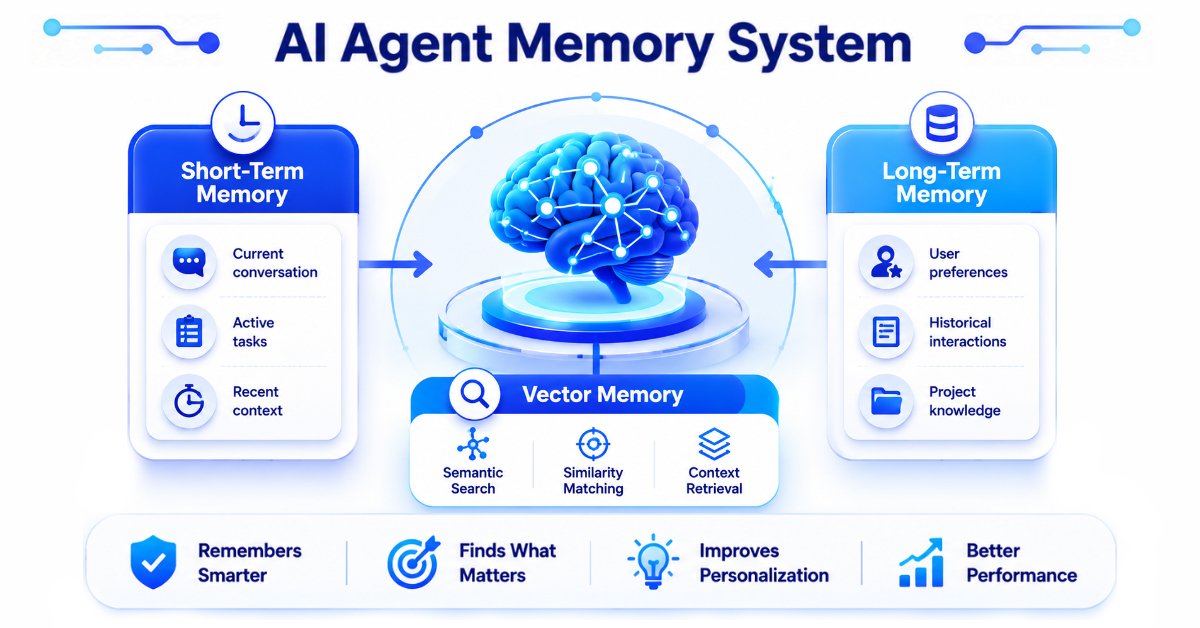
Short-Term Memory
Short-term memory stores information relevant to the current task.
Examples include:
- Current conversation history
- Active objectives
- Recent tool outputs
- Temporary workflow context
This memory helps the agent remain consistent throughout a session.
Long-Term Memory
Long-term memory stores information that remains useful over time.
Examples include:
- User preferences
- Historical interactions
- Business rules
- Project knowledge
A travel assistant might remember:
- Preferred airlines
- Seat preferences
- Hotel budget
- Frequent destinations
This creates more personalized experiences.
Vector Memory
Modern AI agents often use vector databases for memory storage.
Vector databases help AI systems retrieve information based on semantic similarity rather than exact keyword matching.
Instead of storing information based solely on keywords, vector memory stores information based on meaning.
This allows the system to retrieve relevant information even when users phrase requests differently.
For example:
“Affordable hotels in London”
and
“Budget-friendly places to stay in London”
have different wording but nearly identical meaning.
Vector memory helps the agent recognize this relationship.
When exploring how AI agents work, it is also important to understand how they access information beyond their training data.
How Retrieval-Augmented Generation (RAG) Works
Large Language Models have limitations.
Their training data eventually becomes outdated.
They also cannot automatically access new information after training.
Retrieval-Augmented Generation (RAG) helps solve this problem.
AWS provides a useful technical explanation of how Retrieval-Augmented Generation (RAG) combines retrieval systems with language models to improve accuracy and reduce hallucinations.
RAG allows AI agents to retrieve external information before generating a response.
Instead of relying solely on stored knowledge, the agent can consult additional sources.
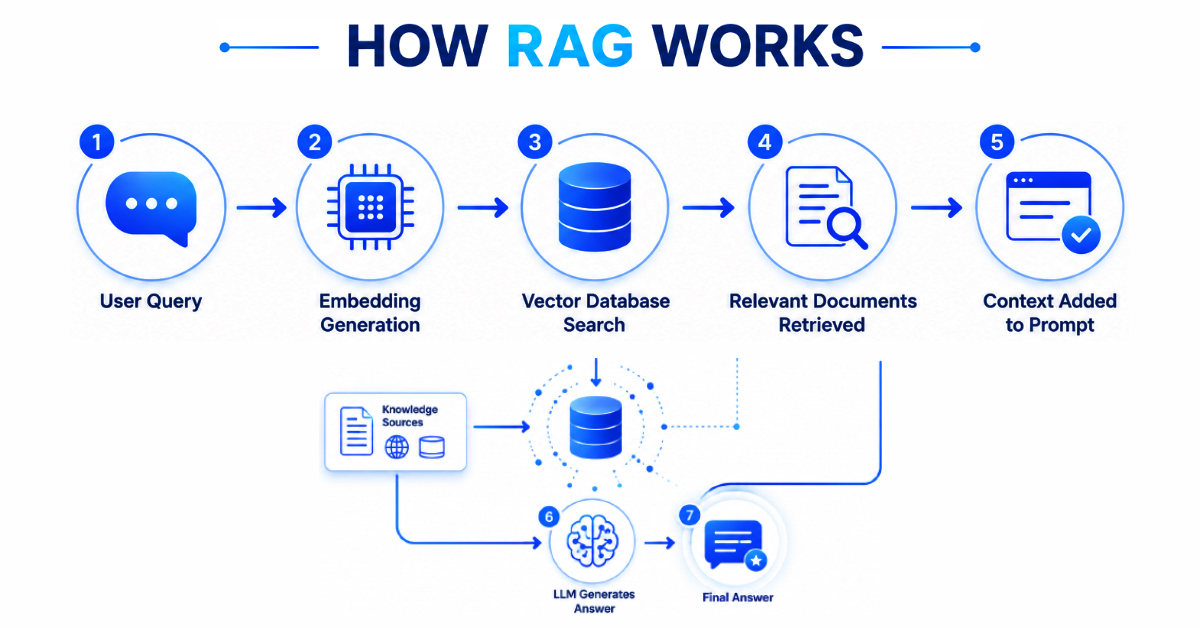
The RAG Process
- User submits a request.
- The request is converted into embeddings.
- A vector database searches for relevant information.
- Matching content is retrieved.
- Retrieved information is provided to the LLM.
- The LLM generates a response using that information.
Example
Suppose a company executive asks:
“What were our best-selling products last quarter?”
An LLM on its own does not have access to an organization’s latest business data or performance metrics.
Using RAG, the agent retrieves recent sales data and incorporates it into the response.
This dramatically improves accuracy.
Why RAG Matters
Without RAG:
- Knowledge becomes outdated
- Hallucination risk increases
- Responses may be incomplete
With RAG:
- Information stays current
- Responses become more accurate
- Enterprise knowledge becomes accessible
This is one reason RAG has become a foundational component of modern AI agent architectures.
Memory vs RAG: Why AI Agents Need Both
Memory and RAG are often confused because both involve retrieving information.
However, they serve different purposes.
Memory Answers:
“What information has the agent previously learned about this user or context?”
Examples:
- User preferences
- Previous conversations
- Historical interactions
RAG Answers:
“What information should I retrieve right now?”
Examples:
- Company documents
- Databases
- Knowledge bases
- Current business records
Think of it this way:
Memory helps the agent remember.
RAG helps the agent research.
The most capable AI agents use both.
For example, if you ask:
“Create a quarterly sales report in the same format I used last time.”
The agent may:
- Use memory to recall your preferred reporting style.
- Use RAG to retrieve the latest sales data.
Together, these systems enable both personalization and accuracy.
How Tool Calling Works in AI Agents
One of the biggest differences between an AI agent and a traditional chatbot is the ability to use tools.
A chatbot can explain how to perform a task.
An AI agent can often perform the task itself.
This capability is known as tool calling.
Tool calling allows an AI agent to interact with external software, APIs, databases, applications, and digital services.
Modern AI platforms More and more support tool-calling mechanisms that enable language models to interact with external systems and perform actions programmatically.
Common tools include:
- Web search engines
- Calendars
- Email platforms
- CRM systems
- Databases
- Payment systems
- Project management software
- Document repositories
Legal professionals are also adopting AI-powered systems that combine information retrieval, document analysis, and workflow automation capabilities.
A Simple Example
Imagine a user says:
Arrange a meeting with the marketing department for next Tuesday.
The agent may:
- Access the company calendar.
- Check participant availability.
- Identify open time slots.
- Create a calendar event.
- Send invitations.
- Confirm completion.
Without tool calling, the AI could only explain the scheduling process.
With tool calling, it can actually perform the workflow.
Why Tool Calling Matters
Large Language Models are excellent at reasoning and language generation.
However, they cannot directly interact with external systems on their own.
Tool calling enables AI agents to move beyond generating responses and perform actions within real-world systems.
This is one of the key technologies driving the rise of agentic AI.
Planning is one of the most important mechanisms behind how AI agents work in complex environments.
How Planning and Task Decomposition Work
Many user requests are too complex to solve in a single step.
For example:
“Research our competitors and prepare a strategic analysis report.”
This task requires multiple actions.
The agent must:
- Identify competitors
- Gather information
- Analyze strengths and weaknesses
- Organize findings
- Create a report
Attempting to solve everything at once often leads to poor results.
Instead, modern AI agents use planning systems.
What Is Task Decomposition?
Task decomposition is the process of breaking a large objective into smaller, manageable tasks.
For example:
Goal:
Create a strategic competitor report.
Subtasks:
- Identify competitors.
- Collect company information.
- Analyze products and services.
- Compare market positioning.
- Generate recommendations.
- Build final report.
Each task becomes easier to complete.
The results are then combined into a final outcome.
Why Planning Improves Performance
Planning helps AI agents:
- Handle complex objectives
- Reduce reasoning errors
- Improve task organization
- Manage long workflows
- Adapt when new information appears
Instead of acting like a text generator, the agent behaves more like a project manager coordinating a series of activities.
The AI Agent Decision Loop
AI agents do not simply perform one action and stop.
Most operate through a continuous decision cycle.
The Decision Loop
Goal
↓
Reason
↓
Plan
↓
Act
↓
Evaluate
↓
Adjust
↓
Repeat
This cycle allows agents to adapt dynamically while working toward a goal.
Example
Suppose an AI agent is asked to:
Identify the most suitable software providers for our organization’s needs.
The agent may:
- Analyze requirements.
- Search available vendors.
- Compare pricing.
- Evaluate reviews.
- Detect missing information.
- Gather additional data.
- Revise recommendations.
The process continues until sufficient confidence is achieved.
This feedback-driven approach is one reason AI agents can handle more complex workflows than traditional automation systems.
How All AI Agent Components Work Together
At this point, we’ve discussed individual components.
The real power of AI agents appears when these components work together.
Consider the following request:
“Create a quarterly sales presentation for tomorrow’s executive meeting.”
The workflow may look like this:
Step 1: LLM Understands the Goal
The reasoning engine determines:
- What the user wants
- What information is required
- What output should be created
Step 2: Memory Provides Context
The agent retrieves:
- Previous presentation styles
- User preferences
- Historical reporting formats
Step 3: RAG Retrieves Current Information
The system gathers:
- Sales figures
- Performance metrics
- Updated business data
Step 4: Planning Creates Tasks
The agent divides the objective into:
- Data collection
- Analysis
- Slide creation
- Summary generation
Step 5: Tool Calling Executes Actions
The agent accesses:
- Business databases
- Analytics platforms
- Presentation software
Step 6: Execution Produces Results
The final presentation is generated and delivered.
No single component could complete this task independently.
The intelligence emerges from their coordination.
Complete End-to-End Workflow Example
To see how these components work together, let’s examine a practical example step by step.
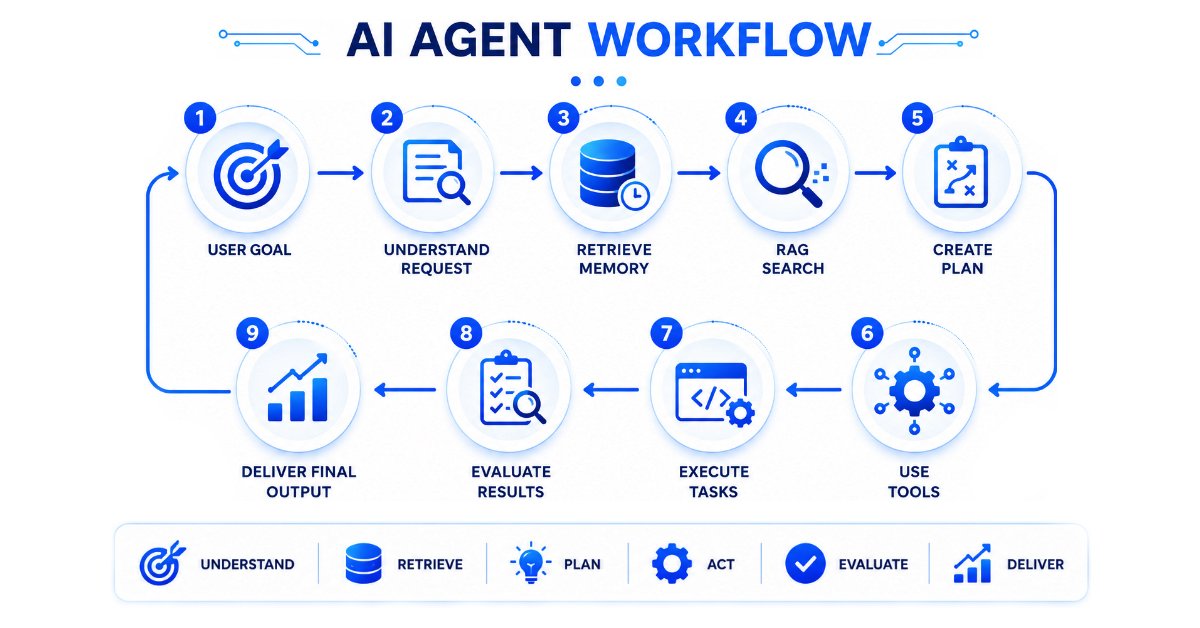
User Request
“Research our top five competitors and create a market analysis report.”
Stage 1: Understanding
The LLM identifies:
- Research objective
- Competitor analysis requirement
- Desired output format
Stage 2: Memory Retrieval
The agent checks:
- Previous reports
- User preferences
- Historical project data
Stage 3: Information Retrieval
Using RAG, the agent gathers:
- Company profiles
- Industry reports
- Product information
- Public business data
Stage 4: Planning
The workflow is divided into:
- Identify competitors.
- Collect information.
- Analyze strengths.
- Analyze weaknesses.
- Generate insights.
- Build report.
Stage 5: Tool Usage
The agent uses:
- Search tools
- Internal databases
- Analytics software
- Document generation systems
Stage 6: Evaluation
The agent reviews:
- Data completeness
- Consistency
- Quality of findings
Stage 7: Final Output
A structured market analysis report is delivered to the user.
This example illustrates how reasoning, memory, retrieval, planning, and tool calling combine into a unified workflow.
Enterprise deployments demonstrate how AI agents work at scale across multiple business systems and workflows.
Enterprise AI Agent Architecture
Enterprise AI agents often operate within much larger systems than consumer assistants.
Research into multi-agent frameworks continues to influence how enterprise-grade AI agent architectures are designed and deployed.
A simplified AI agent architectures might look like this:
User
↓
AI Agent Interface
↓
LLM Reasoning Layer
↓
Memory Layer
↓
RAG Layer
↓
Planning Layer
↓
Tool Integration Layer
↓
Business Systems
Common Enterprise Integrations
- CRM platforms
- ERP systems
- Customer support software
- Internal knowledge bases
- Analytics tools
- Cloud services
The objective is not simply answering questions.
The objective is enabling AI agents to participate in real business workflows.
Many businesses first begin their AI journey with AI tools for small businesses before moving toward more advanced AI agent implementations.
This is why many organizations increasingly view AI agents as digital workers rather than conversational assistants.
Common Limitations of AI Agents
Despite their impressive capabilities, AI agents are not perfect.
Understanding their limitations is important.
Organizations increasingly use structured governance frameworks to manage AI-related risks and ensure responsible deployment.
Hallucinations
AI models may occasionally generate inaccurate information.
Tool Failures
External systems may return incomplete or incorrect data.
Memory Challenges
Retrieving the most relevant information is not always straightforward.
Context Limitations
Agents cannot process unlimited information simultaneously.
Security Risks
Access to sensitive systems requires careful governance and oversight.
Cost Considerations
Large-scale agent deployments can become expensive due to model usage, infrastructure requirements, and tool integrations.
These challenges are active areas of research and development across the AI industry.
The Future of AI Agent Architecture
AI agents are evolving rapidly.
Industry leaders often describe the next generation of autonomous systems as agentic AI, where software can reason, plan, and act toward goals with greater independence.
Several trends are likely to shape the next generation of agentic systems.
Persistent Memory
Future agents may maintain useful context across months or even years.
Better Reasoning
Reasoning models continue improving at solving complex problems.
More Reliable Tool Usage
Agents are becoming better at selecting and using external tools.
Autonomous Workflows
Future systems may manage increasingly sophisticated business processes with minimal supervision.
Human-AI Collaboration
The most likely future is not fully autonomous AI.
Instead, organizations will increasingly combine human expertise with AI-driven execution.
As these technologies mature, AI agents may become a standard component of everyday software.
Frequently Asked Questions
1. How do AI agents work?
AI agents combine reasoning models, memory systems, retrieval mechanisms, planning frameworks, and tool integrations to achieve goals and complete tasks.
2. What is the role of an LLM in an AI agent?
The LLM acts as the reasoning engine, helping the agent understand requests, make decisions, and coordinate actions.
3. What is AI agent memory?
AI agent memory stores information about users, tasks, and previous interactions so the system can maintain context over time.
4. What is RAG in AI agents?
Retrieval-Augmented Generation (RAG) allows agents to retrieve external information before generating responses.
5. Why do AI agents use tools?
Tools allow agents to interact with software systems, databases, APIs, and services to perform real-world actions.
6. What is task decomposition?
Task decomposition is the process of breaking a large objective into smaller, manageable tasks.
7. Can AI agents learn over time?
Some AI systems improve through feedback mechanisms, memory systems, and ongoing model updates.
8. What is the difference between memory and RAG?
Memory stores known information and past context, while RAG retrieves information from external sources when needed.
9. Are AI agents the same as chatbots?
No. Chatbots primarily generate responses, while AI agents can reason, plan, retrieve information, and execute actions.
10. Why are AI agents important?
They enable software systems to move beyond conversation and participate directly in complex workflows.
How do modern AI agents work?
Modern AI agents work by combining LLMs, memory systems, retrieval mechanisms, planning modules, and tool integrations into a coordinated architecture that can reason, make decisions, and perform tasks autonomously.
Conclusion
By now, you should have a clear understanding of how AI agents work and why they are becoming a foundational technology in modern software systems.
The real breakthrough behind AI agents is not a single technology.
It is the combination of multiple technologies working together.
Large Language Models provide reasoning.
Memory systems preserve context.
Retrieval mechanisms supply relevant knowledge.
Planning frameworks break goals into manageable tasks.
Tool calling enables real-world actions.
When these components operate as a unified system, AI can move beyond answering questions and begin pursuing objectives.
That shift—from generating responses to accomplishing goals—is what makes AI agents one of the most important developments in modern artificial intelligence.
As agentic systems continue evolving, understanding how they work will become increasingly valuable for businesses, developers, and anyone interested in the future of intelligent software.