Introduction: AI, Machine Learning, and Deep Learning — Understanding the Difference Before Choosing
Artificial Intelligence has moved from being a futuristic idea to a practical technology used in businesses, apps, healthcare, finance, cybersecurity, and everyday tools.
But as AI becomes more common, one question creates confusion:
What is the difference between AI, Machine Learning, and Deep Learning?
Many people use these terms as if they mean the same thing. A company may say, “We want to implement AI,” but the real question is:
Do they need a simple AI automation system?
A Machine Learning model that predicts patterns?
Or a Deep Learning system that understands complex data like images, audio, and language?
Choosing the wrong approach can increase costs, create unnecessary complexity, and deliver poor results.
The truth is simple:
AI, Machine Learning, and Deep Learning are connected, but they solve different types of problems.
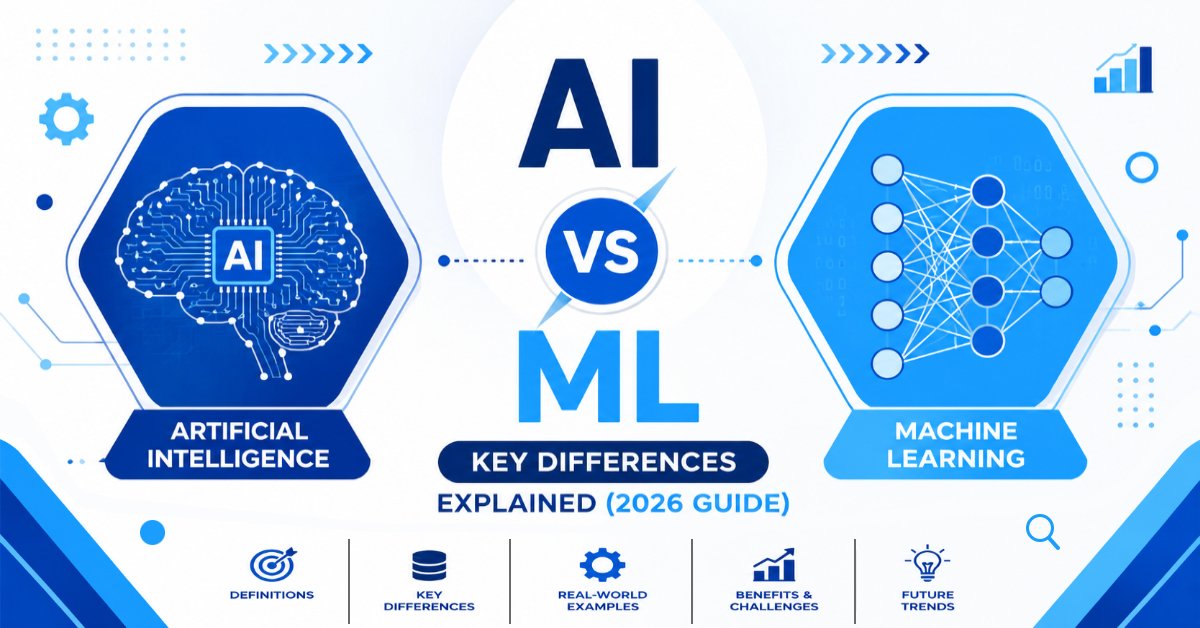
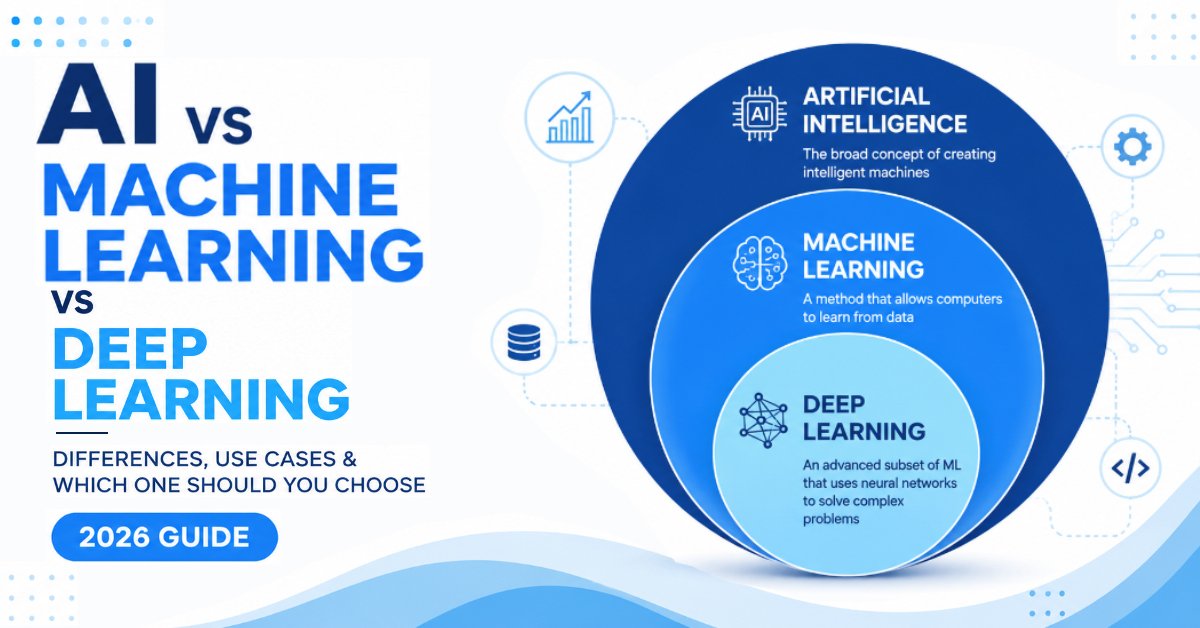
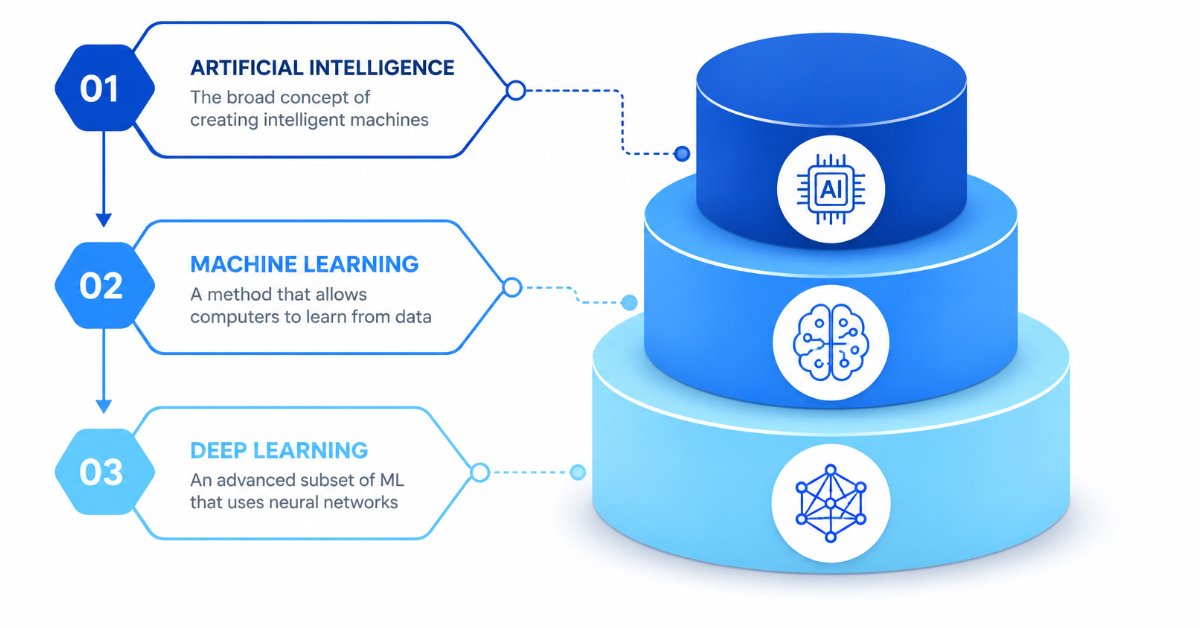
Artificial Intelligence is the broader goal of creating intelligent systems. Machine Learning is a method that allows computers to learn from data. Deep Learning is an advanced form of Machine Learning designed for complex tasks.
AI is the destination, Machine Learning is the learning process, and Deep Learning is the advanced engine that powers complex AI applications.
AI is the destination, Machine Learning is the learning process, and Deep Learning is the advanced engine that powers complex AI applications.
In this guide, we will compare AI vs Machine Learning vs Deep Learning, explore their differences, real-world applications, and explain how businesses can decide which technology is right for their needs in 2026.
Understanding AI vs Machine Learning vs Deep Learning helps businesses choose the right technology instead of investing in unnecessary complexity.
Quick Answer: AI vs ML vs DL in Simple Words
If you remember only one thing from this article, remember this:
Artificial Intelligence (AI)
→ The overall concept of making machines perform tasks that normally require human intelligence.
Machine Learning (ML)
→ A method within AI that allows computers to learn patterns from data and improve predictions.
Deep Learning (DL)
→ A specialized type of Machine Learning used for complex tasks involving images, audio, video, and advanced language understanding.
The relationship looks like this:
Artificial Intelligence (AI)
↓
Machine Learning (ML)
↓
Deep Learning (DL)
Deep Learning is not separate from AI. It is a part of Machine Learning, and Machine Learning is a part of the larger AI field.
AI vs Machine Learning vs Deep Learning: The Relationship Explained
Understanding the hierarchy makes the difference much clearer.
Think of AI as a large umbrella.
Under that umbrella are different techniques and approaches that help machines behave intelligently.
Machine Learning is one of those approaches. Instead of programming every single rule manually, developers train systems using data so they can identify patterns and make decisions.
Deep Learning goes one step further. It is designed for more complex situations where machines need to understand large amounts of unstructured information.
For example:
A business predicting future sales may use Machine Learning.
A company analyzing thousands of product images may use Deep Learning.
A complete customer support automation system may combine multiple AI technologies.
What Is Artificial Intelligence (AI)?
Artificial Intelligence is the broad field focused on creating systems that can perform tasks that usually require human intelligence.
These tasks may include:
- Understanding information
- Making decisions
- Solving problems
- Recognizing patterns
- Automating complex processes
AI is the final goal: creating systems that can act intelligently.
Not every AI system needs Machine Learning or Deep Learning.
Some AI solutions work using predefined rules.
For example:
A simple chatbot that answers fixed questions based on programmed responses can be considered an AI system, even if it does not learn from data.
Modern AI systems, however, increasingly combine Machine Learning, Deep Learning, and other technologies to become more flexible and powerful.
What Is Machine Learning (ML)?
Machine Learning is a branch of AI that allows computers to learn from data instead of relying only on manually written instructions.
The basic idea is:
Give the system data → let it identify patterns → use those patterns to make predictions or decisions.
For example:
An online business can use Machine Learning to analyze previous customer behavior and predict which products a customer may be interested in.
Machine Learning is especially useful for:
- Forecasting
- Recommendations
- Customer analysis
- Fraud detection
- Business predictions
It is often the best choice when organizations have structured data and a clear problem to solve.
Machine Learning is one of the most important parts of Artificial Intelligence, but the two terms are not exactly the same. To understand the difference between these concepts, check our detailed guide on Machine Learning vs Artificial Intelligence.
What Is Deep Learning (DL)?
Deep Learning is an advanced approach within Machine Learning that is designed to handle more complex information.
It is commonly used for:
- Image understanding
- Speech recognition
- Video analysis
- Large-scale language processing
For example:
A system that identifies objects in a photo or understands human speech requires a much deeper level of pattern recognition than a traditional business prediction model.
This is where Deep Learning becomes valuable.
Deep Learning is an advanced form of Machine Learning that uses neural networks to solve complex problems involving images, speech, and large amounts of data. If you want to explore Deep Learning in detail, including how it works, real-world examples, benefits, and future trends, read our complete guide on What Is Deep Learning?
AI vs Machine Learning vs Deep Learning: Complete Comparison
Understanding the difference between AI, Machine Learning, and Deep Learning becomes much easier when we compare them based on their purpose, capabilities, data requirements, and practical use cases.
Although these technologies are connected, they are not interchangeable.
Choosing between them depends on your goals and the type of problem you need to address.
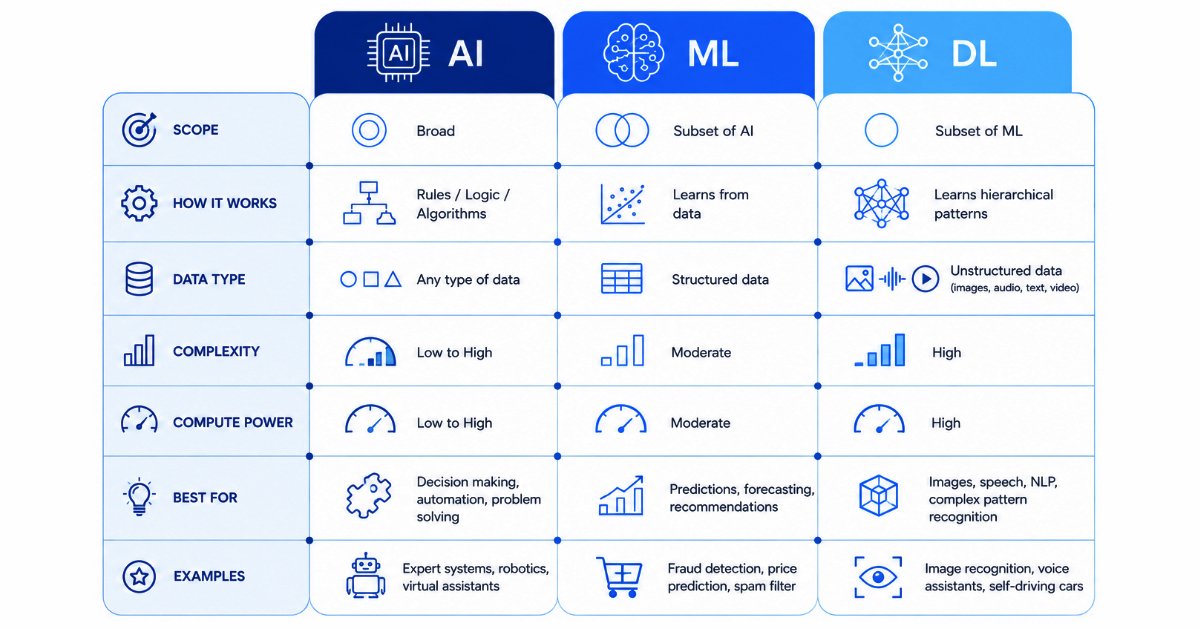
AI vs Machine Learning vs Deep Learning Comparison Table
This AI vs Machine Learning vs Deep Learning comparison makes it easier to understand how these technologies differ in purpose, data requirements, and real-world applications.
| Feature | Artificial Intelligence (AI) | Machine Learning (ML) | Deep Learning (DL) |
| Basic meaning | A field focused on building intelligent systems that can mimic human-like abilities. | A technology that helps machines learn patterns from data without direct programming. | An advanced form of Machine Learning that handles complex patterns |
| Main goal | Make machines perform tasks that require intelligence | Enable systems to learn and improve through experience | Enable machines to understand highly complex information |
| Relationship | The largest category | A subset of AI | A subset of Machine Learning |
| How it works | Uses rules, algorithms, learning systems, or combinations of methods | Finds patterns from data and uses them for predictions | Learns complex patterns from large amounts of data |
| Data requirements | Depends on the type of AI system | Usually works well with structured data | Usually requires large datasets and complex information |
| Computing requirements | Can range from simple to extremely advanced | Usually requires moderate resources | Often needs powerful computing systems |
| Human involvement | Humans define goals and system behavior | Humans usually prepare data and guide training | The system can automatically identify complex features |
| Best used for | Automation, decision-making, intelligent systems | Predictions, forecasting, recommendations, analytics | Images, video, speech, advanced language tasks |
| Examples | AI assistants, automation systems, smart applications | Sales forecasting, recommendation systems, customer predictions | Image recognition, voice assistants, advanced AI models |
| Main limitation | Human intelligence is difficult to fully replicate | Depends heavily on data quality | More expensive and harder to manage |
The Biggest Difference: AI Is the Goal, ML Is the Method, DL Is the Advanced Approach
One of the biggest misconceptions is that AI, Machine Learning, and Deep Learning are competing technologies.
They are not.
They work together.
A simple way to remember:
AI = The overall goal
Creating machines that can perform intelligent tasks.
Machine Learning = The learning approach
Teaching systems to identify patterns from data.
Deep Learning = The advanced technique
Helping machines understand complex information.
For example:
A company building a customer recommendation system may use Machine Learning.
A company creating an image-based search engine may use Deep Learning.
A company automating an entire customer service workflow may use AI that combines multiple technologies.
Where AI, Machine Learning, and Deep Learning Overlap
In real-world projects, these technologies often work together.
A modern AI system may include:
- Traditional programming rules
- Machine Learning models
- Deep Learning models
- Automation tools
The difference is not about choosing only one.
It is about understanding which technology should handle each part of the problem.
When Machine Learning Is the Better Choice
Machine Learning is often the right choice when the problem involves structured information.
Examples:
- Customer databases
- Sales records
- Financial reports
- Business performance data
A company trying to predict future sales does not necessarily need Deep Learning.
A Machine Learning model can analyze:
- Previous sales patterns
- Customer behavior
- Seasonal trends
- Market changes
and provide useful predictions.
Why businesses often choose ML:
- Lower development cost
- Less computing power required
- Faster implementation
- Easier explanation of results
For many business applications, Machine Learning provides excellent results without unnecessary complexity.
When Deep Learning Is the Better Choice
Deep Learning becomes useful when the system needs to understand complex information that is difficult to describe using traditional methods.
Examples:
- Images
- Video
- Voice
- Large amounts of text
Imagine a company creating an app where users upload a product image and the system finds similar products.
A traditional Machine Learning model may struggle because the system needs to understand visual details.
Deep Learning is better suited because it can identify complex patterns inside images.
Common Deep Learning use cases:
- Image recognition
- Speech processing
- Advanced language understanding
- Autonomous systems
When You Do Not Need AI, ML, or Deep Learning
A common mistake is assuming every problem needs AI.
Sometimes a simple software solution is the smarter choice.
If a process has:
- Clear rules
- Limited variables
- Predictable outcomes
traditional programming may be enough.
Example:
A shopping website offers:
“Buy more than ₹5,000 and receive a 10% discount.”
This does not require Machine Learning.
A simple rule-based system can handle it faster and more reliably.
The best technology is not always the most advanced technology.
It is the one that solves the problem efficiently.
Why Choosing the Right Technology Matters in 2026
Businesses today have access to powerful AI tools, but selecting the wrong approach can create problems.
Using Deep Learning for a simple prediction task may increase:
- Cost
- Development time
- Maintenance difficulty
Using basic Machine Learning for a complex image or language problem may reduce accuracy.
The right decision depends on:
- The type of data available
- The complexity of the task
- Required accuracy
- Budget
- Available technical resources
Real-World Applications: How AI, Machine Learning, and Deep Learning Work Together
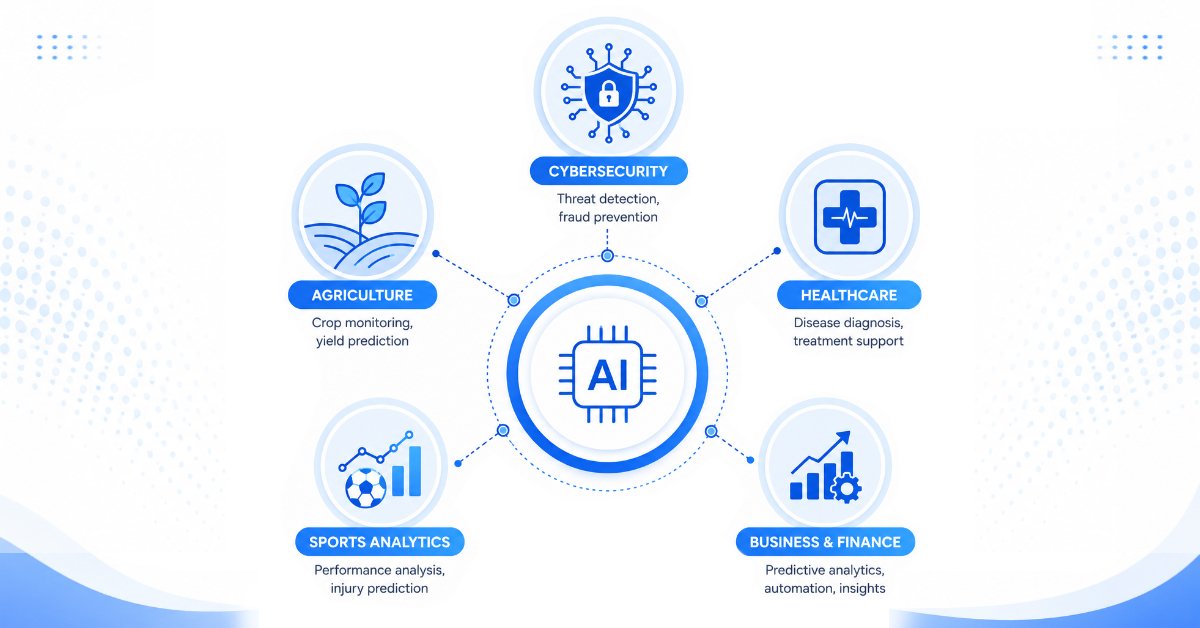
Many people think businesses choose between Artificial Intelligence, Machine Learning, or Deep Learning.
In reality, modern organizations often combine all three.
AI provides the overall intelligent system, Machine Learning helps identify patterns and make predictions, and Deep Learning handles complex information that requires advanced understanding.
Let’s look at how these technologies are used in real-world industries.
1. Cybersecurity: Detecting Threats and Protecting Digital Systems
Cybersecurity is one of the biggest areas where AI technologies are making a difference.
Modern cyber threats are becoming more advanced, and organizations need systems that can detect unusual activity quickly.
How AI is used:
AI helps security systems automate decisions, analyze large amounts of information, and respond faster to possible threats.
For example, an AI-powered security system can monitor network activity and identify potential risks.
How Machine Learning is used:
Machine Learning analyzes patterns in data and learns what normal behavior looks like.
For example:
A company may use ML to understand normal employee login behavior.
If an employee suddenly accesses sensitive files from an unusual location at an unusual time, the system can identify this as suspicious activity.
How Deep Learning is used:
Deep Learning helps analyze more complex security information.
It can identify hidden patterns in:
- Network traffic
- Malware behavior
- Large security datasets
This helps security teams discover threats that may not be obvious through traditional methods.
Key takeaway:
Machine Learning helps detect unusual patterns, while Deep Learning helps analyze more complex security challenges.
2. Agriculture: Improving Farming With Intelligent Technology
Agriculture is another industry where AI is helping businesses and farmers make better decisions.
Farming involves many changing factors:
- Weather
- Soil conditions
- Crop health
- Market demand
AI helps combine this information to improve decision-making.
How AI is used:
AI systems can analyze different sources of information and provide recommendations.
For example:
An AI system may help farmers decide when to plant crops or how to manage resources.
How Machine Learning is used:
Machine Learning works well with structured farming data.
It can help predict:
- Crop production
- Water requirements
- Market trends
- Weather risks
By studying historical information, ML models can identify patterns that help farmers plan better.
How Deep Learning is used:
Deep Learning becomes valuable when visual information is involved.
For example:
Drone images or satellite images can be analyzed to detect:
- Crop diseases
- Pest problems
- Plant health issues
A farmer can use image-based systems to identify problems earlier.
Key takeaway:
Machine Learning helps predict agricultural outcomes, while Deep Learning helps machines understand images and visual data.
3. HR and Recruitment: Creating Smarter Hiring Processes
Recruitment involves analyzing large amounts of information, making it another area where AI can help.
However, human judgment remains important because hiring decisions involve fairness and responsibility.
How AI is used:
AI can automate repetitive tasks such as:
- Organizing applications
- Scheduling interviews
- Managing candidate information
This allows recruiters to focus on higher-value activities.
How Machine Learning is used:
Machine Learning can analyze structured candidate information such as:
- Skills
- Experience
- Education
- Previous hiring patterns
It can help identify candidates whose profiles match specific job requirements.
How Deep Learning is used:
Deep Learning can process more complex information, such as:
- Written communication
- Speech patterns
- Video interview data
This can provide additional insights during recruitment processes.
Key takeaway:
ML works well with candidate data, while DL helps analyze complex communication signals.
4. Sports Analytics: Turning Data Into Better Decisions
Sports organizations increasingly use AI to improve performance and strategy.
Modern teams analyze huge amounts of information to understand players and make better decisions.
How AI is used:
AI systems help coaches and analysts combine information from different sources.
This can support:
- Strategy planning
- Performance analysis
- Decision-making
How Machine Learning is used:
Machine Learning analyzes structured performance data, including:
- Player statistics
- Training records
- Match history
For example:
An ML model can identify performance trends and predict future outcomes.
How Deep Learning is used:
Deep Learning is useful for analyzing video footage.
It can identify:
- Player movement
- Team formations
- Tactical patterns
This allows teams to discover insights that are difficult to analyze manually.
Key takeaway:
Machine Learning finds patterns in performance data, while Deep Learning helps understand complex visual information.
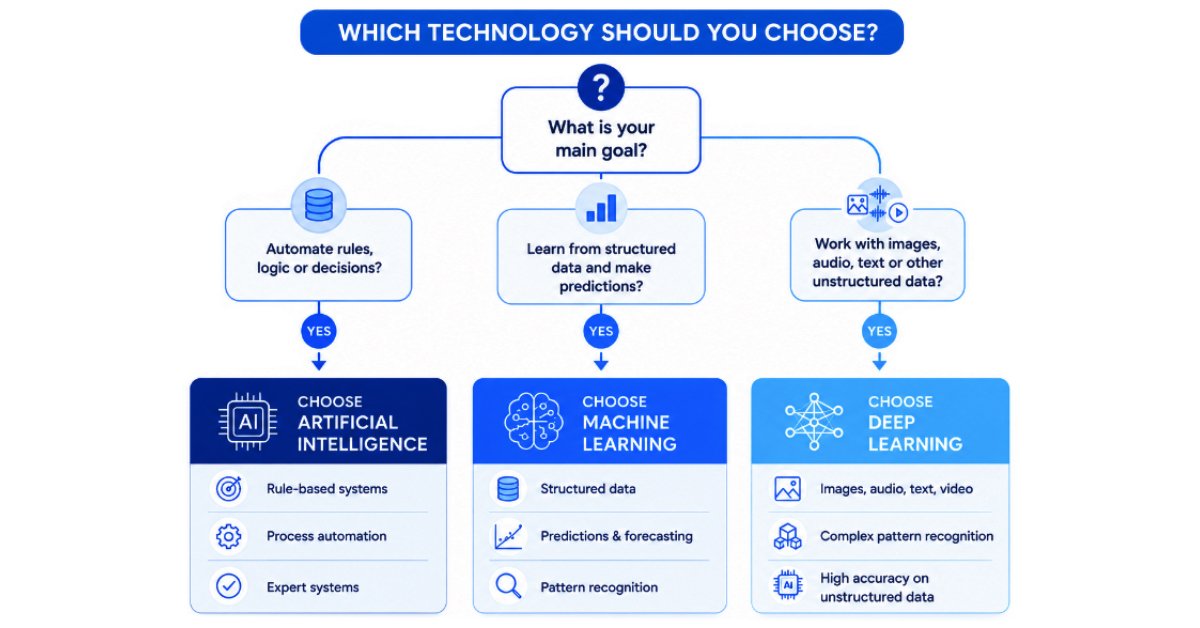
Which Technology Should You Choose? A Practical Decision Framework
The biggest mistake businesses make is choosing technology because it sounds advanced.
Deep Learning may appear more powerful than Machine Learning, but the best solution is not always the most complex one.
The right choice depends on:
- Your business goal
- Your available data
- Your budget
- Required accuracy
- Technical resources
Choose Machine Learning When:
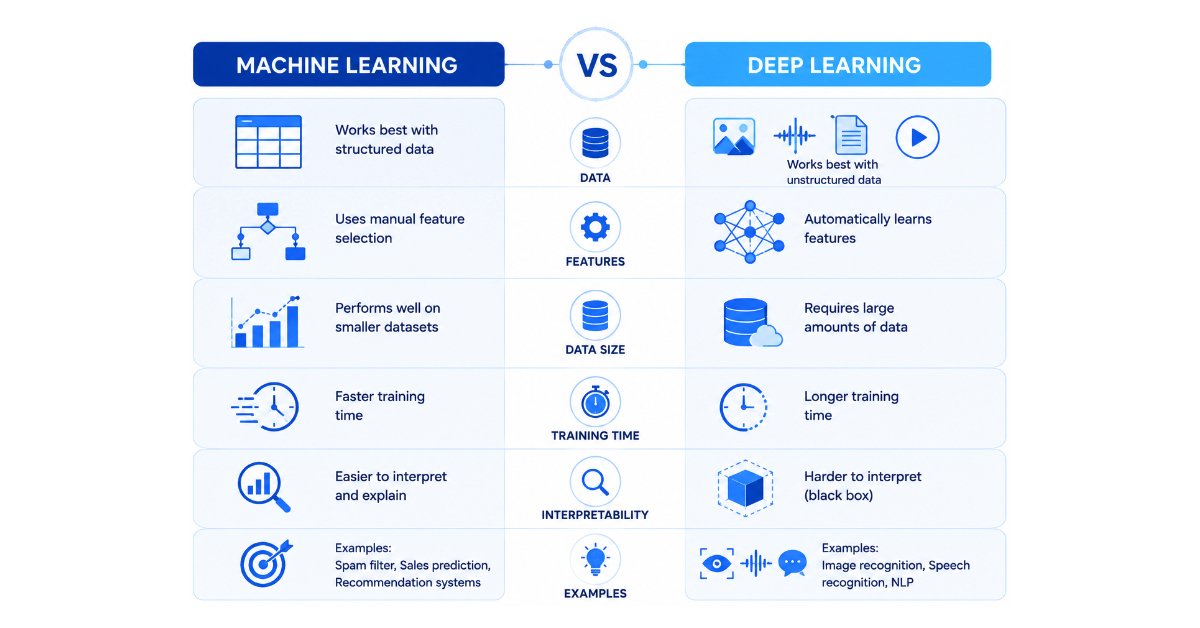
Machine Learning is usually the better option when you have structured data and need predictions.
Examples:
- Customer behavior analysis
- Sales forecasting
- Demand prediction
- Business analytics
- Risk assessment
Choose ML if:
✅ Your data is mostly numbers or records
✅ You need predictions
✅ You want faster implementation
✅ You need easier explanations
Choose Deep Learning When:
Deep Learning is more suitable when your problem involves complex information.
Examples:
- Image recognition
- Voice processing
- Video analysis
- Advanced text understanding
Choose DL if:
✅ You work with images, audio, or video
✅ You have large amounts of data
✅ You need advanced pattern recognition
✅ Accuracy is more important than simplicity
Choose AI Systems When:
Sometimes you need more than a prediction.
You need a system that can understand, decide, and perform multiple actions.
This is where modern AI systems and Agentic AI become useful.
Examples:
- AI assistants
- Automated business workflows
- Intelligent customer support systems
These systems may combine:
- Machine Learning
- Deep Learning
- Language models
- Automation tools
When You Should Not Use AI
Not every business problem needs artificial intelligence.
If the process has simple rules, traditional software may be better.
Examples:
- Invoice calculations
- Fixed pricing rules
- Basic approval systems
A simple solution is often:
- Cheaper
- Faster
- Easier to maintain
The goal is not to use the most advanced technology.
The goal is to solve the problem effectively.
The 2026 Factor: How AI, Machine Learning, and Deep Learning Are Changing
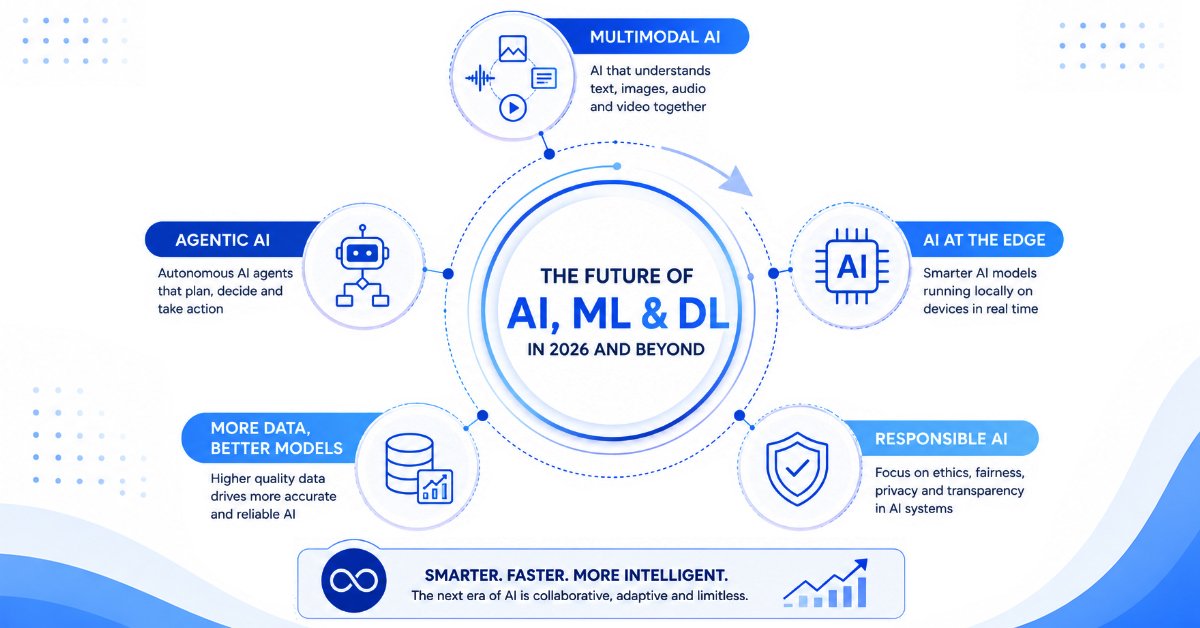
The relationship between Artificial Intelligence, Machine Learning, and Deep Learning is evolving quickly.
A few years ago, businesses often viewed these technologies separately. Today, modern AI systems are combining multiple approaches to create more powerful and practical solutions.
The future is not about choosing only AI, ML, or Deep Learning.
It is about understanding how these technologies work together and using the right approach for the right problem.
1. AutoML: Making Machine Learning More Accessible
Traditionally, building a Machine Learning model required specialized knowledge.
Data scientists had to:
- Prepare data
- Select algorithms
- Test different models
- Improve performance
AutoML (Automated Machine Learning) is changing this process.
AutoML tools help automate parts of Machine Learning development, making it easier for businesses to experiment with AI solutions.
Benefits include:
- Faster model development
- Reduced technical complexity
- Easier AI adoption for smaller teams
In 2026, many companies are focusing less on building everything from scratch and more on finding practical ways to apply AI.
2. Pre-Trained Models and Fine-Tuning: Making Advanced AI Easier to Use
One major change in AI is that organizations no longer always need to create models from zero.
Modern AI development often uses existing powerful models and adapts them for specific tasks.
This process includes:
- Using pre-trained models
- Fine-tuning models for specific industries
- Customizing AI systems with business data
For example:
A company may use an existing AI model and adapt it for customer support, document analysis, or internal business operations.
This reduces:
- Development time
- Cost
- Technical barriers
and allows more businesses to use advanced AI capabilities.
3. Agentic AI: Moving From Answers to Actions
Traditional AI systems often perform a single task:
- Predict information
- Generate content
- Classify data
- Provide recommendations
Agentic AI represents a shift toward systems that can complete multi-step tasks.
Instead of only answering:
“What should I do?”
an AI agent can help:
- Understand a goal
- Collect information
- Analyze options
- Take action
- Provide results
Examples include:
- AI research assistants
- Automated business workflows
- Intelligent customer support systems
Agentic AI combines multiple technologies, including Machine Learning, Deep Learning, language models, and automation.
The next evolution of AI is moving toward systems that can plan, make decisions, and complete tasks independently. Learn more about how these advanced systems work in our guide on AI Agents.
4. Multimodal AI: Understanding Different Types of Data Together
Humans understand the world using multiple forms of information.
We combine:
- Text
- Images
- Audio
- Video
A successful solution depends on choosing the technology that fits the specific need, not simply the most advanced option.
Multimodal AI allows systems to understand and process different types of information together.
For example:
A business AI assistant could analyze:
- A customer message
- A product image
- A voice recording
and provide a more complete response.
This makes AI systems more flexible and useful in real-world situations.
5. Edge AI: Bringing Intelligence Directly to Devices
Many AI systems traditionally depended on cloud computing.
Now, more AI processing is happening directly on devices.
This is known as Edge AI.
Examples include:
- Smartphones
- Smart cameras
- IoT devices
- Industrial equipment
Benefits include:
- Faster responses
- Better privacy
- Lower internet dependency
- Reduced cloud costs
As AI models become smaller and more efficient, advanced intelligence can run closer to where data is created.
Conclusion: AI vs Machine Learning vs Deep Learning — Choose the Right Tool, Not the Most Advanced One
When comparing AI vs machine learning vs deep learning, there is no single winner.
Each technology has a different purpose.
Artificial Intelligence is the overall goal of creating intelligent systems.
Machine Learning helps computers learn from data and identify patterns.
Deep Learning provides advanced capabilities for handling complex information such as images, audio, video, and large-scale language.
The most practical approach in 2026 is not about choosing one blindly, but understanding:
“Which technology is better?”
The better question is:
Selecting the right technology requires understanding your objectives, available data, and the problem you need to address.
Choose Machine Learning when you need predictions from structured data.
Choose Deep Learning when you need advanced understanding of complex information.
Choose AI systems when you need automation, reasoning, and intelligent workflows.
And remember:
A successful solution depends on choosing the technology that fits the specific need, not simply the most advanced option.
A successful solution is not about using the most advanced technology, but about choosing the approach that solves the problem efficiently.
Frequently Asked Questions (FAQ)
1. Is AI the same as Machine Learning?
No. AI is the broader concept of creating intelligent systems, while Machine Learning is one method used to achieve AI by allowing computers to learn from data.
2. Is Deep Learning better than Machine Learning?
Not always. Deep Learning is better for complex tasks involving images, audio, video, and advanced patterns. Machine Learning is often better for structured business problems because it is simpler and requires fewer resources.
3. Can AI, Machine Learning, and Deep Learning work together?
Yes. Many modern AI systems combine all three technologies. For example, Machine Learning can handle predictions, Deep Learning can process complex data, and AI systems can automate decisions.
4. Which technology should a small business choose?
Most small businesses should start by identifying the problem first. If they need predictions from business data, Machine Learning may be enough. If they need image, voice, or advanced automation capabilities, Deep Learning or AI solutions may be more suitable.
5. Do all AI systems use Deep Learning?
No. Some AI systems use simple rules, traditional algorithms, or Machine Learning methods without using Deep Learning.
6. What is the future of AI after Deep Learning?
The future is moving toward combined AI systems, including Agentic AI, multimodal AI, and intelligent automation that can complete more complex tasks.
7. What is the difference between AI vs Machine Learning vs Deep Learning?
The difference between AI vs Machine Learning vs Deep Learning is that AI is the broader concept, Machine Learning helps systems learn from data, and Deep Learning handles complex tasks using advanced neural networks.