Published on WebWorldSolution.com
Introduction
Artificial Intelligence is everywhere.
In this guide, we’ll explore Machine Learning vs Artificial Intelligence, including their differences, similarities, and real-world applications.
From ChatGPT answering complex questions to Netflix recommending your next binge-worthy show, AI has become a part of daily life. Yet despite its popularity, one question continues to confuse students, business owners, developers, and even technology enthusiasts:
Is Machine Learning the same as Artificial Intelligence?
The short answer is no.
Many people use the terms interchangeably because they are closely related. However, understanding the difference between AI and Machine Learning is essential if you want to stay informed about technology trends, pursue a career in tech, or make smarter business decisions.
Think of Artificial Intelligence as the entire universe and Machine Learning as one of its most important planets.
Every Machine Learning system is part of Artificial Intelligence, but not every AI system uses Machine Learning.
This distinction becomes increasingly important as businesses invest billions into AI-powered automation, predictive analytics, generative AI, and intelligent decision-making systems.
In this comprehensive guide, you’ll learn:
- What Artificial Intelligence really means
- What Machine Learning is and how it works
- The key differences between AI and ML
- How Deep Learning fits into the picture
- Real-world examples from leading companies
- Future trends shaping AI and Machine Learning in 2026 and beyond
By the end, you’ll have a crystal-clear understanding of Machine Learning vs Artificial Intelligence and know exactly where each technology fits in the modern digital landscape.
Quick Answer: Machine Learning vs Artificial Intelligence
Artificial Intelligence (AI) is the broader field focused on creating machines that can simulate human intelligence and perform tasks such as reasoning, decision-making, problem-solving, and language understanding. Machine Learning (ML) is a field within Artificial Intelligence that teaches computers to learn from data and become more accurate over time instead of relying solely on pre-written rules. In simple terms, AI is the big umbrella, while Machine Learning is one of the most powerful technologies underneath it.
What is Artificial Intelligence?
Artificial Intelligence refers to the ability of computers or machines to mimic human intelligence.
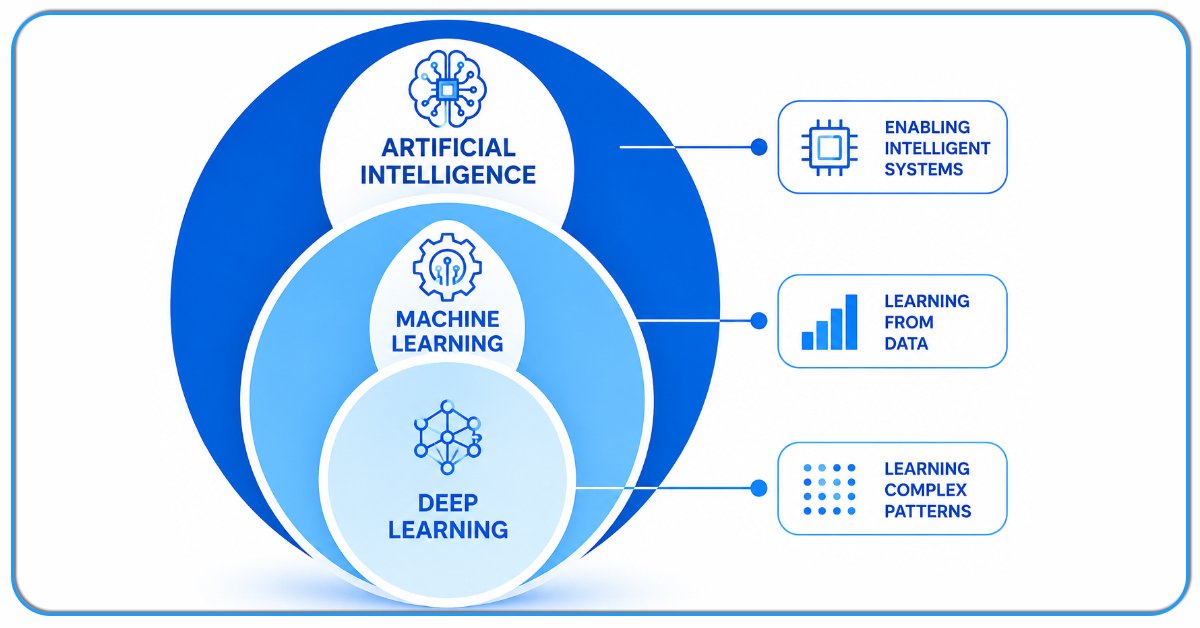
According to IBM, Artificial Intelligence (AI) refers to technologies that enable computers and machines to simulate human learning, reasoning, problem-solving, and decision-making abilities.
The goal of AI is not simply to process information. It is to enable machines to:
- Understand information
- Analyze situations
- Learn from experiences
- Make decisions
- Solve problems
- Communicate naturally
- Perform tasks autonomously
In other words, AI aims to make machines “smart.”
A Simple Example
For example, when you interact with voice assistants like Siri or Google Assistant, you’re using a technology powered by Artificial Intelligence.
When you ask:
“What’s the weather today?”
The assistant:
- Understands your speech
- Interprets your intent
- Retrieves relevant information
- Provides a meaningful response
These capabilities are powered by Artificial Intelligence.
Types of Artificial Intelligence
1. Narrow AI (Weak AI)
Designed to perform specific tasks.
Examples:
- ChatGPT
- Google Search
- Recommendation engines
- Voice assistants
- Fraud detection systems
This is the type of AI we use today.
2. General AI (Strong AI)
General AI refers to a theoretical intelligence system capable of carrying out virtually any mental task that a human can perform.
Researchers continue exploring this area, but General AI has not yet been achieved.
3. Super AI
A theoretical future AI that surpasses human intelligence in virtually every domain.
Currently, this remains a concept rather than reality.
Core Components of Artificial Intelligence
Modern AI often combines multiple technologies:
| AI Component | Purpose |
| Machine Learning | Learning from data |
| Natural Language Processing | Understanding language |
| Computer Vision | Understanding images and videos |
| Robotics | Performing physical tasks |
| Expert Systems | Making decisions using rules |
| Knowledge Representation | Storing and using information |
Artificial Intelligence Examples
Some common AI examples include:
- ChatGPT generating content
- Self-driving vehicles
- AI chatbots
- Smart home assistants
- Facial recognition systems
- Fraud detection software
- Translation tools
- Medical diagnosis platforms
Notice that many of these systems rely heavily on Machine Learning.
That’s where the relationship between AI and ML begins.
What is Machine Learning?
Machine Learning is a branch of AI that empowers computers to analyze data, recognize patterns, and improve their accuracy over time without requiring step-by-step programming for each task.
Instead of writing detailed instructions for every possible situation, developers train algorithms using large datasets.
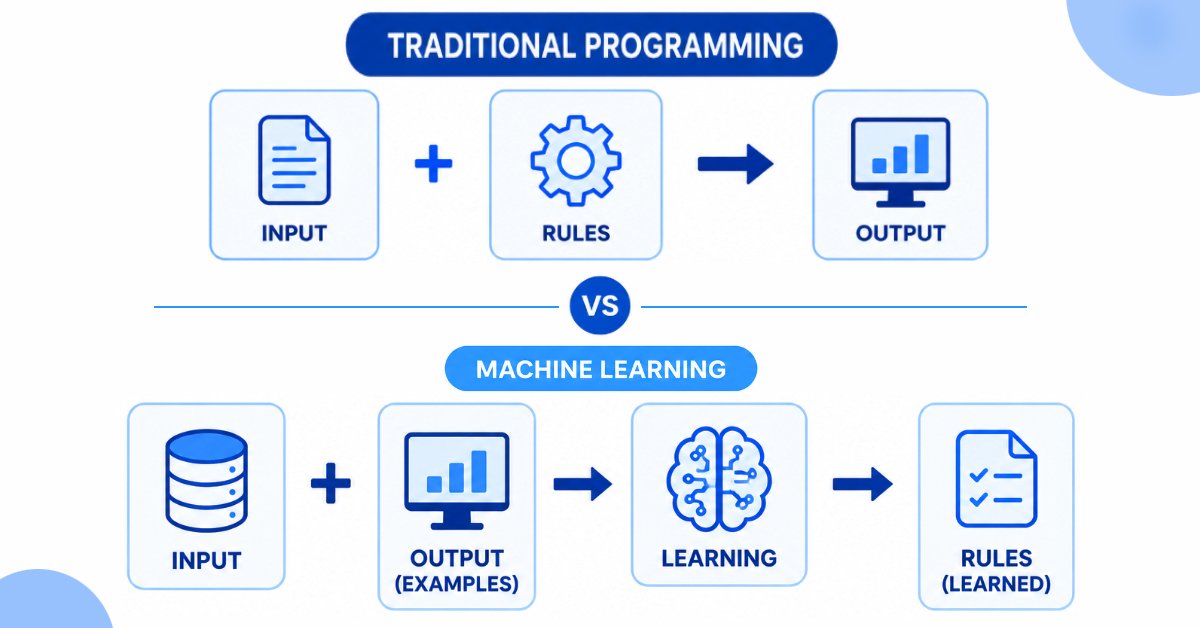
IBM defines Machine Learning as a subset of AI that allows systems to learn from data and improve their performance over time without being explicitly programmed for every task.
The algorithm identifies patterns and improves its predictions over time.
Traditional Programming vs Machine Learning
Traditional Programming
Input + Rules → Output
Example:
A calculator follows predefined rules.
2 + 2 = 4
The outcome is predetermined.
Machine Learning
Input + Data → Learned Rules → Output
Example:
An email spam filter learns from millions of emails and gradually becomes better at identifying spam messages.
How Machine Learning Works
A simplified process looks like this:
| Step | Description |
| Data Collection | Gather relevant information |
| Data Preparation | Clean and organize data |
| Training | Teach the model using data |
| Testing | Evaluate accuracy |
| Deployment | Use model in real-world situations |
| Improvement | Continuously learn and optimize |
Types of Machine Learning
Supervised Learning
Uses labeled data.
Examples:
- House price prediction
- Email spam detection
- Credit risk assessment
Unsupervised Learning
Uses unlabeled data.
Examples:
- Customer segmentation
- Pattern discovery
- Market basket analysis
Reinforcement Learning
Learns through rewards and penalties.
Examples:
- Robotics
- Gaming AI
- Autonomous vehicles
Machine Learning Applications
Today, Machine Learning powers:
- Recommendation systems
- Search engines
- Image recognition
- Predictive maintenance
- Healthcare analytics
- Financial forecasting
- Personalized advertising
- Customer support automation
Much of the intelligence behind today’s AI-powered tools comes from Machine Learning, which enables them to learn, adapt, and improve over time.
Machine Learning vs Artificial Intelligence: Quick Comparison Table
The easiest way to understand Artificial Intelligence vs Machine Learning is through comparison.
Understanding Machine Learning vs Artificial Intelligence is essential for anyone interested in modern technology and data-driven innovation.
| Feature | Artificial Intelligence | Machine Learning |
| Definition | Broad field focused on creating intelligent machines | Subset of AI focused on learning from data |
| Scope | Large | Narrower |
| Goal | Simulate human intelligence | Learn patterns and improve predictions |
| Data Dependency | May or may not require data | Requires large datasets |
| Decision Making | Can use logic, rules, learning, reasoning | Primarily data-driven |
| Complexity | Broader and more complex | Specialized area within AI |
| Examples | Chatbots, robots, expert systems | Recommendation engines, predictive models |
| Relationship | Parent technology | Child technology |
The difference between AI and Machine Learning is that Artificial Intelligence is the broader concept of machines performing intelligent tasks, while Machine Learning is a subset of AI that allows systems to learn from data and improve automatically without explicit programming.
Machine Learning vs Artificial Intelligence: Key Differences
Understanding the relationship is helpful.
Understanding the differences is essential.
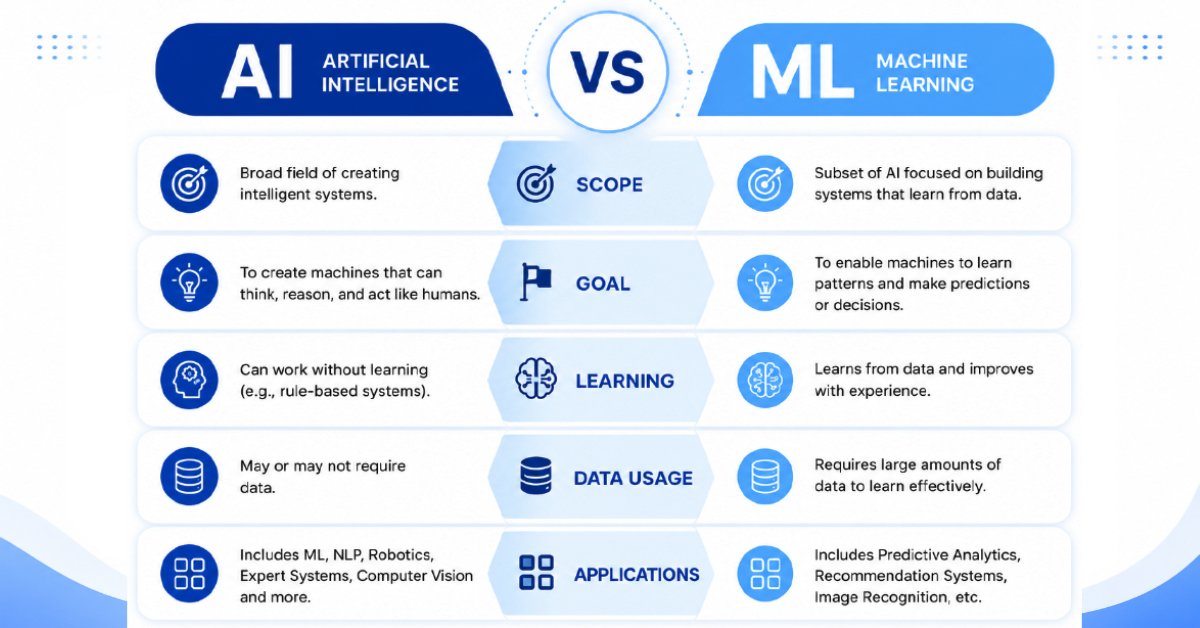
Let’s break them down.
1. Goals
Artificial Intelligence Goal
At its core, AI is about developing systems that can understand information, make decisions, and carry out tasks in an intelligent way.
Its focus includes:
- Reasoning
- Planning
- Decision-making
- Understanding language
- Problem-solving
Machine Learning Goal
Machine Learning focuses specifically on learning from data.
Its objective is to:
- Find patterns
- Predict outcomes
- Improve accuracy
Example
AI Goal:
A virtual assistant capable of understanding requests.
ML Goal:
Learning user preferences to provide better responses.
When comparing Machine Learning vs Artificial Intelligence, it is important to remember that Machine Learning is a subset of Artificial Intelligence.
2. Scope
One of the biggest differences lies in scope.
Artificial Intelligence
Includes:
- Machine Learning
- Deep Learning
- Robotics
- Computer Vision
- NLP
- Expert Systems
Machine Learning
Focuses only on:
- Learning from data
- Building predictive models
- Pattern recognition
Visual Relationship
Artificial Intelligence
│
├── Machine Learning
│ ├── Deep Learning
│
├── Robotics
├── NLP
├── Expert Systems
└── Computer Vision
AI is the larger ecosystem.
Machine Learning is one of the core areas that helps power many modern Artificial Intelligence applications.
3. Learning Process
Artificial Intelligence
Can operate using:
- Predefined rules
- Logic systems
- Expert knowledge
- Learning algorithms
Machine Learning
Relies heavily on:
- Data
- Statistical models
- Pattern recognition
Example
An expert system created using fixed medical rules is AI.
A diagnostic model trained on millions of patient records is Machine Learning.
4. Data Requirements
AI
Some AI systems can function with relatively little training data.
Rule-based systems are a classic example.
Machine Learning
ML systems depend heavily on data.
Generally:
- More data = Better accuracy
- Poor data = Poor results
This is why companies invest heavily in data collection and management.
5. Applications
Artificial Intelligence Applications
- Virtual assistants
- Autonomous robots
- Intelligent chatbots
- Smart homes
- Language translation
Machine Learning Applications
- Product recommendations
- Fraud detection
- Customer segmentation
- Predictive analytics
- Forecasting systems
6. Complexity
Artificial Intelligence
Often combines multiple technologies.
A modern AI system may include:
- NLP
- Computer Vision
- ML models
- Decision engines
Machine Learning
Focuses specifically on learning algorithms.
Although highly technical, its scope remains narrower than AI.
Common Misconceptions About AI and Machine Learning
Many articles stop at definitions.
However, misconceptions often create the biggest confusion.
Myth #1: AI and Machine Learning Are the Same Thing
Reality:
Machine Learning is a subset of AI.
They are related but not identical.
Myth #2: All AI Learns Automatically
Reality:
Some AI systems use fixed rules and do not learn at all.
Myth #3: Machine Learning Thinks Like Humans
Reality:
ML models recognize patterns.
They do not possess consciousness or human understanding.
Myth #4: More Data Always Means Better Results
Reality:
Poor-quality data can reduce accuracy regardless of quantity.
Myth #5: AI Will Replace Every Job
Reality:
AI is more likely to transform jobs than eliminate all of them.
Workers who learn AI tools often become more productive rather than obsolete.
AI vs ML vs Deep Learning Comparison Table
One more layer of confusion exists: Deep Learning.
Let’s simplify it.
| Feature | Artificial Intelligence | Machine Learning | Deep Learning |
| Scope | Broadest | Subset of AI | Subset of ML |
| Data Requirement | Low to High | Medium to High | Very High |
| Human Intervention | Higher | Moderate | Lower |
| Complexity | Broad | Moderate | Very High |
| Hardware Needs | Moderate | Moderate | High |
| Examples | Chatbots, Robots | Recommendation Systems | Image Recognition, LLMs |
| Learning Method | Rules + Learning | Data Learning | Neural Networks |
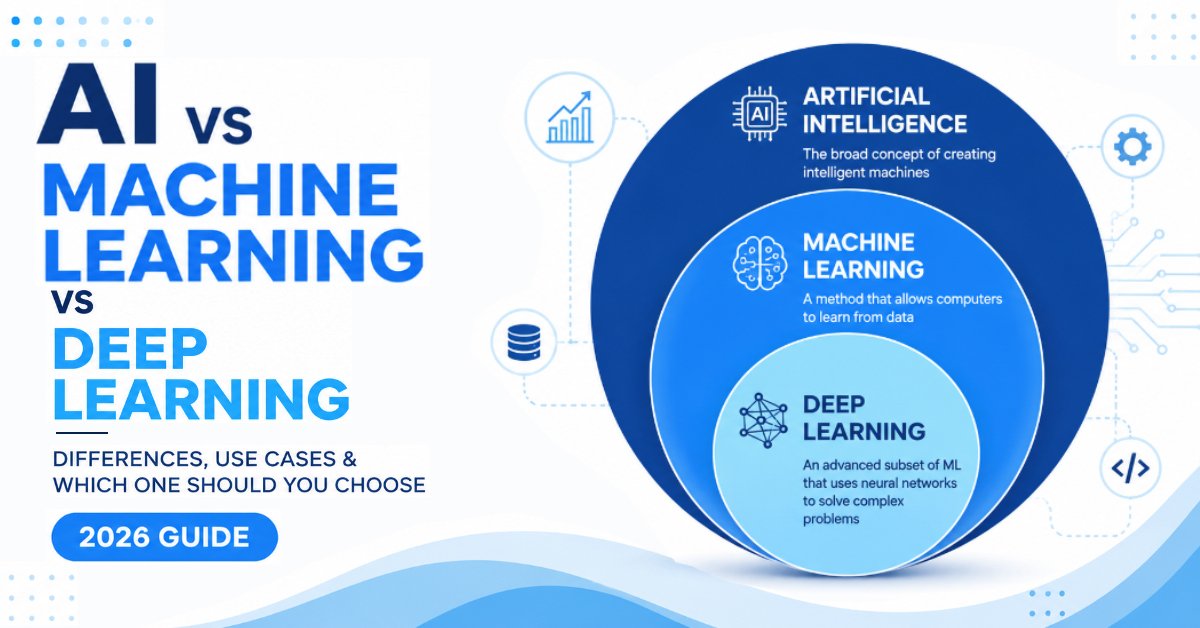
To understand the complete relationship between these technologies, it is important to look at how Artificial Intelligence, Machine Learning, and Deep Learning differ from each other.
Hierarchy
Artificial Intelligence
↓
Machine Learning
↓
Deep Learning
Deep Learning powers many of today’s most advanced AI breakthroughs, including generative AI systems and large language models.
How AI and Machine Learning Work Together
One of the biggest mistakes people make is viewing AI and Machine Learning as competitors.
They aren’t.
They work together.
Think about building a modern electric car.
The car represents AI.
The engine represents Machine Learning.
Without the engine, the car cannot function effectively.
Without the car, the engine has no practical purpose.
The same relationship exists between AI and ML.
Modern machine learning models can identify patterns, make predictions, and continuously improve as they process more data.
Example: ChatGPT
Artificial Intelligence provides:
- Language understanding
- Conversational capabilities
- Decision-making frameworks
Machine Learning provides:
- Pattern recognition
- Training from massive datasets
- Response generation improvements
Together, they create an intelligent conversational experience.
Modern AI systems are becoming more autonomous with the rise of AI agents, which can analyze information, make decisions, and complete tasks with minimal human intervention.
Example: E-commerce Recommendations
Artificial Intelligence handles:
- User interaction
- Personalization logic
- Customer engagement
Machine Learning handles:
- Behavioral analysis
- Purchase prediction
- Recommendation generation
The result is a highly personalized shopping experience.
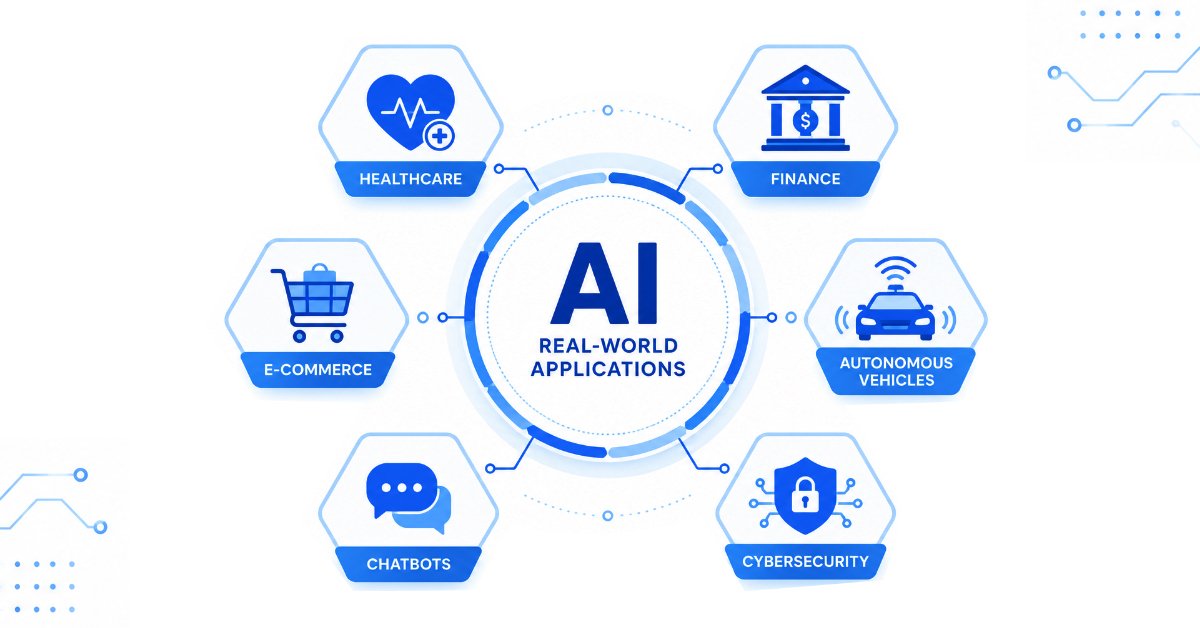
Real-World Examples of Artificial Intelligence and Machine Learning
Theory is useful, but real-world examples make the distinction between AI and Machine Learning much easier to understand.
Let’s examine how some of the world’s most successful companies use these technologies.
1. Netflix: Personalized Content Recommendations
Every time you open Netflix, the platform presents movies and TV shows that seem surprisingly relevant to your interests.
This experience is powered largely by Machine Learning.
How Machine Learning Helps Netflix
ML algorithms analyze:
- Viewing history
- Watch time
- Search behavior
- Ratings
- User preferences
The system continuously learns and improves recommendations.
Where AI Comes In
Artificial Intelligence combines recommendation engines with:
- User experience optimization
- Content categorization
- Personalized interfaces
- Automated decision-making
Business Impact
Netflix’s recommendation engine is estimated to save the company billions of dollars annually by improving user retention and engagement.
Key Takeaway: Machine Learning learns user preferences, while AI delivers an intelligent entertainment experience.
2. Amazon: Smart Shopping Experiences
Amazon is one of the best examples of AI and ML working together.
Machine Learning Applications
Amazon uses ML for:
- Product recommendations
- Demand forecasting
- Inventory management
- Dynamic pricing
Artificial Intelligence Applications
Amazon uses AI through:
- Alexa voice assistant
- Customer support automation
- Warehouse robotics
- Smart logistics systems
Example
When Amazon suggests:
“Customers who bought this item also bought…”
that’s primarily Machine Learning in action.
3. Google Search
Google processes billions of searches every day.
Providing accurate results requires both AI and Machine Learning.
Machine Learning’s Role
ML helps Google:
- Understand search intent
- Rank webpages
- Detect spam
- Improve search relevance
AI’s Role
AI contributes:
- Natural language understanding
- Conversational search
- AI-generated summaries
- Voice search capabilities
This is why search results today are significantly smarter than they were ten years ago.
4. ChatGPT
ChatGPT is among the most recognizable AI tools in the world.
Many people call it AI, which is correct.
But Machine Learning is also a critical component.
AI Capabilities
ChatGPT can:
- Answer questions
- Generate content
- Translate languages
- Assist with coding
- Summarize information
Machine Learning Capabilities
The model learns patterns from vast amounts of training data and uses those patterns to generate responses.
Why It Matters
ChatGPT demonstrates how modern AI systems often depend heavily on advanced Machine Learning and Deep Learning techniques.
5. Fraud Detection in Banking
Millions of financial transactions take place every day, making it challenging for banks and other institutions to monitor them manually.
Identifying fraud manually would be impossible.
Machine Learning’s Role
ML models analyze:
- Spending patterns
- Transaction locations
- Purchase behavior
- Risk indicators
They quickly identify unusual activities.
AI’s Role
AI systems:
- Evaluate risk levels
- Trigger alerts
- Recommend actions
- Support investigation teams
Real Benefit
Fraud detection systems save banks and customers billions of dollars annually.
6. Healthcare and Medical Diagnosis
Healthcare is one of the most promising applications of AI.
Machine Learning Applications
ML can:
- Analyze medical images
- Predict disease risks
- Identify health patterns
- Support diagnosis
Artificial Intelligence Applications
AI systems can:
- Assist physicians
- Automate administrative tasks
- Recommend treatment options
- Improve patient experiences
Practical Example
An AI-powered radiology system may identify potential abnormalities in X-rays while helping doctors make faster and more informed decisions.
Benefits of Artificial Intelligence
Organizations across industries continue investing heavily in AI because of its transformative advantages.
1. Improved Efficiency
AI automates repetitive tasks and reduces manual workloads.
Examples include:
- Customer service chatbots
- Data entry automation
- Document processing
2. Faster Decision-Making
AI systems can process large amounts of information in seconds.
Businesses gain:
- Faster insights
- Better forecasting
- Improved responsiveness
3. Enhanced Customer Experience
AI enables:
- Personalized recommendations
- Instant support
- Customized interactions
This leads to higher customer satisfaction.
4. Scalability
Unlike human teams, AI systems can handle millions of interactions simultaneously.
This makes growth more manageable.
5. Competitive Advantage
Organizations adopting AI often gain:
- Better efficiency
- Lower costs
- Faster innovation
- Improved customer retention
Benefits of Machine Learning
Machine Learning offers unique advantages beyond general AI capabilities.
1. Continuous Improvement
Unlike traditional software, ML systems improve as they process more data.
The model becomes increasingly accurate over time.
2. Better Predictions
ML excels at forecasting outcomes.
Examples include:
- Sales forecasting
- Demand prediction
- Risk assessment
3. Pattern Recognition
Machine Learning can uncover hidden patterns that humans might miss.
This capability drives innovation across industries.
4. Personalization
Modern personalization depends heavily on ML.
Examples include:
- Netflix recommendations
- Spotify playlists
- Amazon product suggestions
5. Data-Driven Decisions
Machine Learning helps organizations make decisions based on evidence rather than assumptions.
Challenges, Risks, and Limitations of AI and Machine Learning
AI has enormous potential, but it is important to understand that it is not a cure-all for every business or technological challenge.
Understanding limitations is critical for realistic expectations.
Challenge 1: Data Quality Issues
High-quality data is the foundation of successful Machine Learning, as model accuracy and reliability depend heavily on the information provided.
Poor data often leads to:
- Incorrect predictions
- Bias
- Reduced accuracy
Challenge 2: High Implementation Costs
AI projects often require:
- Skilled professionals
- Infrastructure investments
- Data management systems
For smaller organizations, these costs can be significant.
Challenge 3: Bias and Fairness Concerns
AI systems may inherit biases present in training data.
This can create ethical and operational challenges.
Challenge 4: Lack of Transparency
Many modern Machine Learning models can generate highly accurate predictions, but the reasoning behind their decisions is often not easy to understand.
Understanding how decisions are made can be difficult.
To address these concerns, many organizations are adopting Responsible AI frameworks that promote fairness, accountability, and transparency.
Challenge 5: Security Risks
AI systems can become targets for:
- Data manipulation
- Cyberattacks
- Model exploitation
Organizations must prioritize AI security.
Challenge 6: Regulatory Uncertainty
Governments worldwide are developing AI regulations.
Businesses must stay informed and compliant.
Should You Learn AI or Machine Learning First?
This is one of the most common questions among students and professionals.
The answer depends on your goals.
If You’re a Beginner
Start with Artificial Intelligence concepts.
Learn:
- AI fundamentals
- AI applications
- AI ethics
- Industry use cases
This builds a strong foundation.
Deep Learning is an advanced branch of Machine Learning that uses neural networks to handle complex tasks such as image recognition, natural language processing, and generative AI.
If You’re Interested in Data Science
Focus on Machine Learning.
Key skills include:
- Python
- Statistics
- Data analysis
- Model development
If You’re a Business Professional
Learn AI first.
Understanding AI strategy often delivers more value than learning algorithms.
If You’re a Developer
Learn AI fundamentals and then move into Machine Learning and Deep Learning.
This path provides the strongest long-term opportunities.
Learning Path Recommendation
| Stage | Focus Area |
| Step 1 | AI Fundamentals |
| Step 2 | Data Analysis |
| Step 3 | Machine Learning |
| Step 4 | Deep Learning |
| Step 5 | Generative AI |
| Step 6 | AI Agents & Automation |
This progression aligns with current industry demands in 2026.
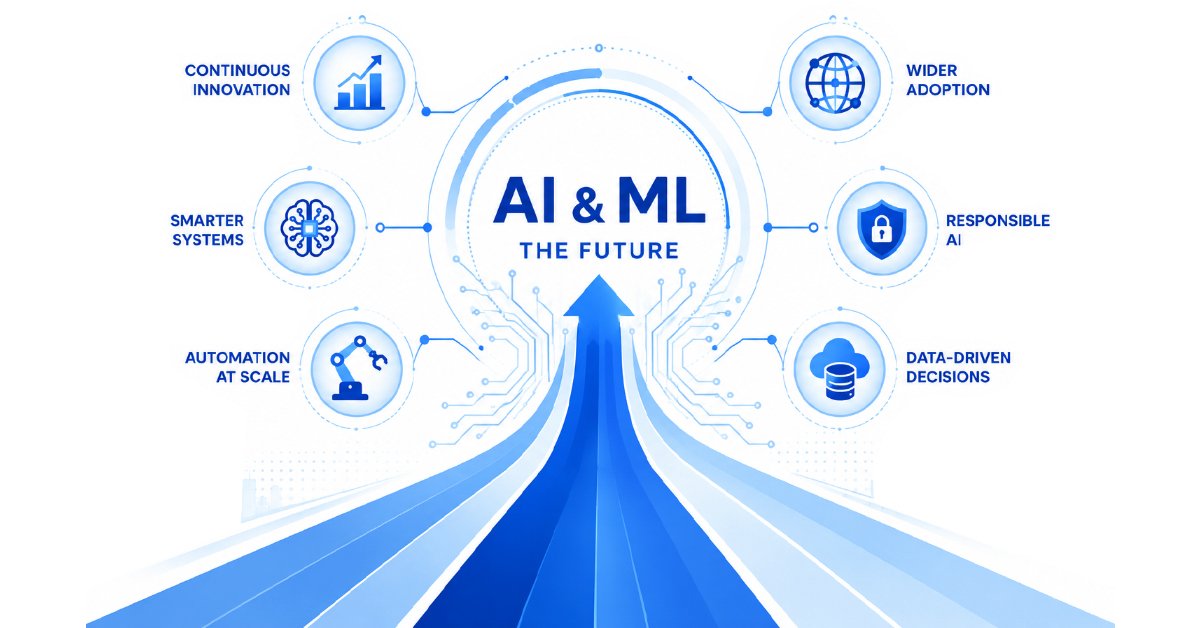
Future of AI and Machine Learning in 2026 and Beyond
The next decade will likely redefine how businesses operate.
Several trends are already shaping the future.
Research published by Stanford HAI suggests that AI agents, multimodal systems, and human-AI collaboration will continue to shape the next generation of intelligent technologies.
1. AI Agents Will Become Mainstream
AI agents can:
- Perform multi-step tasks
- Make decisions
- Interact with software systems
Businesses are rapidly adopting agent-based workflows.
2. Generative AI Expansion
Generative AI is moving beyond content creation.
Future applications include:
- Product design
- Software development
- Drug discovery
- Engineering simulations
3. Hyper-Personalization
Machine Learning will deliver increasingly customized experiences.
Expect more personalized:
- Education
- Healthcare
- Marketing
- Shopping
4. Industry-Specific AI
Instead of general-purpose solutions, organizations will deploy specialized AI models tailored to their industries.
5. Responsible AI
Organizations will prioritize:
- Transparency
- Fairness
- Security
- Compliance
Trustworthy AI will become a competitive advantage.
6. Human-AI Collaboration
The future is not humans versus AI.
It is humans working alongside AI.
Professionals who learn to use AI effectively will likely outperform those who ignore it.
Expert Insights: What Businesses Often Get Wrong About AI
After analyzing hundreds of AI implementations across industries, a common pattern emerges.
Many organizations focus on technology before identifying business problems.
This approach frequently leads to disappointing results.
Insight #1: AI Is Not a Strategy
AI is a tool.
Successful companies start with a business objective and then determine whether AI can help achieve it.
Insight #2: Data Is More Valuable Than Algorithms
Many businesses obsess over choosing the perfect AI model.
In reality, data quality often has a much larger impact on outcomes.
Insight #3: Small Wins Matter
Organizations that begin with focused AI projects often achieve better results than those attempting company-wide transformations immediately.
Examples include:
- Customer support automation
- Sales forecasting
- Lead scoring
- Process automation
Insight #4: AI Adoption Is a Cultural Challenge
Technology is rarely the biggest obstacle.
Employee training, leadership alignment, and change management often determine success.
Insight #5: AI Literacy Will Become Essential
Just as digital literacy became mandatory in the internet era, AI literacy is becoming a critical skill for modern professionals.
Key Takeaways
Machine Learning vs Artificial Intelligence at a Glance
- Artificial Intelligence is the broader field focused on creating intelligent systems.
- Machine Learning is a subset of AI that learns from data.
- Deep Learning is a subset of Machine Learning.
- AI may use rules, reasoning, and learning techniques.
- ML relies heavily on data and pattern recognition.
- Most modern AI applications combine AI, ML, and Deep Learning.
- Businesses gain the most value when AI solves specific problems.
- AI and ML will continue transforming industries throughout 2026 and beyond.
Frequently Asked Questions (FAQ)
1. What is the main difference between AI and Machine Learning?
Artificial Intelligence is the broader concept of creating intelligent systems, while Machine Learning is a subset of AI that enables systems to learn from data without explicit programming.
2. Is Machine Learning part of Artificial Intelligence?
Yes. Machine Learning is one of the most important branches of Artificial Intelligence.
3. Which is better: AI or Machine Learning?
Neither is better. Machine Learning is a component of AI, and both technologies often work together.
4. Does AI always use Machine Learning?
No. Some AI systems rely on predefined rules and logic rather than Machine Learning.
5. What is Deep Learning?
Deep Learning is a specialized subset of Machine Learning that uses neural networks to process large amounts of data.
6. Is ChatGPT AI or Machine Learning?
ChatGPT is an Artificial Intelligence system powered by advanced Machine Learning and Deep Learning models.
7. Which industries benefit most from AI and ML?
Healthcare, finance, retail, manufacturing, logistics, education, cybersecurity, and marketing are among the biggest beneficiaries.
8. Should beginners learn AI or Machine Learning first?
Most beginners should start with AI fundamentals and then progress into Machine Learning.
9. Can Machine Learning work without data?
No. Machine Learning requires data to identify patterns and improve performance.
10. Will AI replace human jobs completely?
AI will automate certain tasks, but it is more likely to augment human capabilities and create new opportunities than replace all jobs.
Final Verdict
When comparing Machine Learning vs Artificial Intelligence, the most important thing to remember is that they are not competing technologies.
Artificial Intelligence is the broader vision of creating machines capable of intelligent behavior.
Machine Learning is one of the most powerful methods used to achieve that vision.
In simple terms:
- AI is the destination.
- Machine Learning is one of the roads leading there.
As AI continues reshaping industries in 2026 and beyond, understanding the difference between AI and Machine Learning will help students make better career decisions, businesses invest more strategically, and professionals stay ahead in an increasingly AI-driven world.
Whether you’re exploring AI for personal growth, business innovation, software development, or academic learning, one thing is clear: