If you’re trying to understand the pros and cons of digital marketing, the short answer is simple: digital marketing can help small businesses reach more customers, generate measurable results, and compete with larger brands at a lower cost.
But there is another side to the story.
Digital marketing also takes time, consistency, and strategy. It can waste money when done poorly, and it rarely produces instant results.
That is exactly why small business owners keep asking the same question in 2026:
Is digital marketing still worth it?
The honest answer is yes — but only when approached realistically.
Customers today rarely buy without doing some kind of online research first. They search on Google, read reviews, compare options, browse social media, and visit websites before making even small buying decisions.
That means whether you run a local bakery, a home repair service, an online store, or a consulting business, your online presence now influences your offline sales.
In this guide, you’ll learn the real advantages and disadvantages of digital marketing, practical examples for small businesses, and when digital marketing makes sense — and when it may not.
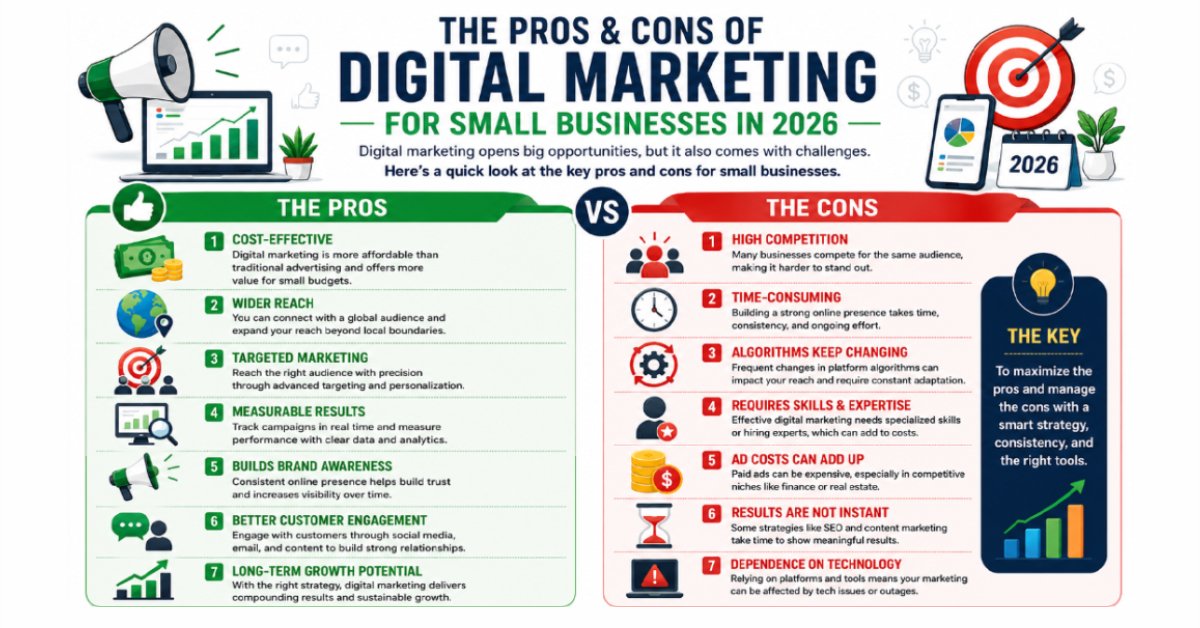
Quick Answer: What Are the Pros and Cons of Digital Marketing?
Digital marketing helps businesses reach highly targeted customers, track performance, and grow brand visibility at a relatively low cost.
However, digital marketing also has drawbacks. It can take months to build momentum, competition is intense, and businesses can easily waste money if strategy and execution are weak.
For most small businesses in 2026, digital marketing is worth it — but only when it is done consistently and strategically.
What Is Digital Marketing?
Digital marketing is the promotion of products or services through online channels.
These channels include:
- search engines like Google
- websites and blogs
- social media platforms
- email marketing
- paid online advertising
- local business listings
- video platforms
In simple terms, digital marketing is how businesses get discovered online.
Years ago, a small business could depend mainly on foot traffic, newspaper ads, referrals, or word of mouth.
Today, the customer journey looks very different.
Someone searching for a nearby cafe might type:
- best coffee near me
- café open now
- breakfast place with Wi-Fi
A person looking for a plumber might search:
- emergency plumber near me
- pipe leakage repair
- water heater service today
The business that appears at the right moment often wins the customer.
According to research published by Think with Google, online research continues to influence both online and offline purchase decisions.
That is digital marketing in action.
Why It Matters More in 2026
Customers no longer wait for advertising to find them.
They actively research before buying.
Even when the final purchase happens offline, the buying decision often begins online.
That is why understanding the pros and cons of digital marketing matters more today than it did even a few years ago.
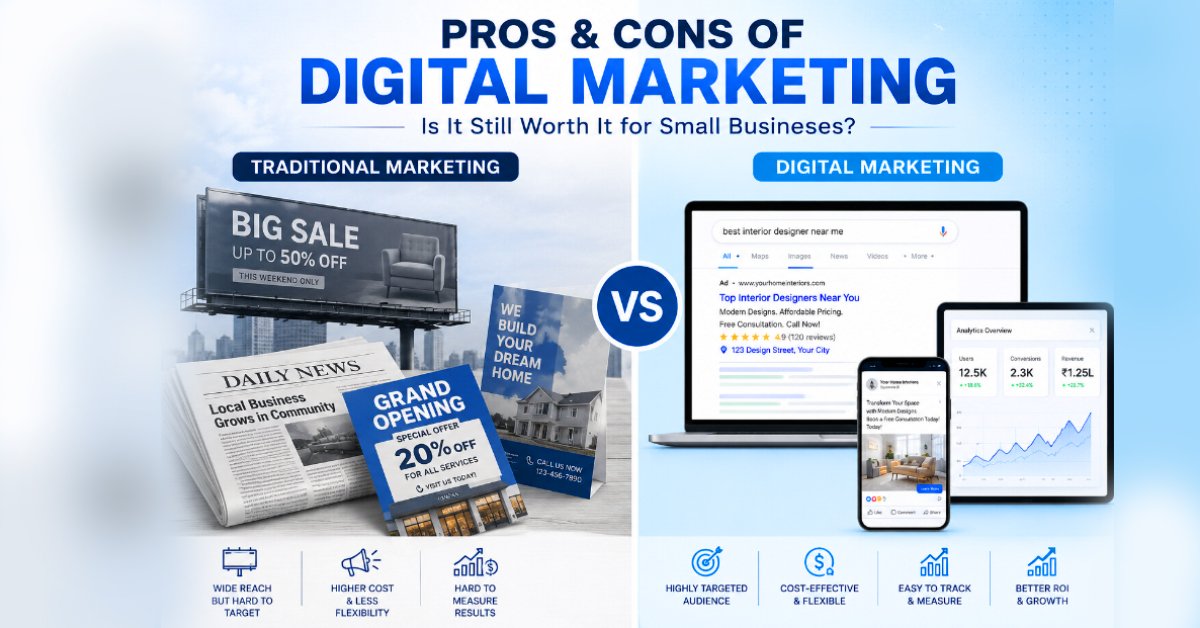
Digital Marketing vs Traditional Marketing
| Factor | Digital Marketing | Traditional Marketing |
| Cost | Lower entry cost | Usually higher upfront cost |
| Targeting | Highly precise | Broad audience targeting |
| Tracking | Easy to measure | Often difficult to measure |
| Speed | Fast for ads, slower for SEO | Can create quick local awareness |
| Long-Term Value | Strong with SEO and content | Usually ends when campaign stops |
For small businesses with limited budgets, that difference can be significant.
Top Advantages of Digital Marketing
Digital marketing has become essential for a reason.
When done properly, it gives small businesses tools that were once available only to companies with large advertising budgets.
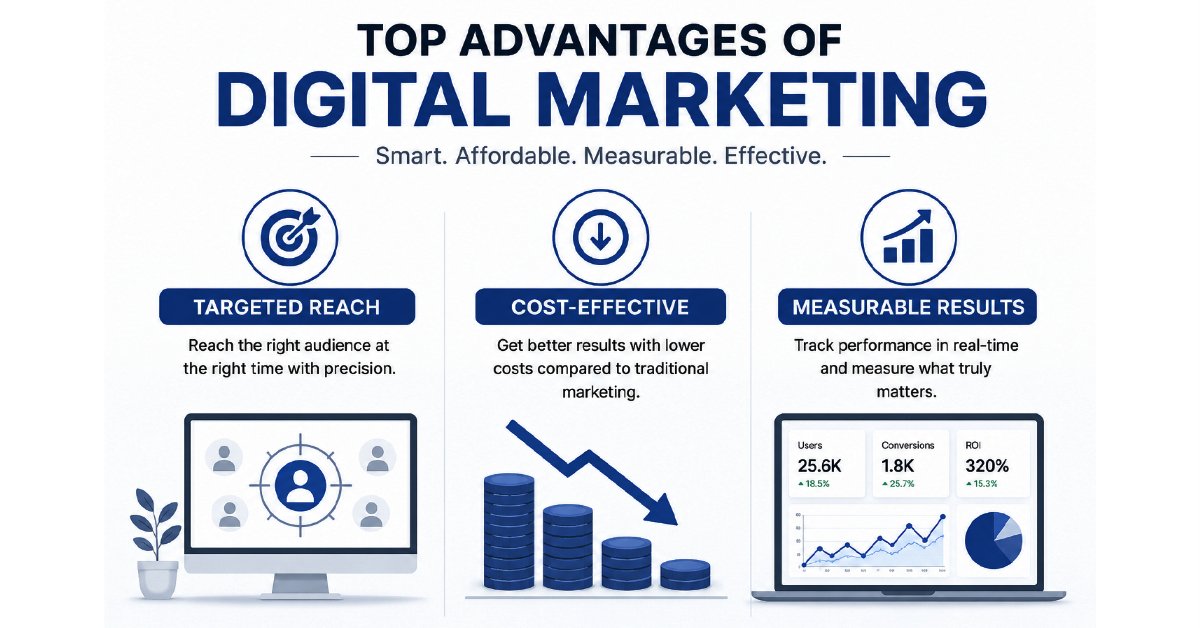
1. Lower Cost Than Traditional Marketing
Traditional advertising often requires a significant upfront investment.
A newspaper ad, radio campaign, or billboard can cost a lot — and you may never know exactly how many customers it generated.
Digital marketing offers more flexibility.
A small business can start with:
- a modest Google Ads campaign
- local SEO
- a few helpful blog posts
- social media content
- low-cost email campaigns
Small Business Example
Imagine a local cleaning service.
It could spend ₹5,000 on flyers and hope people notice.
Or it could spend ₹5,000 running highly targeted search ads for people already searching “home cleaning service near me.”
The second option reaches people with immediate buying intent.
That is a major advantage.
2. Highly Targeted Audience Reach
One of the biggest strengths of digital marketing is precision targeting.
Instead of promoting your offer to everyone, you can target the people most likely to buy.
You can target users based on:
- location
- age
- interests
- search intent
- device type
- online behavior
Example
A small boutique selling handmade jewelry does not need nationwide exposure.
It can focus only on women in specific cities who are actively interested in fashion, accessories, or gift shopping.
That level of targeting helps reduce wasted spend.
3. Measurable Results
This is where digital marketing becomes especially powerful.
Traditional marketing often leaves business owners guessing.
Digital marketing provides real numbers.
You can track:
- clicks
- impressions
- website traffic
- lead form submissions
- sales
- conversion rates
- cost per acquisition
Businesses can also use tools like Google Analytics to better understand traffic, conversions, and customer behavior.
Practical Example
Suppose a dentist runs two landing pages.
One gets 250 visitors and 4 appointments.
The other gets 180 visitors and 12 appointments.
That data makes decision-making much easier.
Instead of guessing, the dentist knows what works.
For small businesses, that can save a lot of money over time.
4. Helps Small Businesses Compete With Bigger Brands
A small business may not have a massive advertising budget.
But online, relevance often beats size.
A local law firm that publishes useful content answering client questions may outrank larger competitors for local search terms.
A local bakery with great reviews and strong local SEO may outperform a bigger chain in map results.
That creates real opportunity.
5. Builds Long-Term Visibility
Paid ads stop when you stop paying.
But SEO content can continue bringing traffic for months or even years.
That long-term value matters.
Industry reports from HubSpot Marketing Statistics continue to show the long-term value of SEO and content marketing for lead generation.
Example
A small laptop repair shop writes an article called:
“Why Is My Laptop Overheating?”
If that article ranks well, it can bring local visitors continuously.
Some of those visitors become customers.
That is marketing value that keeps working long after the content is published.
6. Better Customer Relationships
Digital marketing is not just about getting new customers.
It also helps businesses stay connected with existing ones.
Through email, social media, or helpful content, businesses can stay visible after the first purchase.
Example
A skincare store can send:
- product usage tips
- seasonal recommendations
- exclusive discounts
- skin care advice
That keeps customers engaged and increases repeat purchases.
7. Faster Testing and Improvement
Digital marketing allows businesses to test ideas quickly.
You can test:
- headlines
- landing pages
- offers
- calls to action
- ad creatives
Then you can improve based on real data.
That speed is extremely valuable when budgets are limited.
Top Disadvantages of Digital Marketing
Digital marketing has clear strengths.
But it is not effortless.
Understanding the downsides helps small businesses avoid costly mistakes.
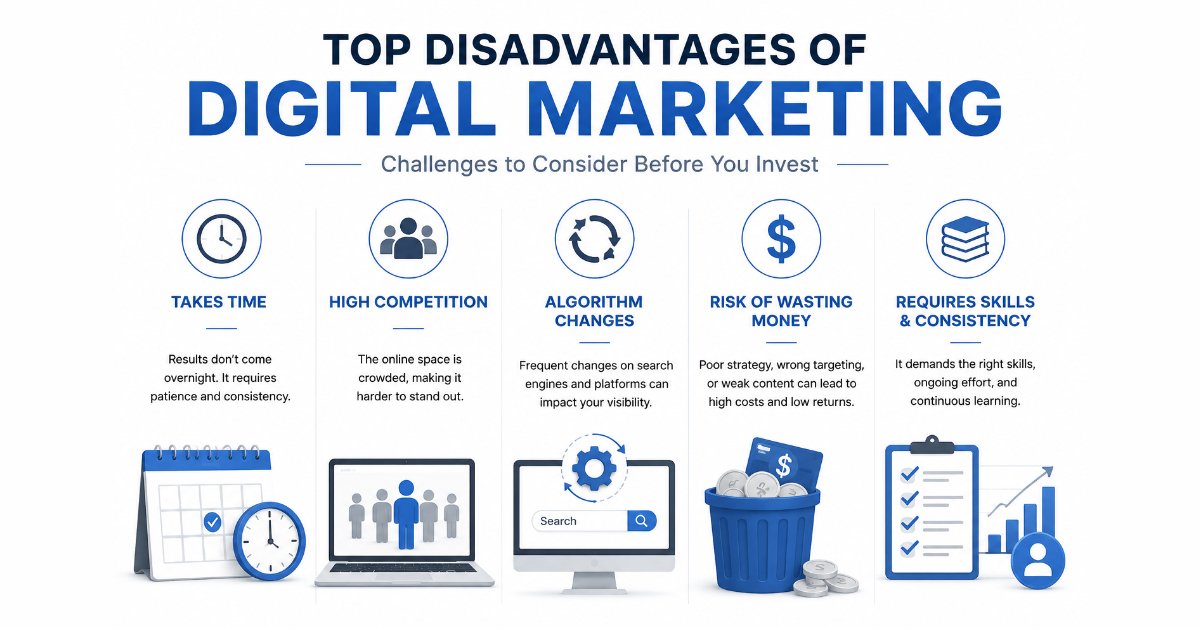
1. It Takes Time
This is probably the biggest frustration.
Many small business owners launch a website, post on social media for a few weeks, and expect immediate sales.
That is rarely how it works.
SEO often takes months.
Content marketing takes consistency.
Trust takes time to build.
Example
A new accounting firm may publish excellent tax-related content.
But it might take several months before Google starts sending meaningful traffic.
That delay can feel discouraging.
2. Competition Is Intense
Digital marketing lowered the barriers to entry.
That is good — but it also means everyone is competing.
For popular keywords, you may compete with:
- large brands
- established publishers
- major ecommerce stores
- aggressive advertisers
Example
A new online store trying to rank for “best gaming laptop” will face fierce competition.
That is why smaller businesses usually need niche positioning instead of broad targeting.
3. Algorithms Keep Changing
Google changes.
Social media platforms change.
Ad platforms change.
What worked last year may not work as well today.
This can be frustrating, especially if a business depends heavily on one traffic source.
Websites like Search Engine Journal regularly cover major Google algorithm updates and SEO industry changes.
Example
A business that relies only on social media reach may suddenly lose visibility after an algorithm update.
That is why diversification matters.
4. It Is Easy to Waste Money
Digital marketing can be cost-effective.
But it can also waste money quickly.
Common mistakes include:
- poor targeting
- weak landing pages
- unclear offers
- chasing clicks instead of sales
- running ads without conversion tracking
Example
A furniture store spends ₹20,000 on ads.
The ads generate plenty of traffic.
But if visitors do not see pricing, trust signals, or clear product information, the campaign may fail.
Traffic is not the same as revenue.
5. It Requires Skills
Good digital marketing involves multiple disciplines.
You may need to understand:
- SEO
- copywriting
- analytics
- customer psychology
- landing page design
- advertising strategy
For a small business owner already handling operations, staffing, and customer service, this can feel overwhelming.
6. Negative Feedback Is Public
Online visibility creates opportunity.
It also creates exposure.
Bad reviews, complaints, or poor customer experiences can spread quickly.
That means digital marketing also includes reputation management.
For some small businesses, this is uncomfortable — but unavoidable.
Is Digital Marketing Worth It for Small Businesses?
The real pros and cons of digital marketing become clearer when small businesses compare long-term growth potential with short-term challenges.
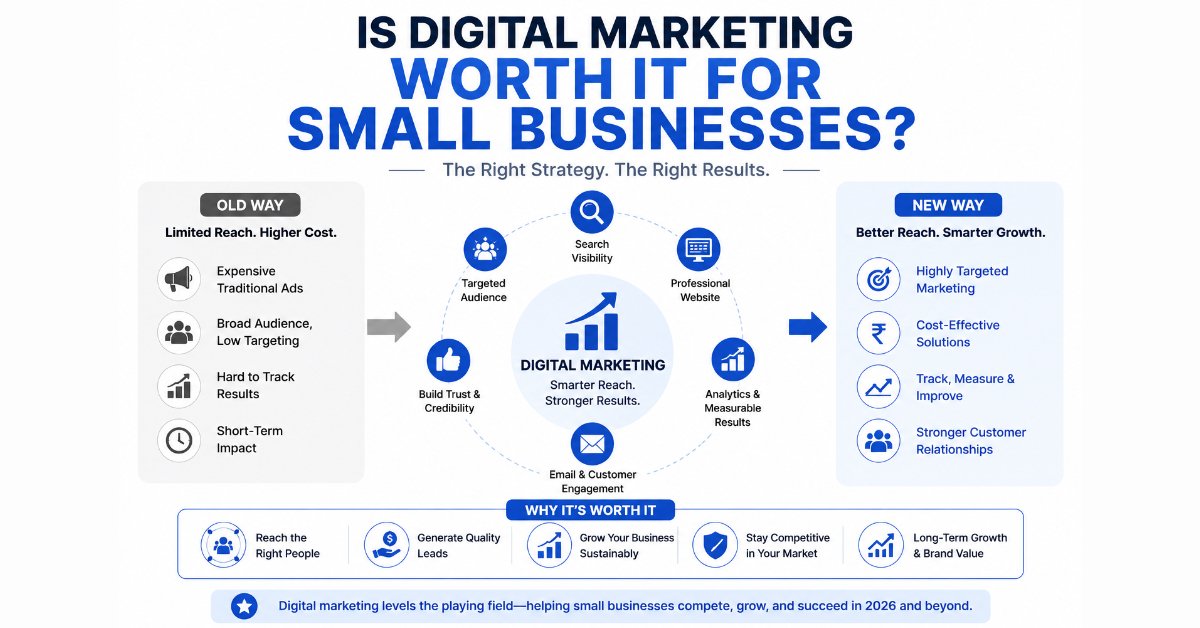
For most small businesses in 2026, yes.
But not because it is easy.
It is worth it because it gives smaller businesses something incredibly valuable:
control.
You can start small.
You can test.
You can measure.
You can improve.
That makes digital marketing practical in ways traditional marketing often is not.
Real Example: Local Plumbing Business
Imagine a plumber serving a specific city.
The traditional approach might include:
- flyers
- referrals
- newspaper ads
The digital approach might include:
- local SEO
- service pages for specific repair services
- customer reviews
- a Google Business profile
- search ads for urgent service keywords
Now imagine someone has a burst pipe at 9 PM.
They search online.
Which business gets the call?
Usually the one that shows up first.
That is why digital marketing is often worth it.
Optimizing a Google Business Profile can significantly improve local visibility and customer inquiries for small businesses.
When It Feels Like It Is Not Working
Digital marketing often feels ineffective when:
- expectations are unrealistic
- the strategy is unclear
- execution is inconsistent
- the product or service itself is weak
Digital marketing can amplify a good business.
It cannot fix a broken one.
When Digital Marketing Works Best
Digital marketing performs especially well under certain conditions.
Understanding these conditions can save a lot of wasted effort.
1. When Customers Search Before Buying
If your customers research online before purchasing, digital marketing matters a lot.
This applies strongly to:
- local service businesses
- health clinics
- consultants
- online stores
- restaurants
- software companies
If customers search, compare, and evaluate online, visibility becomes critical.
Consumer research behavior continues to shift online across both local and ecommerce purchases.
2. When the Offer Is Clear
Clear offers convert better.
For example:
- same-day AC repair
- affordable bookkeeping for freelancers
- organic skincare for oily skin
Specificity improves results.
Vague marketing rarely performs well.
3. When There Is a Clear Next Step
Traffic matters only if visitors know what to do next.
A strong digital marketing funnel usually includes one clear action:
- call now
- request quote
- book consultation
- buy today
- schedule appointment
Many small businesses lose customers because their websites create confusion.
4. When There Is Consistency
A business publishing helpful content every month for a year often beats a competitor posting randomly for three weeks.
Consistency compounds.
That is how digital marketing becomes powerful over time.
When Digital Marketing May Not Be the Best Choice
Digital marketing is valuable — but it is not always the first thing a business should focus on.
1. When the Offer Is Weak
If customers do not clearly understand what you sell or why it matters, marketing will struggle.
First fix the offer.
Then amplify it.
2. When Growth Depends Mostly on Relationships
Some businesses grow mainly through referrals, networking, and partnerships.
For example:
- niche B2B suppliers
- industrial vendors
- highly relationship-driven service businesses
Digital marketing can still help — but may not be the primary growth driver.
3. When the Business Cannot Handle Leads
This happens often.
A business invests in marketing.
Leads start coming in.
Then:
- calls go unanswered
- follow-ups are slow
- emails are ignored
That wastes money.
Marketing only works when operations can support it.
4. When Expectations Are Unrealistic
Some businesses expect massive growth from tiny budgets.
That usually ends in disappointment.
Digital marketing can be affordable.
But serious growth still requires investment.
Common Mistakes Small Businesses Make
Many businesses fail with digital marketing not because it is ineffective, but because they make predictable mistakes.
Trying to Be Everywhere
You do not need every social platform.
You do not need every marketing tactic.
Focus where customer intent is strongest.
For many small businesses, that is often Google search first.
Chasing Traffic Instead of Revenue
10,000 visitors sound exciting.
But 100 targeted visitors who convert are usually far more valuable.
Always focus on business outcomes.
Ignoring Local SEO
For local businesses, this is one of the most expensive mistakes.
Often, improving local visibility produces faster results than trying to rank nationally.
Expecting Instant Results
Digital marketing often rewards patience more than urgency.
Businesses that understand this make smarter long-term decisions.
Practical Digital Marketing Strategy for Small Businesses in 2026
If you run a small business and want a practical approach, this is a sensible place to start.
Step 1: Fix the Basics
Before spending money on ads or content, make sure you have:
- a fast website
- clear services or products
- trust signals like testimonials and reviews
- strong calls to action
- simple contact options
Without these basics, marketing leaks money.
Step 2: Focus on High-Intent Traffic First
Start where buying intent is strongest.
Usually that means:
- local SEO
- Google search
- service pages
- transactional keywords
- Google Business profile optimization
This often performs better than random social media posting.
Step 3: Create Useful Content
Helpful content builds trust and long-term visibility.
Examples
A local accountant could publish:
- tax filing checklist for freelancers
- common GST mistakes small businesses make
A repair shop could publish:
- why phone batteries drain fast
- signs your laptop needs thermal paste replacement
Useful content attracts the right audience.
Step 4: Track What Actually Matters
Do not obsess over vanity metrics.
Track what directly impacts growth:
- leads
- booked appointments
- sales
- cost per acquisition
- customer lifetime value
That is how digital marketing becomes a business tool rather than guesswork.
Before making long-term marketing investments, businesses should fully understand the pros and cons of digital marketing and how they affect growth, visibility, and customer acquisition.
Frequently Asked Questions
1. Is digital marketing good for small businesses?
Yes. For most small businesses, digital marketing can be highly effective because it allows targeted reach, measurable results, and lower entry costs than traditional advertising.
2. What is the biggest disadvantage of digital marketing?
The biggest disadvantage is time. SEO, content marketing, and trust-building usually do not produce immediate returns.
3. Is digital marketing expensive?
Not necessarily. Small businesses can start with modest budgets. However, costs can rise quickly in competitive markets or when campaigns are poorly managed.
4. Is digital marketing better than traditional marketing?
Not always. Digital marketing is usually better for targeting and measurement, while traditional marketing can still work well for local visibility and offline audiences.
5. Can a small business do digital marketing without hiring an agency?
Yes. Many small businesses start with local SEO, a Google Business profile, simple content, and email marketing before hiring outside help.
6. What are the biggest pros and cons of digital marketing?
This is perfect because:
it sounds natural
helps SEO
improves FAQ relevance
7. Why is understanding the pros and cons of digital marketing important?
Understanding the pros and cons of digital marketing helps businesses make smarter decisions about budgeting, customer targeting, long-term growth, and online competition.
Final Verdict
So, what are the real pros and cons of digital marketing in 2026?
The biggest advantages
Digital marketing helps small businesses:
- reach targeted customers
- compete with larger brands
- measure performance
- generate long-term visibility
- acquire customers more efficiently
The biggest disadvantages
Digital marketing also brings:
- intense competition
- slow early results
- constant platform changes
- skill requirements
- wasted spend if strategy is weak
Is It Still Worth It?
Yes — for most small businesses, absolutely.
But only when approached with realistic expectations.
Digital marketing is not a shortcut.
It is not instant growth.
It is a long-term business asset.
The businesses winning in 2026 are not always the ones spending the most.
Before investing heavily, businesses should carefully evaluate the pros and cons of digital marketing based on their goals, budget, and competition.
They are the ones that understand customer intent, create genuinely useful content, build trust, and stay consistent.
That is where sustainable growth happens.
If you run a small business today, the better question is no longer:
“Should I do digital marketing?”
The better question is:
“How can I do digital marketing better than my competitors?”
That is where the real opportunity begins.