Introduction
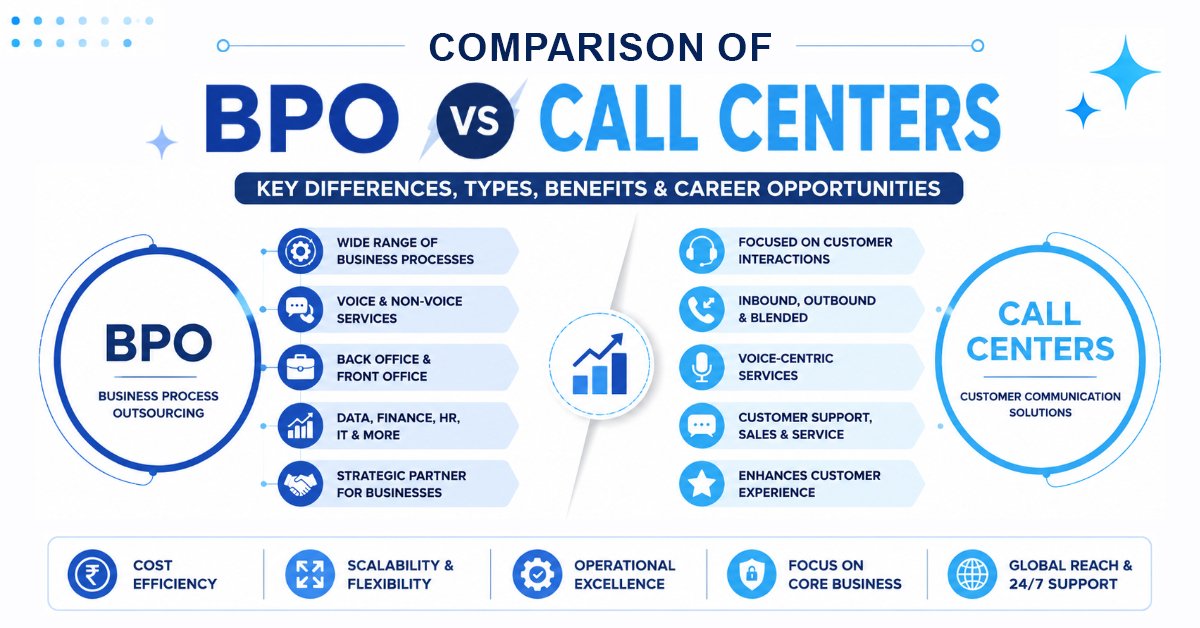
If you’ve ever searched for BPO vs Call Center, you’ve probably noticed that many people use these terms interchangeably. While they are closely related, they are not the same thing.
Understanding BPO vs Call Center is essential for business owners, students, and job seekers because the two terms are often used interchangeably despite having different roles in business operations.
Imagine you call your bank to report a lost debit card. The representative who answers your call works in a call center. However, behind the scenes, another team may verify your identity, update your records, process your request, and handle documentation. Those additional tasks are often performed by a Business Process Outsourcing (BPO) provider.
This simple example highlights the biggest difference:
- A call center mainly handles customer communication through phone calls.
- A BPO manages a much wider range of business processes, including customer support, finance, HR, IT services, data processing, and more.
Understanding this distinction is important whether you’re:
- Looking for a BPO or call center job
- Starting or growing a business
- Choosing an outsourcing partner
- Preparing for interviews
- Learning about the outsourcing industry
- Simply curious about how global businesses operate
In this comprehensive guide, you’ll learn:
- What BPO means
- What a call center is
- The difference between BPO and call center operations
- Types of BPO and call centers
- Practical examples
- Which option is best for different business needs
By the end of this article, you’ll have a clear understanding of how these two concepts relate—and when each one makes the most sense.
Quick Answer
A BPO (Business Process Outsourcing) is a company that manages one or more business functions for another organization, while a call center specifically handles customer communication through inbound and outbound phone calls. In simple terms, every call center can be part of a BPO, but not every BPO is a call center because BPO services extend far beyond voice support. Knowing the difference between BPO vs Call Center helps businesses choose the right outsourcing solution based on their operational needs.
Key Takeaways
- BPO stands for Business Process Outsourcing.
- A call center focuses primarily on customer communication via phone.
- BPO includes both voice and non-voice business processes.
- Call centers are often one department within a larger BPO organization.
- BPO services can include HR, finance, IT support, payroll, data entry, and customer service.
- Call centers mainly manage inbound, outbound, or blended customer calls.
- Businesses choose BPOs to reduce costs, improve efficiency, and access specialized expertise.
- Modern BPOs increasingly use AI, automation, cloud platforms, and analytics.
- Career opportunities exist in both industries with strong growth potential.
- Choosing between a BPO and a call center depends on your business goals and operational requirements.
- Understanding BPO vs Call Center makes it easier to choose the right outsourcing model for your business or career goals.
To fully understand BPO vs Call Center, it’s important to first learn what Business Process Outsourcing (BPO) is and how it differs from a traditional call center.
What Is BPO?
Quick Definition
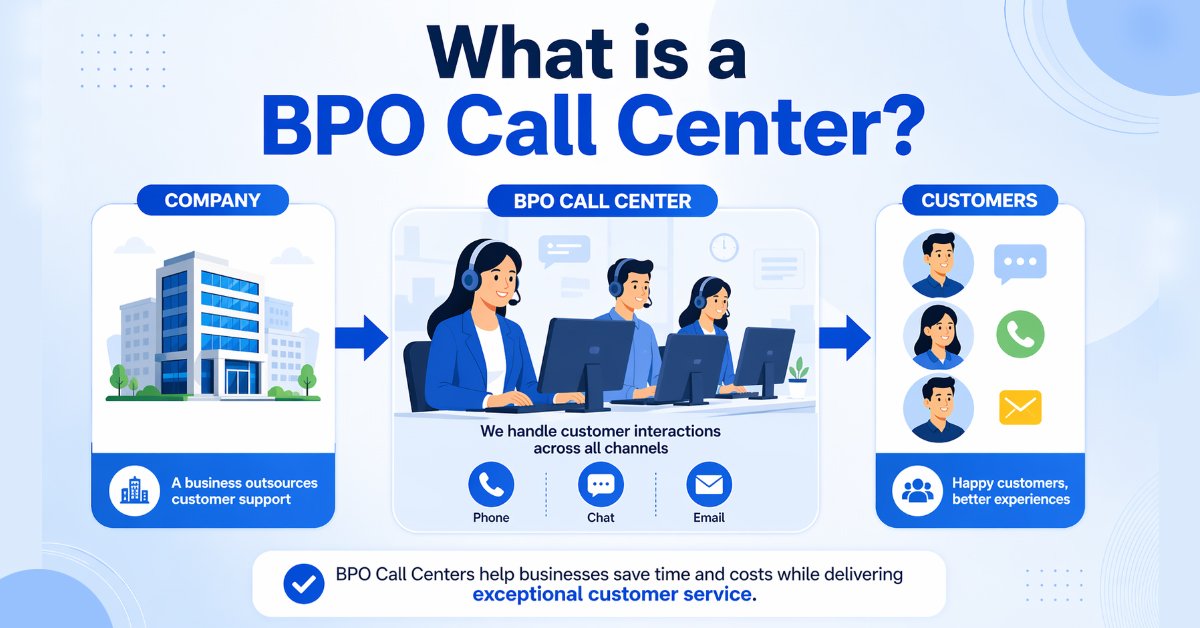
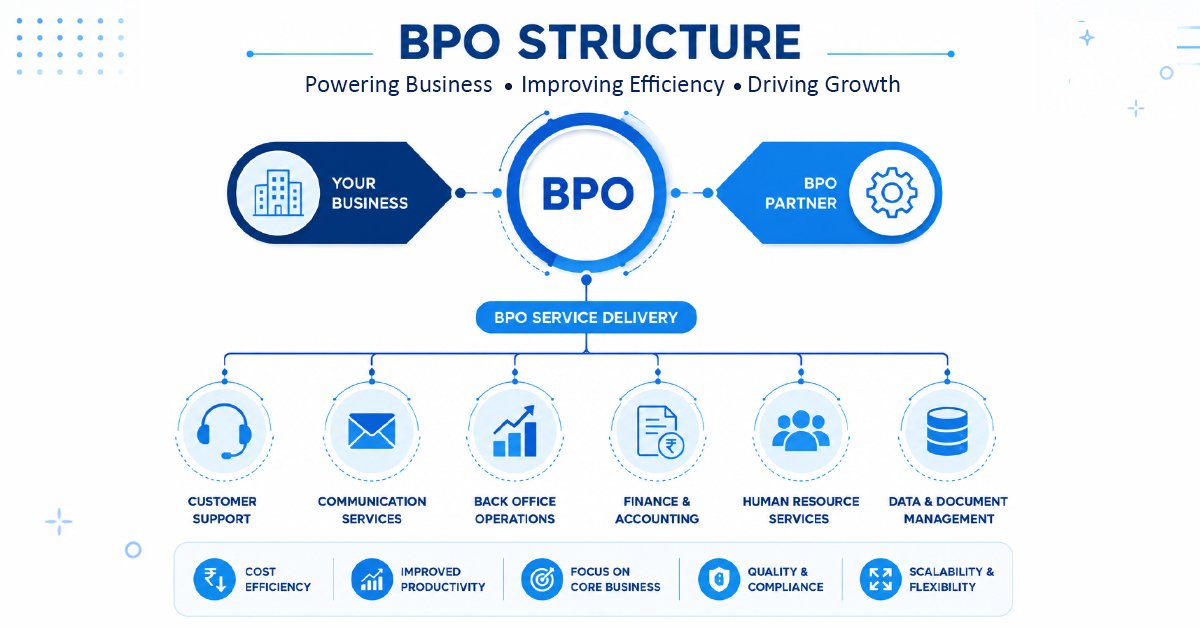
Business Process Outsourcing (BPO) is the practice of hiring an external company to perform specific business functions instead of managing them in-house.
In simple words, a business outsources certain tasks to specialists so it can focus on its core operations.
Key Points
- Handles complete business processes
- Includes voice and non-voice services
- Used by companies of all sizes
- Improves efficiency and reduces operational costs
Example
A growing e-commerce company outsources customer support, payroll processing, invoice management, and order verification to a BPO provider while focusing internally on product development and marketing.
Key Takeaway
A BPO manages business functions—not just customer calls.
BPO Meaning Explained
The full form of BPO is Business Process Outsourcing.
It involves contracting specific operational tasks to a third-party service provider with the expertise, technology, and workforce needed to perform those tasks efficiently.
Instead of hiring dozens or hundreds of employees internally, businesses can rely on experienced outsourcing partners.
Today, BPO has become a strategic business decision rather than simply a way to reduce costs. Organizations use outsourcing to improve customer experiences, scale operations quickly, and gain access to specialized skills.
Industries commonly using BPO include:
- Banking and financial services
- Healthcare
- Retail and e-commerce
- Telecommunications
- Travel and hospitality
- Insurance
- Information technology
- Education
- Logistics
- Manufacturing
According to industry reports from organizations such as NASSCOM, Deloitte, and Grand View Research, the global outsourcing industry continues to expand as businesses increasingly adopt digital transformation, automation, and cloud technologies.
How Does Business Process Outsourcing Work?
At its core, BPO is about delegating business operations to experts.
A typical outsourcing process looks like this:
| Step | What Happens |
| Identify a business process | Customer support, payroll, HR, accounting, etc. |
| Choose a BPO provider | Select an outsourcing partner with relevant expertise |
| Transfer knowledge | Share workflows, policies, and tools |
| Operations begin | The BPO team performs the assigned processes |
| Performance monitoring | Service quality is measured using KPIs and SLAs |
| Continuous improvement | Processes are optimized over time |
Businesses maintain oversight while the outsourcing provider manages day-to-day operations.
Voice Process vs Non-Voice Process
One of the biggest misconceptions is that every BPO employee answers customer calls.
That isn’t true.
BPO operations are generally divided into voice and non-voice processes.
| Voice Process | Non-Voice Process |
| Phone support | Email support |
| Technical support | Live chat |
| Sales calls | Data entry |
| Customer service | Payroll processing |
| Collections | Document verification |
| Appointment scheduling | Claims processing |
Voice Process
Employees communicate directly with customers through telephone conversations.
Examples include:
- Customer support
- Technical assistance
- Sales
- Banking support
- Insurance claims support
Non-Voice Process
Employees work without making or receiving phone calls.
Examples include:
- Data processing
- Email support
- Chat support
- Finance and accounting
- HR administration
- Content moderation
- Medical billing
- Document management
Example
An airline may outsource customer phone support (voice process) while also outsourcing ticket verification and refund processing (non-voice process) to the same BPO provider.
Key Takeaway
A BPO can manage both voice and non-voice operations, making it much broader than a traditional call center.
Industries That Commonly Use BPO Services
Almost every major industry benefits from outsourcing certain business functions.
Some common examples include:
| Industry | Commonly Outsourced Functions |
| Banking | Customer support, loan processing, fraud monitoring |
| Healthcare | Medical billing, appointment scheduling, claims processing |
| E-commerce | Order support, returns management, live chat |
| Telecom | Technical support, billing inquiries, customer service |
| Insurance | Claims processing, customer support |
| Travel | Reservation support, booking assistance |
| Retail | Inventory support, customer care |
| IT | Help desk, infrastructure monitoring |
Benefits of Business Process Outsourcing
Businesses outsource for many reasons beyond cost savings.
1. Lower Operating Costs
Companies can avoid significant investments in infrastructure, recruitment, training, and technology.
2. Access to Specialized Talent
Experienced outsourcing providers employ professionals with expertise in specific business functions.
3. Better Scalability
Businesses can quickly expand or reduce support teams based on seasonal demand without major hiring efforts.
4. Increased Efficiency
Dedicated teams follow standardized workflows and performance metrics that help improve productivity.
5. Focus on Core Business
Instead of spending time on administrative tasks, companies can concentrate on innovation, strategy, and growth.
6. Improved Customer Experience
Many BPO providers offer multilingual support, extended service hours, and specialized customer service teams.
What Is a Call Center?
Quick Definition
A call center is a centralized department or service provider that manages customer interactions over the telephone, including incoming and outgoing calls.
Its primary goal is to provide customer support, technical assistance, sales, or other communication services.
Key Points
- Focuses mainly on voice communication
- Handles inbound and outbound calls
- Supports customer service and sales
- Can operate independently or as part of a BPO
Example
When a customer calls an internet provider because their broadband connection isn’t working, the representative answering the phone is typically working in a call center.
Key Takeaway
A call center specializes in customer communication rather than managing complete business operations.
Call Center Meaning Explained
A call center is designed to handle large volumes of telephone conversations efficiently.
Depending on business needs, call center agents may:
- Answer customer questions
- Resolve complaints
- Provide technical support
- Schedule appointments
- Process service requests
- Conduct sales campaigns
- Follow up with customers
- Collect customer feedback
Unlike a full-service BPO, a call center focuses primarily on communication rather than administrative or operational processes.
How Does a Call Center Work?
A customer contacts the business by phone or receives a call from an agent.
The call is routed through specialized software to the appropriate representative.
The agent:
- Verifies customer information.
- Understands the issue or request.
- Provides assistance or resolves the problem.
- Records the interaction in a customer relationship management (CRM) system.
- Escalates complex issues if necessary.
This structured workflow helps businesses deliver consistent customer support while tracking service quality.
Technologies Used in Modern Call Centers
Today’s call centers rely on advanced technologies to improve efficiency and customer experience.
Common technologies include:
| Technology | Purpose |
| CRM Software | Stores customer information and interaction history |
| Automatic Call Distribution (ACD) | Routes calls to the right agents |
| Interactive Voice Response (IVR) | Allows customers to navigate menus before speaking to an agent |
| Call Recording | Supports quality assurance and compliance |
| Workforce Management | Schedules agents based on demand |
| Cloud Contact Center Platforms | Enable remote and scalable operations |
| AI Chatbots | Handle routine customer inquiries before transferring to agents |
| Speech Analytics | Analyzes conversations to identify trends and improve service |
These technologies help organizations improve response times, monitor performance, and deliver more personalized customer experiences.
Common Examples of Call Center Services
Businesses use call centers for many customer-facing activities.
Some common examples include:
- Product inquiries
- Technical support
- Billing assistance
- Telecom customer service
- Banking helplines
- Appointment scheduling
- Customer feedback surveys
- Telemarketing campaigns
- Order confirmations
- Emergency support lines
Example
A telecommunications company may operate a call center where customers can activate new services, report network issues, ask billing questions, or request plan changes—all through a single support number.
Key Takeaway
A call center’s core responsibility is managing customer conversations efficiently, while a BPO may handle those calls alongside many other business processes.
The following BPO vs Call Center comparison table highlights the major differences at a glance, making it easier to understand their purpose, scope, and business applications.
BPO vs Call Center: Comparison Table
Quick Answer
The biggest difference is simple: a call center handles customer phone interactions, while a BPO manages broader business functions that may include call center services as one component.
| Feature | BPO | Call Center |
| Meaning | Outsourcing complete business processes | Department focused on telephone communication |
| Primary Purpose | Improve overall business operations | Manage customer interactions over phone |
| Scope | Broad (voice + non-voice processes) | Narrow (primarily voice communication) |
| Departments | HR, finance, payroll, IT, customer support, data processing, procurement, and more | Customer service, sales, technical support, collections |
| Communication Channels | Phone, email, chat, social media, back-office systems | Mainly inbound and outbound phone calls |
| Technology Used | CRM, ERP, AI, workflow automation, analytics, cloud platforms | CRM, IVR, ACD, dialers, call recording, speech analytics |
| Employees | Specialists across multiple business functions | Customer service representatives and call center agents |
| Business Goal | Increase efficiency and optimize business operations | Deliver fast, effective customer communication |
| Cost Structure | Varies by outsourced process and service scope | Typically based on call volumes, agents, or service levels |
| Scalability | High across multiple business functions | High for customer communication operations |
| Example | Managing payroll, customer support, accounting, and HR for a company | Handling customer inquiries, complaints, and sales calls |
Key Takeaway
Every call center focuses on customer communication, but a BPO can support nearly every operational area of a business.
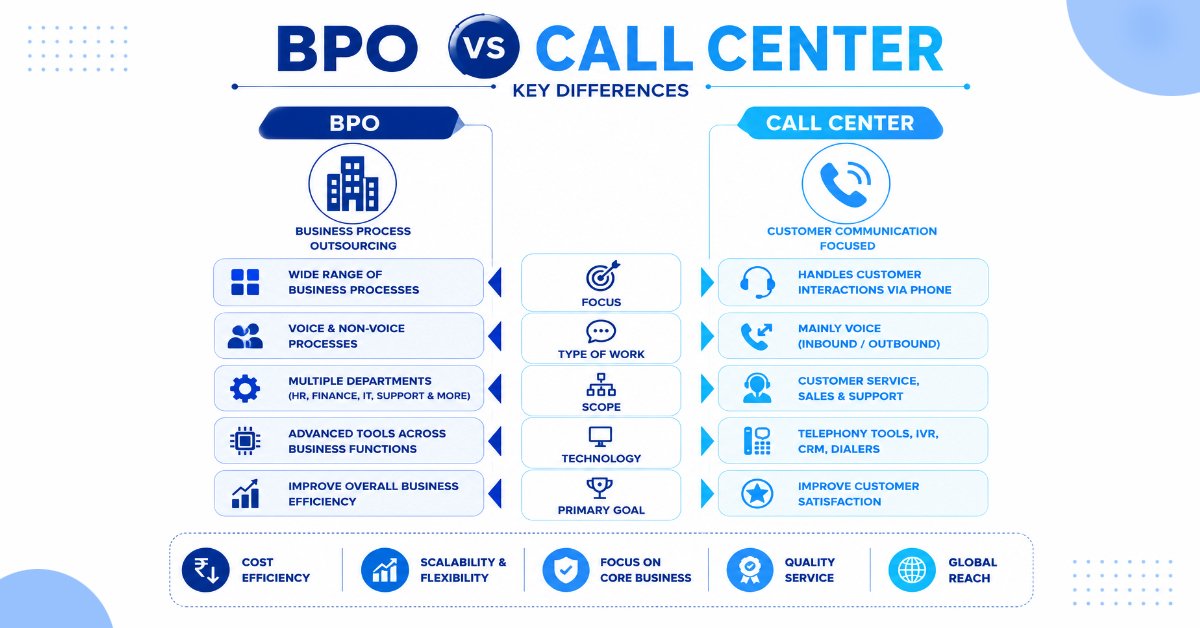
While both models support business operations, understanding BPO vs Call Center becomes much easier when you compare them across practical business scenarios.
Key Differences Between BPO and Call Center
Quick Answer
Although call centers are often part of BPO operations, they differ significantly in scope, responsibilities, technologies, and business objectives.
1. Scope of Services
A call center concentrates on customer communication through phone calls.
A BPO manages a much broader range of business operations, including customer service, accounting, HR, finance, IT support, procurement, data processing, and document management.
Example
A retailer may outsource its customer helpline to a call center, while outsourcing payroll, inventory data processing, and invoice management to a BPO provider.
Key Takeaway: BPO covers entire business functions, whereas a call center specializes in voice-based customer interactions.
2. Business Objective
The primary goal of a call center is to improve customer communication and resolve inquiries efficiently.
A BPO aims to optimize business operations, reduce costs, improve productivity, and support long-term business growth.
Example
A software company may use a call center to answer customer support calls but rely on a BPO partner to handle finance, HR, and technical back-office operations.
Key Takeaway: Call centers improve customer experience; BPOs improve overall business performance.
3. Types of Work Performed
Call center agents mainly perform voice-based tasks such as customer support, sales, collections, and technical assistance.
BPO professionals may work on voice processes as well as non-voice activities like payroll processing, claims management, document verification, data analysis, and email support.
Example
A healthcare organization may outsource appointment scheduling through a call center while using a BPO team for medical billing and insurance claims processing.
Key Takeaway: BPO includes both customer-facing and back-office work, while call centers focus primarily on phone interactions.
4. Customer Interaction
A call center is designed primarily for direct interaction with customers through inbound and outbound phone calls.
A BPO may involve direct customer communication, but many of its services are performed behind the scenes without any customer interaction. Back-office BPO teams often handle administrative, financial, and operational tasks that support the business internally.
Example
A customer calls an insurance company to report a claim. The call center agent records the complaint and provides initial assistance, while a BPO team verifies documents, processes the claim, and updates internal records.
Key Takeaway: Call centers focus on direct customer communication, whereas BPOs can manage both customer-facing and back-office operations.
5. Communication Channels
A call center mainly communicates with customers through telephone calls, including inbound and outbound voice support.
A BPO supports multiple communication channels depending on the services being outsourced. These may include phone calls, email, live chat, social media, customer portals, and other digital communication platforms.
Example
An e-commerce company receives customer inquiries through phone calls, email, and live chat. A BPO provider manages all these channels, while a traditional call center primarily handles voice calls.
Key Takeaway: Call centers mainly specialize in voice communication, while BPOs provide support across multiple communication channels.
6. Required Skills
A call center requires employees to have strong communication, listening, customer service, and problem-solving skills.
A BPO requires these skills as well, but many roles also demand specialized knowledge in areas such as finance, accounting, human resources, IT support, healthcare, legal services, or data analysis, depending on the process being handled.
Example
A technical support executive in a call center needs excellent communication and troubleshooting skills, whereas a payroll executive in a BPO requires knowledge of payroll systems, taxation, and compliance.
Key Takeaway: Call center roles focus mainly on communication skills, while BPO roles often require additional functional or technical expertise.
7. Technology Used
A call center relies on communication technologies that help agents manage customer conversations efficiently.
A BPO uses a broader range of business technologies, including Customer Relationship Management (CRM) software, Enterprise Resource Planning (ERP) systems, workflow automation, Robotic Process Automation (RPA), artificial intelligence, and analytics platforms to manage various business processes.
Example
A telecom call center uses IVR and automatic call distribution systems to route customer calls, while a finance BPO uses workflow automation software to process invoices and maintain financial records.
Key Takeaway: Call centers use technology focused on customer communication, whereas BPOs use technology to manage complete business operations.
8. Business Functions Covered
A call center mainly handles customer-facing functions such as customer support, sales, technical assistance, and telemarketing.
A BPO covers a much wider range of business functions, including customer service, finance and accounting, payroll, human resources, procurement, IT support, data processing, compliance, and document management.
Example
A manufacturing company outsources its customer helpline to a call center while relying on a BPO provider to manage payroll, procurement, invoice processing, and employee records.
Key Takeaway: Call centers focus on customer communication, whereas BPOs support multiple business departments under one outsourcing model.
9. Career Opportunities
A call center offers career opportunities mainly in customer service, technical support, sales, quality assurance, training, and operations management.
A BPO provides a wider range of career paths across customer support, finance, HR, IT services, business analytics, healthcare processing, legal support, and project management, allowing professionals to specialize in different domains.
Example
A graduate may begin as a customer service executive in a call center and later become a team leader. In a BPO, the same individual could transition into HR, finance, business analytics, or operations management based on experience and skills.
Key Takeaway: Both industries offer strong career growth, but BPOs provide broader opportunities for specialization and long-term career development.
10. Business Use Cases
A call center is the right choice for businesses that primarily need customer support, technical assistance, sales campaigns, or telemarketing services.
A BPO is more suitable for organizations that want to outsource multiple operational functions such as payroll, accounting, HR, finance, IT support, customer service, and back-office processing to improve overall efficiency.
Example
A startup may initially outsource only its customer support to a call center. As the company grows, it may partner with a BPO provider to manage payroll, accounting, HR, and other administrative operations while continuing to use the call center for customer communication.
Key Takeaway: Choose a call center when your primary need is customer communication, and choose a BPO when you want to outsource multiple business processes under one provider.
Similarities Between BPO and Call Center
Quick Answer
Although BPOs and call centers are different, they share the common goal of helping businesses operate more efficiently and deliver better customer experiences. In many organizations, a call center functions as one service within a broader BPO operation.
Key Similarities
- Both support business operations.
- Both aim to improve customer satisfaction.
- Both help companies reduce operational costs.
- Both use modern technologies such as CRM, cloud platforms, and AI tools.
- Both rely on trained professionals and standardized workflows.
- Both measure performance using Key Performance Indicators (KPIs) and Service Level Agreements (SLAs).
Real Example
A telecom company may outsource customer calls to a call center while using the same BPO provider for billing, customer verification, and back-office processing. Both teams work together to deliver a seamless customer experience.
Key Takeaway
A call center and a BPO often complement each other rather than compete with each other.
Types of BPO
Quick Answer
BPO services can be categorized based on the type of business function being outsourced. Each type helps organizations improve efficiency in a specific area.
1. Front Office BPO
Definition
Front Office BPO focuses on activities that involve direct interaction with customers.
These services typically include:
- Customer support
- Technical support
- Sales
- Appointment scheduling
- Live chat
- Email support
Real Example
An online retailer outsources its customer support team to handle product inquiries, order tracking, and return requests.
Advantages
- Improves customer satisfaction
- Provides multilingual support
- Extends service hours
- Enhances customer engagement
Key Takeaway
Front Office BPO improves the customer experience by handling customer-facing activities professionally.
2. Back Office BPO
Definition
Back Office BPO manages internal administrative and operational tasks that customers rarely see but are essential for running a business.
Common services include:
- Payroll processing
- Data entry
- Accounting
- Invoice processing
- Procurement support
- Document management
- Compliance support
Real Example
A manufacturing company outsources payroll processing and accounts payable to a specialized BPO provider.
Advantages
- Reduces administrative workload
- Improves operational accuracy
- Saves time
- Lowers operating costs
Key Takeaway
Back Office BPO keeps business operations running smoothly behind the scenes.
3. Knowledge Process Outsourcing (KPO)
Definition
Knowledge Process Outsourcing involves specialized work that requires professional expertise and analytical skills.
Typical KPO services include:
- Financial analysis
- Market research
- Investment research
- Business analytics
- Data science
- Legal research
- Healthcare research
Real Example
An investment firm outsources market research reports to analysts with industry expertise.
Advantages
- Access to specialized talent
- Better business insights
- Higher-quality decision-making
- Reduced research costs
Key Takeaway
KPO focuses on knowledge-intensive tasks rather than routine operational work.
4. Legal Process Outsourcing (LPO)
Definition
Legal Process Outsourcing involves outsourcing legal support services to qualified professionals.
Typical services include:
- Contract review
- Legal documentation
- Litigation support
- Compliance research
- Intellectual property documentation
Real Example
A multinational company outsources contract management to a legal services provider to improve efficiency.
Advantages
- Reduces legal expenses
- Improves document accuracy
- Provides access to legal expertise
- Helps manage large document volumes
Key Takeaway
LPO allows organizations to handle legal work more efficiently without expanding in-house legal teams.
5. Human Resource Outsourcing (HRO)
Definition
Human Resource Outsourcing involves delegating HR-related functions to external service providers.
Common HR services include:
- Recruitment support
- Payroll administration
- Employee onboarding
- Benefits administration
- Performance management support
- HR compliance
Real Example
A fast-growing startup outsources payroll and employee onboarding so its leadership team can focus on product development and business growth.
Advantages
- Saves HR costs
- Improves compliance
- Simplifies hiring
- Allows HR teams to focus on strategic initiatives
Key Takeaway
HRO helps businesses manage their workforce more efficiently while reducing administrative overhead.
Summary of BPO Types
| BPO Type | Primary Focus | Common Services | Best For |
| Front Office BPO | Customer interaction | Customer service, sales, technical support | Improving customer experience |
| Back Office BPO | Internal operations | Payroll, accounting, data processing | Operational efficiency |
| KPO | Specialized expertise | Research, analytics, consulting | Knowledge-intensive work |
| LPO | Legal services | Contracts, litigation support, compliance | Legal process management |
| HRO | Human resources | Recruitment, payroll, onboarding | Workforce management |
Key Takeaway
Different BPO models solve different business challenges. Choosing the right one depends on the specific processes a company wants to outsource.
Types of Call Centers
Quick Answer
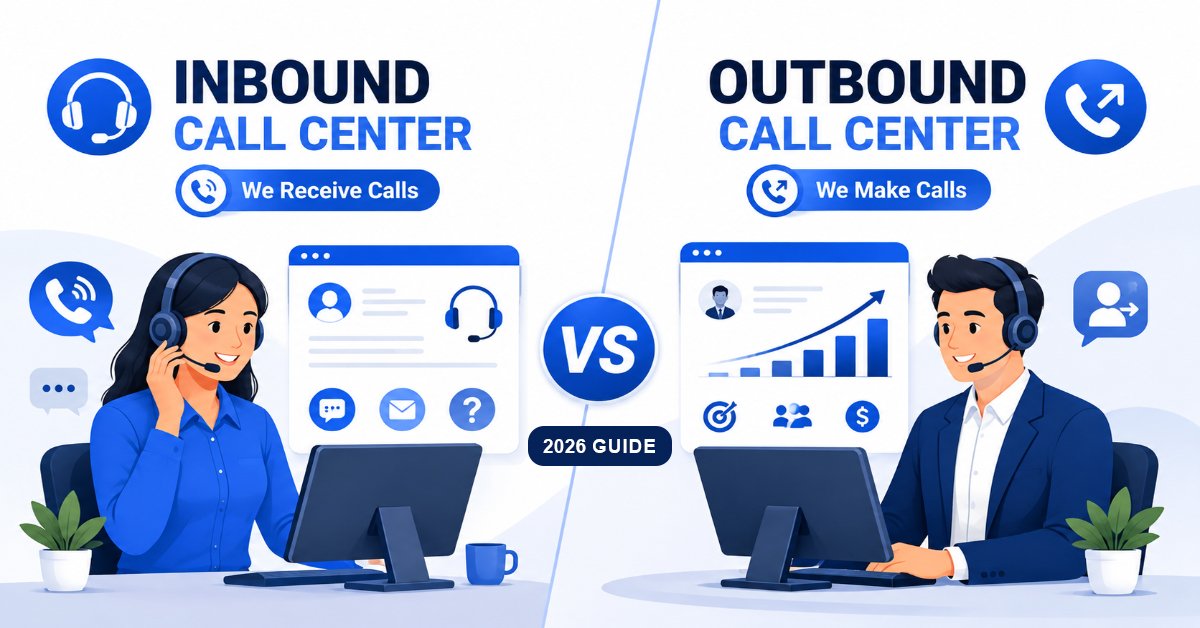
Call centers are generally classified by the type of customer interactions they manage. The four most common types are inbound, outbound, blended, and virtual call centers.
1. Inbound Call Center
Definition
An inbound call center receives calls initiated by customers.
Common services include:
- Customer support
- Billing assistance
- Technical support
- Product inquiries
- Complaint resolution
Business Scenario
A broadband provider receives calls from customers experiencing internet connectivity issues. Agents troubleshoot problems and, if needed, schedule technician visits.
Advantages
- Improves customer satisfaction
- Faster issue resolution
- Better customer retention
- Enhances brand trust
Key Takeaway
Inbound call centers are designed to help customers rather than sell to them.
2. Outbound Call Center
Definition
An outbound call center makes calls to customers or prospects.
Typical activities include:
- Sales campaigns
- Appointment reminders
- Customer surveys
- Payment reminders
- Lead generation
- Renewal calls
Business Scenario
A bank contacts customers whose credit cards are about to expire and offers renewal assistance.
Advantages
- Increases sales opportunities
- Supports marketing campaigns
- Strengthens customer relationships
- Improves customer engagement
Key Takeaway
Outbound call centers focus on proactive customer communication.
3. Blended Call Center
Definition
A blended call center handles both incoming and outgoing calls using the same team or integrated workforce.
Business Scenario
A telecommunications company answers customer support calls while also contacting customers about service upgrades or feedback surveys.
Advantages
- Better resource utilization
- Increased operational flexibility
- Improved customer experience
- Higher productivity
Key Takeaway
Blended call centers provide a balanced approach by supporting both service and sales functions.
4. Virtual Call Center
Definition
A virtual call center allows agents to work remotely using cloud-based communication platforms instead of a centralized office.
Business Scenario
An online software company employs support agents across different cities and countries, enabling 24/7 customer assistance through a cloud contact center platform.
Advantages
- Lower infrastructure costs
- Easier hiring from a broader talent pool
- Business continuity during disruptions
- Flexible workforce management
Key Takeaway
Virtual call centers make customer support more scalable and location-independent.
Comparison of Call Center Types
| Type | Primary Purpose | Customer Interaction | Best Use Case |
| Inbound | Customer support | Incoming calls | Technical support, customer service |
| Outbound | Sales and outreach | Outgoing calls | Marketing, collections, lead generation |
| Blended | Service + sales | Incoming & outgoing | Businesses needing both support and outreach |
| Virtual | Remote operations | Cloud-based communication | Distributed teams and global support |
Real-World Examples
Quick Answer
Many well-known organizations use outsourcing to support business operations. The exact outsourcing arrangements may vary over time, but the following examples illustrate common industry practices rather than company-specific contractual relationships.
Note: These examples describe typical use cases in the industry and should not be interpreted as confirmation of any specific outsourcing partnership unless publicly documented.
Amazon
Amazon handles millions of customer interactions every day.
Common outsourcing use cases include:
- Customer service during peak shopping seasons
- Email and chat support
- Order tracking assistance
- Technical support for devices and services
At the same time, Amazon also relies on extensive in-house teams for many business functions.
Flipkart
As a major e-commerce platform, Flipkart experiences significant spikes in customer inquiries during large sales events.
Typical outsourced activities may include:
- Customer support
- Returns assistance
- Delivery-related inquiries
- Live chat support
This helps maintain service quality during periods of high demand.
Airtel
Telecommunications providers often receive high volumes of customer requests.
Common support functions include:
- Billing inquiries
- SIM activation guidance
- Technical troubleshooting
- Plan information
- Complaint registration
Some customer support operations may be managed through outsourced service providers while strategic functions remain in-house.
Jio
Jio serves millions of mobile and broadband users.
Typical outsourcing use cases include:
- Customer care
- Technical assistance
- Complaint management
- Sales support
- Customer verification
Outsourcing helps organizations scale support efficiently during periods of rapid growth.
HDFC Bank
Banks manage large volumes of customer interactions every day.
Common outsourcing functions across the banking industry include:
- Customer helplines
- Card support
- Loan inquiry assistance
- Document verification
- Back-office processing
- Customer onboarding support
Highly regulated activities continue to follow strict compliance and security requirements.
IBM
IBM is both a technology company and a provider of business consulting and managed services.
Organizations may work with companies like IBM for:
- IT support
- Infrastructure management
- Business consulting
- Digital transformation
- Managed business services
This illustrates that modern BPO extends far beyond customer service.
Key Takeaway
Large organizations often combine internal teams with specialized outsourcing partners to improve efficiency, scalability, and customer service.
Advantages of BPO
Quick Answer
BPO enables businesses to improve efficiency, reduce operational complexity, and access specialized expertise without significantly increasing internal resources.
1. Cost Optimization
Businesses can reduce expenses related to hiring, office space, technology, and training by outsourcing suitable business processes.
2. Access to Skilled Professionals
BPO providers specialize in particular business functions and often employ experienced teams with industry-specific expertise.
3. Scalability
Organizations can quickly increase or decrease service capacity based on seasonal demand, business growth, or changing customer requirements.
4. Faster Business Operations
Dedicated teams and standardized workflows help improve turnaround times for routine tasks.
5. Focus on Core Competencies
By outsourcing administrative or repetitive work, companies can dedicate more time and resources to innovation, product development, and strategic planning.
6. Access to Modern Technology
Many BPO providers invest in cloud platforms, automation tools, analytics, and AI solutions that may otherwise require substantial investment.
7. Improved Customer Experience
Well-trained outsourcing teams can provide multilingual support, extended service hours, and standardized service quality.
Key Takeaway
BPO is most valuable when businesses want to improve operational efficiency while concentrating on long-term growth.
Advantages of Call Centers
Quick Answer
Call centers help businesses provide timely, consistent, and professional customer communication, strengthening customer relationships and improving service quality.
1. Faster Customer Support
Customers receive assistance through dedicated teams trained to resolve issues efficiently.
2. Improved Customer Satisfaction
Prompt responses and effective issue resolution contribute to a better overall customer experience.
3. Better Sales Opportunities
Outbound call centers support lead generation, product promotions, and customer retention campaigns.
4. Consistent Communication
Standardized scripts, quality monitoring, and agent training help ensure consistent customer interactions.
5. Performance Monitoring
Managers can evaluate metrics such as response time, call quality, and first-call resolution to identify areas for improvement.
6. Flexible Operations
Modern cloud-based call centers make it easier to expand support teams and provide services across multiple time zones.
Key Takeaway
A call center is the right choice when customer communication is the primary operational requirement.
How to Choose Between a BPO and a Call Center
Quick Answer
Choose based on the business functions you want to outsource. If you only need customer communication, a call center may be enough. If you want to outsource multiple operational processes, a BPO is usually the better option.
Choose a Call Center If…
- You primarily need phone-based customer support.
- Your business receives a high volume of customer calls.
- You want help with sales campaigns or lead generation.
- Technical support over the phone is your main requirement.
- Most customer interactions occur through voice communication.
Choose a BPO If…
- You want to outsource multiple business functions.
- You need both voice and non-voice support.
- Payroll, accounting, HR, or data processing consume too many internal resources.
- Your company is expanding rapidly and needs scalable operational support.
- You want access to specialized expertise across different business areas.
Choose Both If…
Many medium and large businesses benefit from combining both models.
For example:
- A dedicated call center manages customer communication.
- A BPO provider handles finance, HR, document processing, compliance support, and back-office operations.
This combination allows organizations to deliver excellent customer service while maintaining efficient internal processes.
Decision Framework
| Your Business Need | Best Choice | Why |
| Customer support only | Call Center | Specialized in handling customer calls |
| Technical phone support | Call Center | Voice-based expertise |
| Sales campaigns | Call Center | Optimized for outbound communication |
| Payroll and accounting | BPO | Back-office specialization |
| HR management | BPO | Administrative expertise |
| Data processing | BPO | Efficient non-voice operations |
| Multiple business functions | BPO | Comprehensive outsourcing solution |
| Customer support + operations | Both | End-to-end business support |
Key Takeaway
The best choice depends on your business objectives, not on which model is “better” overall.
Which One Is Better for Business?
Quick Answer
Neither is universally better. The right solution depends on your company’s size, operational complexity, and long-term goals.
Business Size Recommendations
| Business Size | Recommended Solution | Why |
| Small Businesses | Call Center (or a small BPO for selected tasks) | Cost-effective customer support without outsourcing unnecessary functions |
| Growing Companies | BPO + Call Center | Supports expansion by combining customer service with operational efficiency |
| Large Enterprises | Comprehensive BPO with integrated call center services | Scalable support across multiple departments and regions |
Small Businesses
Small businesses often have limited budgets and lean teams. Outsourcing customer support through a call center—or selectively outsourcing back-office tasks to a BPO—can improve service quality without requiring major investments.
Growing Companies
As operations expand, administrative work also increases. A broader BPO partnership can manage HR, payroll, finance, and customer support, allowing leadership to focus on scaling the business.
Large Enterprises
Large organizations usually require a combination of customer communication, operational support, analytics, compliance, and technology integration. Comprehensive BPO solutions with integrated call center capabilities often provide the flexibility and scale these businesses need.
Key Takeaway
Choose the outsourcing model that aligns with your current business needs while leaving room for future growth.
Career Opportunities in BPO and Call Centers
Quick Answer
Both BPO and call center industries offer excellent career opportunities for freshers and experienced professionals. While call center roles typically focus on customer communication, BPO careers span a much wider range of business functions, including finance, HR, IT support, data processing, and operations.
Key Points
- Suitable for freshers and graduates.
- Opportunities in voice and non-voice processes.
- Career growth into leadership and specialized roles.
- Demand continues to grow with digital transformation and global outsourcing.
Real Example
A graduate may start as a customer service executive in a call center, become a team leader within a few years, and later transition into operations management or quality assurance within a larger BPO organization.
Key Takeaway
BPO careers offer broader specialization, while call centers are often an excellent starting point for building communication and customer service skills.
Understanding BPO vs Call Center can also help job seekers choose a career path that matches their skills, interests, and long-term goals.
Common BPO Jobs
Popular BPO roles include:
- Customer Support Executive
- Technical Support Executive
- Data Entry Specialist
- Payroll Executive
- HR Associate
- Finance & Accounting Executive
- Claims Processing Executive
- Medical Billing Specialist
- Email Support Executive
- Chat Support Executive
- Quality Analyst (QA)
- Workforce Management Executive
- Business Analyst
- Operations Executive
Common Call Center Jobs
Typical call center positions include:
- Customer Service Representative (CSR)
- Call Center Agent
- Technical Support Agent
- Sales Executive
- Telemarketing Executive
- Collections Executive
- Customer Success Associate
- Team Leader
- Quality Analyst
- Trainer
- Operations Manager
Skills Required
Employers usually look for candidates with a combination of technical and soft skills.
Technical Skills
- Basic computer knowledge
- CRM software familiarity
- MS Office
- Email communication
- Typing skills
- Problem-solving ability
Soft Skills
- Communication skills
- Active listening
- Patience
- Empathy
- Teamwork
- Time management
- Conflict resolution
- Adaptability
Career Growth
Career progression is generally performance-based.
A common career path looks like this:
Customer Support Executive
⬇
Senior Executive
⬇
Team Leader
⬇
Assistant Manager
⬇
Operations Manager
⬇
Senior Operations Manager
⬇
Business Unit Head
Professionals can also move into:
- Quality Assurance
- Training
- Workforce Management
- Business Analytics
- Process Excellence
- Client Relationship Management
Salary Comparison in India
Note: Salaries vary depending on the city, company, experience, industry, language skills, and process type. The figures below are approximate annual salary ranges.
| Role | Approximate Salary (India) |
| Customer Support Executive | ₹2.2–4.0 lakh per year |
| Technical Support Executive | ₹3–5.5 lakh per year |
| Chat/Email Support Executive | ₹2.5–4.5 lakh per year |
| Team Leader | ₹5–8 lakh per year |
| Quality Analyst | ₹4.5–8 lakh per year |
| Trainer | ₹4.5–8 lakh per year |
| Operations Manager | ₹8–18 lakh per year |
| Business Analyst | ₹6–15 lakh per year |
Key Takeaway
The outsourcing industry offers multiple career paths, and employees can transition from customer-facing roles to management or specialized operational positions with experience and skill development.
Future of BPO and Call Centers
Quick Answer
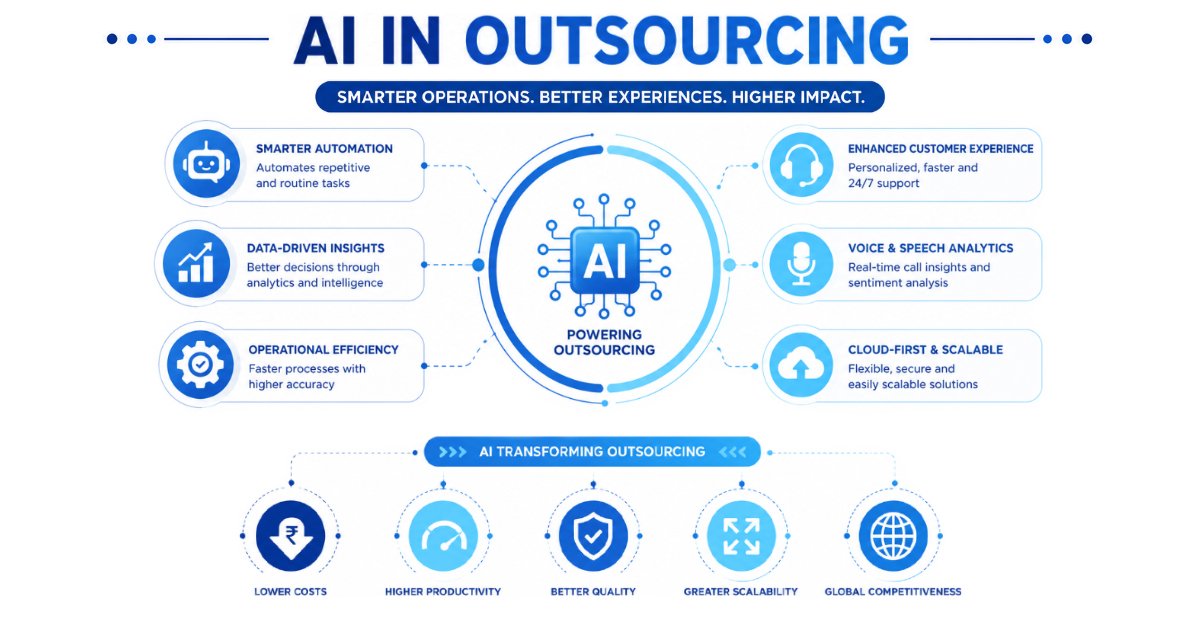
The future of BPO and call centers is not about replacing people with AI—it’s about combining human expertise with intelligent technology to deliver faster, more personalized, and more efficient services.
Key Points
- AI will automate repetitive tasks.
- Human agents will handle complex interactions.
- Cloud-based platforms will become the standard.
- Data-driven decision-making will increase.
- New digital skills will be more valuable than ever.
Artificial Intelligence (AI)
AI helps automate routine customer interactions, summarize conversations, and recommend solutions to agents.
Example:
An AI assistant can instantly retrieve customer history before an agent answers the call.
Automation
Routine tasks like invoice processing, ticket routing, and document verification can now be automated, reducing manual effort and improving accuracy.
Voice AI
Voice AI enables systems to understand spoken language and answer simple customer queries without human intervention.
Typical uses include:
- Appointment confirmations
- Balance inquiries
- Order status updates
- Call routing
Chatbots
Modern chatbots can answer frequently asked questions through websites, apps, and messaging platforms.
They also transfer complex cases to human agents when needed.
Speech Analytics
Speech analytics tools analyze customer conversations to identify:
- Customer sentiment
- Frequently reported issues
- Compliance risks
- Agent coaching opportunities
Cloud Contact Centers
Cloud technology allows support teams to work from virtually anywhere while providing secure access to customer information and communication tools.
Benefits include:
- Easy scalability
- Remote work
- Faster deployment
- Lower infrastructure costs
Agent Assist
Instead of replacing customer service representatives, Agent Assist tools provide real-time suggestions during customer conversations.
These tools can:
- Recommend answers
- Search knowledge bases
- Summarize calls
- Generate follow-up notes
Future Skills Professionals Should Learn
To remain competitive, professionals should develop skills in:
- AI-assisted customer service
- Digital communication
- Data analysis
- CRM platforms
- Cloud-based collaboration tools
- Business analytics
- Emotional intelligence
- Critical thinking
- Cybersecurity awareness
Key Takeaway
The future belongs to professionals who can effectively combine technical skills with strong communication and problem-solving abilities.
Common Myths About BPO and Call Centers
Quick Answer
Many misconceptions about the outsourcing industry are outdated. Today’s BPOs and call centers use advanced technology, provide diverse career opportunities, and support critical business operations.
Myth 1: BPO and Call Centers Are Exactly the Same
Reality: A call center is only one type of BPO service. BPO includes many non-customer-facing business functions.
Myth 2: Every BPO Job Involves Taking Calls
Reality: Many BPO roles focus on email support, finance, HR, data processing, analytics, and IT services without any phone interaction.
Myth 3: Outsourcing Is Only About Saving Money
Reality: Businesses also outsource to improve service quality, gain specialized expertise, increase scalability, and accelerate digital transformation.
Myth 4: AI Will Eliminate All BPO Jobs
Reality: AI automates repetitive tasks, but human judgment, empathy, and complex problem-solving remain essential.
Myth 5: Call Centers Only Handle Customer Complaints
Reality: They also manage technical support, sales, appointment scheduling, customer onboarding, renewals, surveys, and many other customer interactions.
Myth 6: BPO Careers Offer No Long-Term Growth
Reality: Many professionals build successful careers in operations, quality assurance, analytics, training, consulting, and senior leadership after starting in entry-level roles.
Key Takeaway
Understanding the realities of modern outsourcing helps businesses make better decisions and helps job seekers identify valuable career opportunities.
Expert Tips Before Choosing a BPO or Call Center
Expert Tips
Before selecting an outsourcing partner, consider the following recommendations:
- Clearly define the business processes you want to outsource.
- Choose a provider with experience in your industry.
- Verify security certifications and data protection practices.
- Review Service Level Agreements (SLAs) carefully.
- Ask about disaster recovery and business continuity plans.
- Evaluate technology capabilities, including AI and cloud platforms.
- Start with a pilot project before committing to large-scale outsourcing.
- Monitor performance regularly using measurable KPIs.
- Maintain open communication with your outsourcing partner.
- Focus on long-term value instead of choosing solely based on the lowest price.
Key Takeaway
A successful outsourcing relationship depends on careful planning, realistic expectations, and continuous performance monitoring.
Common Mistakes Businesses Make
Businesses often fail to achieve the expected results because of avoidable mistakes.
Some of the most common include:
- Outsourcing without clearly defined objectives.
- Choosing a provider based only on price.
- Ignoring data security and compliance requirements.
- Setting unrealistic performance expectations.
- Providing inadequate training and documentation.
- Failing to establish clear communication channels.
- Not reviewing KPIs and customer feedback regularly.
- Treating outsourcing as a one-time project rather than an ongoing partnership.
Key Takeaway
Successful outsourcing requires strategic planning, collaboration, and continuous improvement—not simply transferring work to another company.
Decision Checklist
Use this checklist before choosing between a BPO and a call center.
✅ Do you only need customer phone support?
✅ Do you also need payroll, HR, accounting, or data processing?
✅ Is customer experience your primary business priority?
✅ Do you expect seasonal increases in customer demand?
✅ Have you defined measurable KPIs and SLAs?
✅ Does the provider have relevant industry experience?
✅ Have you reviewed their security and compliance standards?
✅ Can their services scale as your business grows?
If you answered “yes” to most of the operational questions, a BPO may be the better choice. If your primary requirement is handling customer calls efficiently, a call center may be sufficient.
Frequently Asked Questions (FAQs)
1. What is the main difference between a BPO and a call center?
A BPO manages a wide range of business processes, including customer support, finance, HR, and data processing, while a call center primarily handles inbound and outbound customer phone interactions.
2. Is every call center a BPO?
Not necessarily. Some call centers operate independently, while others function as one department within a larger BPO organization.
3. Which is better for small businesses: a BPO or a call center?
If your main requirement is customer support, a call center may be sufficient. If you want to outsource multiple operational functions, a BPO is generally a better option.
4. Are BPO jobs and call center jobs the same?
No. Call center jobs focus mainly on voice-based customer communication, while BPO jobs also include non-voice roles such as finance, HR, data processing, analytics, and IT support.
5. What is the difference between voice and non-voice processes?
Voice processes involve direct communication through phone calls, whereas non-voice processes include email support, live chat, document processing, payroll, and data entry.
6. Can a company use both a BPO and a call center?
Yes. Many organizations combine both to manage customer interactions while outsourcing additional business functions such as accounting, HR, and back-office operations.
7. Does AI replace call center agents?
AI automates repetitive tasks and assists agents with routine queries, but human representatives remain essential for handling complex issues, empathy, and decision-making.
8. Is the BPO industry growing?
Yes. Global demand for outsourcing continues to grow as businesses increasingly adopt cloud technologies, AI, automation, and digital transformation to improve efficiency and customer experience.
Conclusion
Understanding the difference between BPO vs Call Center is essential for anyone exploring outsourcing, preparing for interviews, or deciding how to improve business operations.
A call center specializes in customer communication through inbound and outbound calls, making it ideal for organizations that need efficient customer service, sales support, or technical assistance.
A BPO, on the other hand, provides a much broader range of services. In addition to customer support, it can manage payroll, finance, HR, IT support, data processing, compliance, and many other operational functions. This broader scope makes BPO an effective solution for businesses looking to improve efficiency and focus on their core competencies.
Neither model is universally better. The right choice depends on your business goals, operational requirements, budget, and growth plans. Some organizations only need a dedicated call center, while others benefit from a full-service BPO. Many larger companies successfully combine both approaches to deliver excellent customer experiences while streamlining internal operations.
As AI, automation, and cloud technologies continue to evolve, the outsourcing industry will keep changing—but the importance of skilled professionals, strong customer relationships, and strategic business partnerships will remain constant.
Choose the solution that best supports your long-term objectives, rather than assuming one option is always superior.
Whether you’re a business owner, student, or job seeker, understanding BPO vs Call Center will help you make informed decisions and select the outsourcing model that best fits your needs.