- 1 Quick Answer
- 2 Why Trust This Guide
- 3 Introduction
- 4 Industry Adoption Snapshot
- 5 What Is an AI Agent?
- 6 How AI Agents Work
- 7 How Modern AI Agents Use LLMs, Memory, and Tool Calling
- 8 Components of a Modern AI Agent System
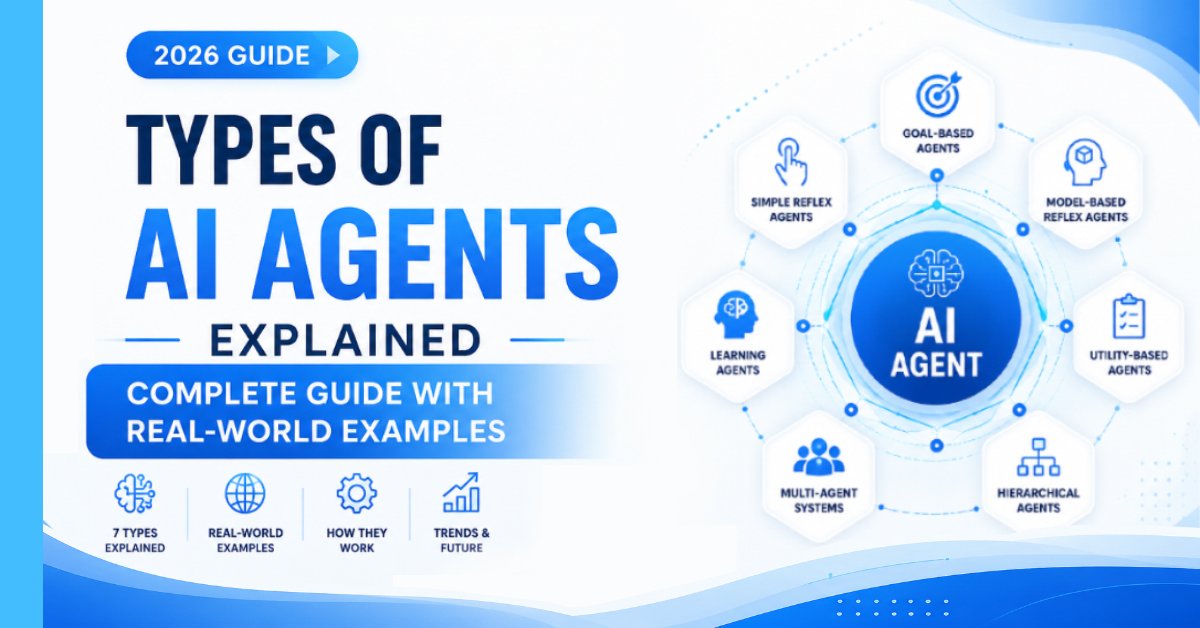
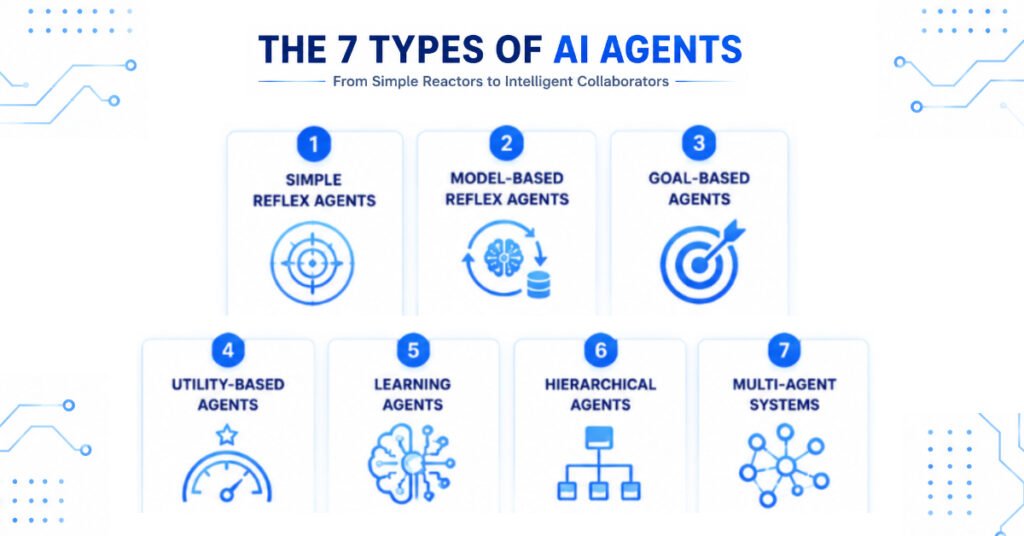
- 9 The 7 Main Types of AI Agents
- 10 AI Agents vs Chatbots
- 11 AI Agents vs AI Copilots vs LLMs
- 12 Real-World Applications of AI Agents
- 13 Real Workflow Example: How an AI Agent Handles an E-commerce Refund Request
- 14 The Rise of Agentic AI in 2026
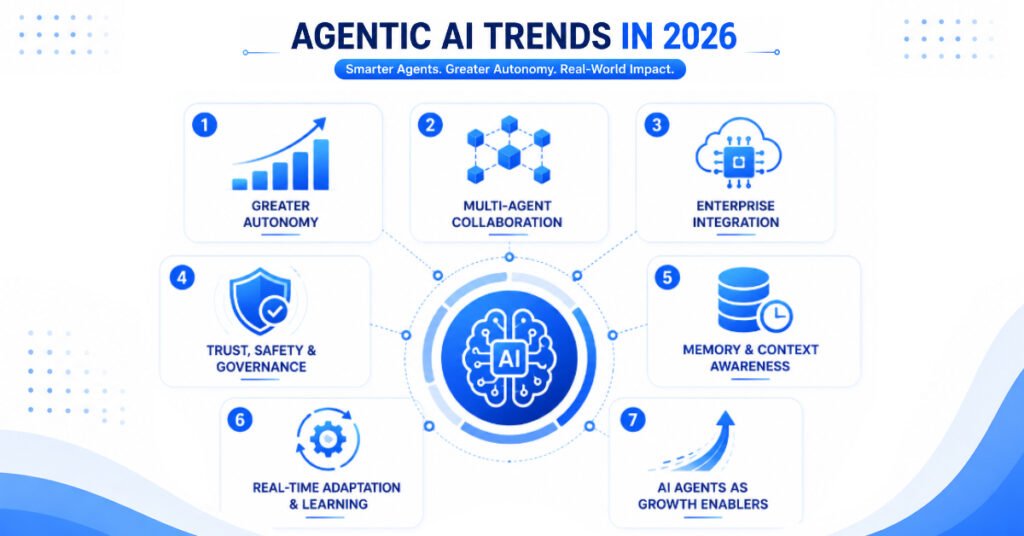
- 15 Emerging AI Agent Trends in 2026
- 16 Benefits of AI Agents
- 17 What We Learned From Testing AI Agents
- 18 Challenges and Limitations of AI Agents
- 19 Challenges Businesses Face When Implementing AI Agents
- 20 Comparison Table of AI Agent Types
- 21 How to Choose the Right AI Agent
- 22 Which Type of AI Agent Should Businesses Use?
- 23 How Beginners Can Start Learning AI Agents
- 24 Common AI Agent Misconceptions
- 25 Future of AI Agents
- 26 Expert Perspective: Why AI Agents Matter Now
- 27 Conclusion
- 28 Frequently Asked Questions (FAQ)
- 28.1 1. What are the main types of AI agents?
- 28.2 2. What is an AI agent in simple words?
- 28.3 3. What is the difference between AI agents and chatbots?
- 28.4 4. Which type of AI agent is the most advanced?
- 28.5 5. What industries use AI agents?
- 28.6 6. What is agentic AI?
- 28.7 7. Are AI agents dangerous?
- 28.8 8. How do learning agents improve over time?
- 28.9 9. What are real-world examples of AI agents?
- 28.10 10. Will AI agents replace human jobs?
- 28.11 11. Can AI agents work without LLMs?
- 28.12 12. Are AI agents expensive?
- 28.13 13. What programming languages are used for AI agents?
- 28.14 14. Can small businesses use AI agents?
- 28.15 15. What skills are required to build AI agents?
- 28.16 16. Are AI agents secure?
Quick Answer
AI agents are intelligent software systems that can observe their environment, make decisions, and take actions autonomously to achieve specific goals.
The seven major types of AI agents are:
- Simple Reflex Agents
- Model-Based Reflex Agents
- Goal-Based Agents
- Utility-Based Agents
- Learning Agents
- Hierarchical Agents
- Multi-Agent Systems
These AI agents are widely used in healthcare, finance, cybersecurity, robotics, e-commerce, enterprise automation, software development, and autonomous systems.
Why Trust This Guide
This guide combines research from industry reports, AI trends, enterprise workflow observations, and practical analysis of modern AI systems. The content has been reviewed to explain AI agents in beginner-friendly language while maintaining technical accuracy. The goal is to help beginners and professionals understand how AI agents work using practical examples, industry use cases, and current AI developments.
Introduction
Artificial intelligence is rapidly evolving from simple chatbots into autonomous systems capable of reasoning, planning, learning, and executing tasks with minimal human involvement.
Today’s AI systems can:
- generate software code
- automate workflows
- detect fraud
- analyze medical scans
- optimize supply chains
- coordinate robotics
- and act like intelligent digital coworkers
At the center of this transformation is a powerful concept known as the AI agent.
Unlike traditional software that only follows fixed instructions, AI agents can:
- observe environments
- analyze information
- make decisions
- use external tools
- remember context
- and improve performance over time
This shift is driving the rise of agentic AI — a new generation of intelligent systems designed to complete complex tasks autonomously.
For businesses, AI agents are becoming increasingly valuable because modern digital environments constantly change. Static automation systems often fail when unexpected situations occur, while adaptive AI agents can dynamically respond to new information in real time.
According to industry research from organizations like Gartner, McKinsey, and the Stanford AI Index, enterprise AI adoption continues accelerating as businesses invest heavily in intelligent automation and autonomous workflow systems.
Industry Adoption Snapshot
Recent industry reports indicate that AI adoption continues accelerating across industries as organizations move beyond experimental projects toward production-level systems and intelligent automation.
Research from the Stanford AI Index, McKinsey State of AI Report, and Gartner AI research suggests that businesses increasingly prioritize intelligent automation and AI-powered workflow systems.
- workflow automation
- customer service systems
- predictive analytics
- AI-powered decision-making
- autonomous operational tools
This shift is increasing demand for AI agents capable of reasoning, planning, and executing tasks with minimal human intervention.
What Is an AI Agent?
An AI agent is an intelligent system that can observe its environment, make decisions, and take actions to achieve a specific goal.
In simple terms, an AI agent acts like a digital decision-maker.
AI agents are often described as intelligent agents in AI because they can process information and respond dynamically to changing environments.
A typical AI agent can:
- collect information
- analyze situations
- evaluate possible actions
- choose the best response
- and execute tasks autonomously
Humans naturally follow a similar process every day.
For example:
- you see dark clouds
- your brain predicts rain
- you carry an umbrella
AI agents work similarly, except they rely on technologies such as:
- machine learning
- neural networks
- reasoning systems
- memory architectures
- reinforcement learning
- and data analysis algorithms
Modern AI agents are becoming increasingly advanced because they can:
- adapt to changing situations
- learn from experience
- automate complex workflows
- collaborate with other AI systems
- and interact with external software tools
This evolution is transforming AI from passive assistants into autonomous digital workers.
How AI Agents Work
Most AI agents follow a continuous operational cycle:
Observe → Analyze → Decide → Act → Learn
This process enables intelligent systems to interact dynamically with changing environments.
For example, imagine an AI customer support agent for an e-commerce company.
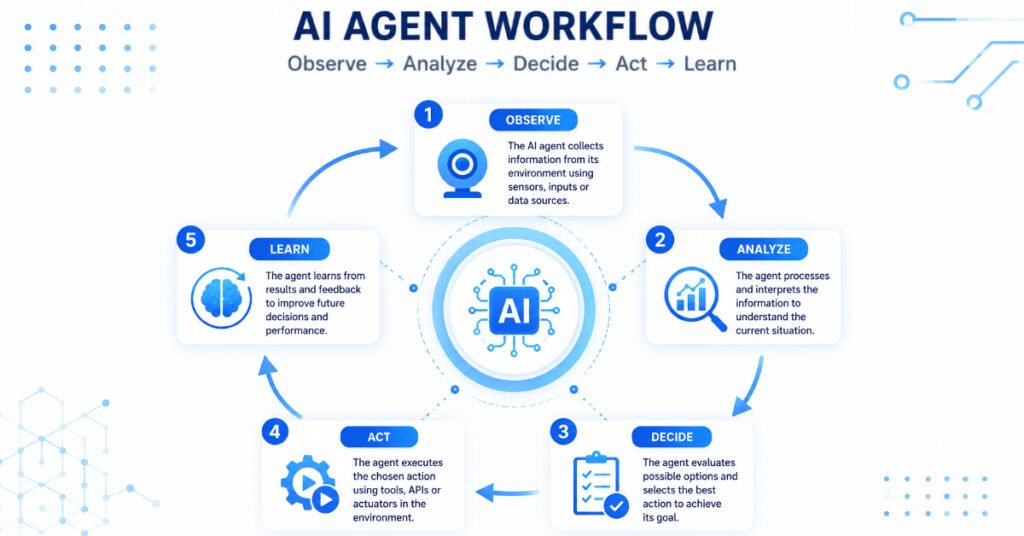
Step 1: Observe
The AI system receives a customer complaint regarding delayed shipping.
Step 2: Analyze
The agent examines:
- order status
- delivery timelines
- customer history
- shipping logistics
- and inventory information
Step 3: Decide
The system determines the best possible response based on available data.
Step 4: Act
The AI automatically sends tracking details, updates delivery estimates, and may even issue compensation.
Step 5: Learn
The interaction data is stored and analyzed to improve future customer support performance.
This entire workflow can happen within seconds.
That’s why businesses increasingly use AI agents for:
- intelligent automation
- fraud detection
- operational optimization
- cybersecurity monitoring
- predictive analytics
- and enterprise workflow orchestration
How Modern AI Agents Use LLMs, Memory, and Tool Calling
Modern AI agents are significantly more advanced than traditional automation software because they combine multiple AI technologies into unified intelligent systems.
Many advanced AI agents use large language models (LLMs) as their reasoning engine.
These systems can:
- understand natural language
- analyze context
- generate responses
- plan tasks
- and coordinate actions autonomously
However, modern AI agents are not powered by language models alone.
Modern AI reasoning systems increasingly combine memory, tools, and planning capabilities to improve AI decision-making models.
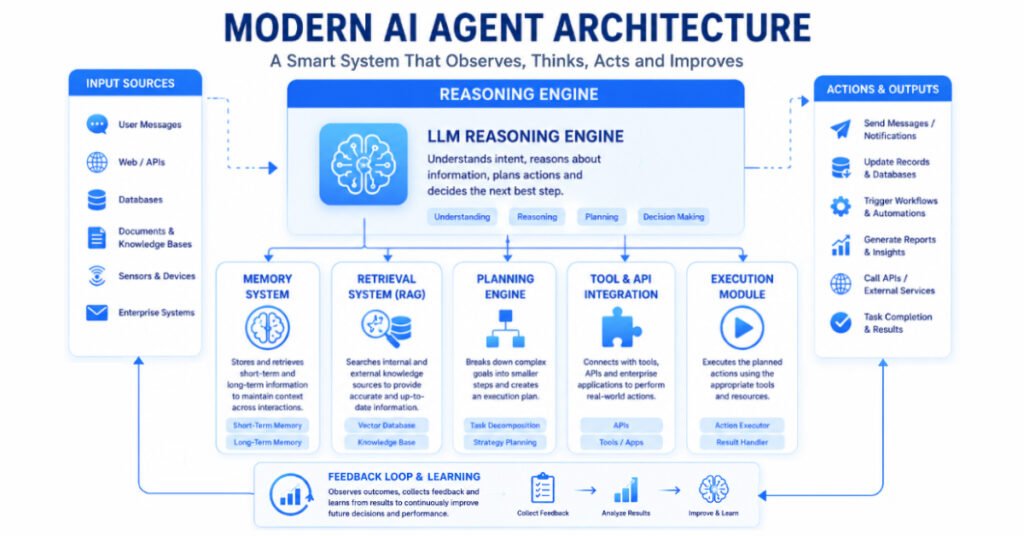
They often combine several advanced components:
Memory Systems
AI agents use short-term and long-term memory systems to retain information, maintain context, and improve continuity across tasks.
Tool Calling
Modern AI agents can interact with:
- APIs
- databases
- web search tools
- enterprise software
- calculators
- and automation platforms
This allows them to complete real-world tasks rather than simply generating text responses.
Planning Engines
Some AI agents break complex objectives into smaller actionable steps using planning frameworks and reasoning systems.
Retrieval Systems
Enterprise AI systems increasingly use retrieval-augmented generation (RAG) and vector databases to access updated external knowledge dynamically.
Multi-Agent Coordination
Advanced AI ecosystems may involve multiple specialized agents collaborating together to solve complex tasks efficiently.
This architecture is helping modern AI evolve beyond traditional chatbots toward autonomous workflow systems capable of executing sophisticated business operations.
Components of a Modern AI Agent System
Modern AI agents rarely rely on a single AI model. Instead, they operate as connected systems made of multiple components working together.
Think of it like a digital employee inside a company. One part thinks, another remembers information, another accesses tools, and another executes actions.
LLM Reasoning Engine
The reasoning engine acts as the brain of the AI agent.
It helps the system:
● understand user requests
● analyze context
● generate decisions
● plan next actions
For example, if a customer says:
“My order never arrived.”
The LLM interprets intent and determines what needs to happen next.
Memory Layer
Memory enables AI agents to maintain context across interactions.
Memory may include:
● customer history
● previous conversations
● user preferences
● task history
Without memory, every interaction starts from zero.
Planning Module
Complex goals often require multiple steps.
Planning systems help agents:
● divide tasks into smaller actions
● prioritize steps
● adjust strategies dynamically
For example, booking a trip may involve:
- searching flights
- comparing prices
- reserving hotels
- creating schedules
Retrieval System
AI knowledge can become outdated.
Retrieval systems help agents access:
● live company data
● documents
● databases
● web information
● knowledge bases
Many enterprise systems use Retrieval-Augmented Generation (RAG) to provide current information.
Tool Integration
AI agents increasingly interact with external systems.
Examples include:
● APIs
● CRM platforms
● payment systems
● search tools
● analytics dashboards
This turns AI from a text generator into an action-taking system.
Execution Layer
The execution layer performs actual actions.
Examples:
● sending emails
● updating records
● processing refunds
● creating reports
● scheduling meetings
Feedback Loop
Modern AI agents improve using feedback.
Feedback may come from:
● user ratings
● success metrics
● correction data
● operational outcomes
Over time, this helps the system become more accurate and efficient.
The 7 Main Types of AI Agents
Not all AI agents are equally intelligent.
Some follow simple predefined rules, while others can reason, learn continuously, optimize decisions, and collaborate with other AI systems.
Let’s explore the seven major types of AI agents.
1. Simple Reflex Agents
Definition
Simple reflex agents are the most basic form of AI agents.
They respond directly to specific conditions using predefined rules.
These systems:
- do not remember past events
- cannot learn from experience
- and react only to current inputs
How Simple Reflex Agents Work
They follow a condition-action model:
“If this happens, do that.”
Examples include:
- if motion is detected, turn on lights
- if spam keywords appear, filter the email
- if temperature rises, activate cooling systems
Advantages
- fast response times
- low computational cost
- easy implementation
- reliable for repetitive automation
Limitations
- no memory capability
- no learning ability
- poor adaptability
- limited intelligence
Real-World Examples
- smart thermostats
- automatic doors
- motion sensor lighting
- basic spam filters
Industries Using Simple Reflex Agents
- smart homes
- manufacturing
- retail security
- industrial automation
Expert Insight
Although simple reflex agents appear limited, they remain extremely important because lightweight automation systems power billions of IoT devices worldwide. In many industrial environments, reliability and speed are more valuable than advanced reasoning capabilities.
2. Model-Based Reflex Agents
Definition
Model-based reflex agents maintain an internal model of the environment.
Unlike simple reflex agents, they can remember information and use historical context during decision-making.
How Model-Based Reflex Agents Work
These systems:
- observe environments
- store internal data
- update contextual understanding
- and make decisions using both past and current information
Advantages
- improved environmental awareness
- better decision-making accuracy
- stronger navigation capabilities
- suitable for partially observable environments
Limitations
- more complex architecture
- increased computational requirements
- limited long-term strategic planning
Real-World Examples
- robot vacuum cleaners
- warehouse robots
- autonomous navigation systems
- self-driving vehicle mapping systems
Industries Using Model-Based Agents
- robotics
- transportation
- logistics
- warehouse automation
Expert Insight
Model-based agents are becoming increasingly important because real-world environments are unpredictable. Autonomous systems that rely only on immediate inputs often fail when visibility is incomplete or situations change unexpectedly.
3. Goal-Based Agents
Definition
Goal-based agents are designed to achieve specific objectives.
Instead of simply reacting to conditions, they evaluate multiple actions and select strategies that help accomplish defined goals.
How Goal-Based Agents Work
These agents:
- identify goals
- analyze possible actions
- predict outcomes
- and choose optimal strategies
They commonly use:
- search algorithms
- planning systems
- reasoning engines
- and decision trees
Advantages
- flexible decision-making
- strategic planning
- adaptive behavior
- effective problem-solving
Limitations
- slower processing for complex tasks
- higher resource usage
- dependency on clearly defined objectives
Real-World Examples
- GPS navigation systems
- AI scheduling assistants
- workflow automation platforms
- route optimization software
Industries Using Goal-Based Agents
- logistics
- project management
- transportation
- enterprise automation
Expert Insight
Goal-based agents are becoming foundational for agentic AI because businesses increasingly require systems capable of independently completing multi-step workflows rather than simply responding to commands.
4. Utility-Based Agents
Definition
Utility-based agents choose actions that maximize the best overall outcome.
Instead of merely achieving goals, these systems optimize decisions based on efficiency, risk, value, and probability.
How Utility-Based Agents Work
These systems evaluate:
- cost
- efficiency
- customer satisfaction
- probability of success
- and resource allocation
They use utility functions to score possible actions and determine optimal decisions.
Advantages
- optimized decision-making
- effective uncertainty handling
- strong resource management
- advanced analytical capabilities
Limitations
- difficult utility function design
- expensive computational requirements
- large data dependencies
Real-World Examples
- stock trading algorithms
- recommendation engines
- ride-sharing optimization systems
- dynamic pricing platforms
Industries Using Utility-Based Agents
- finance
- e-commerce
- healthcare analytics
- transportation
Expert Insight
Utility-based agents are increasingly valuable in industries where optimization directly impacts profitability. In areas like finance and logistics, even small efficiency improvements can generate massive economic benefits at scale.
5. Learning Agents
Definition
Learning agents improve performance continuously using experience, feedback, and data analysis.
These systems represent some of the most advanced AI architectures used today.
How Learning Agents Work
Learning agents:
- collect data
- identify patterns
- evaluate outcomes
- and improve future decisions
They commonly rely on:
- machine learning
- deep learning
- neural networks
- reinforcement learning
Advantages
- continuous improvement
- adaptability
- personalized experiences
- scalable intelligence
Limitations
- large training data requirements
- expensive infrastructure
- bias risks
- potential hallucinations
Real-World Examples
- fraud detection systems
- AI writing assistants
- predictive healthcare analytics
- streaming recommendation engines
Industries Using Learning Agents
- healthcare
- finance
- cybersecurity
- education
- e-commerce
- software development
Expert Insight
Learning agents are driving the current AI revolution because static automation systems cannot adapt fast enough in rapidly changing digital environments. Businesses increasingly prefer adaptive AI systems that continuously optimize themselves without requiring constant manual updates.
6. Hierarchical Agents
Definition
Hierarchical agents organize intelligence into multiple layers.
Higher-level agents manage strategy, while lower-level agents execute operational tasks.
How Hierarchical Agents Work
Higher-level systems:
- coordinate workflows
- allocate resources
- define strategic goals
Lower-level systems:
- execute actions
- monitor environments
- perform operational tasks
Advantages
- high scalability
- efficient coordination
- strong workflow management
- enterprise suitability
Limitations
- highly complex architecture
- communication overhead
- expensive maintenance
Real-World Examples
- enterprise workflow systems
- smart factory automation
- military defense coordination
- large-scale robotics management
Industries Using Hierarchical Agents
- manufacturing
- logistics
- infrastructure management
- robotics
Expert Insight
Hierarchical architectures are increasingly important because large enterprise AI ecosystems require coordination across multiple departments, systems, and operational layers simultaneously.
7. Multi-Agent Systems
Definition
Multi-agent systems involve multiple AI agents collaborating together to solve problems collectively.
Instead of relying on one centralized AI system, multiple specialized agents coordinate tasks dynamically.
How Multi-Agent Systems Work
Agents communicate to:
- exchange information
- coordinate actions
- optimize workflows
- and solve distributed problems collaboratively
This creates scalable collaborative intelligence.
Many organizations use AI orchestration techniques to coordinate autonomous software agents across large systems.
Advantages
- massive scalability
- parallel problem-solving
- specialized task handling
- resilient system architecture
Limitations
- synchronization complexity
- communication challenges
- cybersecurity risks
Real-World Examples
- smart traffic systems
- autonomous drone coordination
- warehouse robotics
- smart city infrastructure
Industries Using Multi-Agent Systems
- transportation
- robotics
- logistics
- cloud computing
- smart infrastructure
Expert Insight
Many researchers believe multi-agent systems represent the future of enterprise AI because no single AI model can efficiently manage every complex business process independently at global scale.
AI Agents vs Chatbots
Many people confuse AI agents with traditional chatbots.
However, modern AI agents are significantly more advanced.
| Feature | Traditional Chatbots | AI Agents |
| Primary Role | Answer questions | Complete tasks autonomously |
| Memory | Limited | Advanced contextual memory |
| Learning Ability | Minimal | Continuous learning |
| Decision-Making | Rule-based | Intelligent reasoning |
| Tool Usage | Rare | Common |
| Autonomy | Low | High |
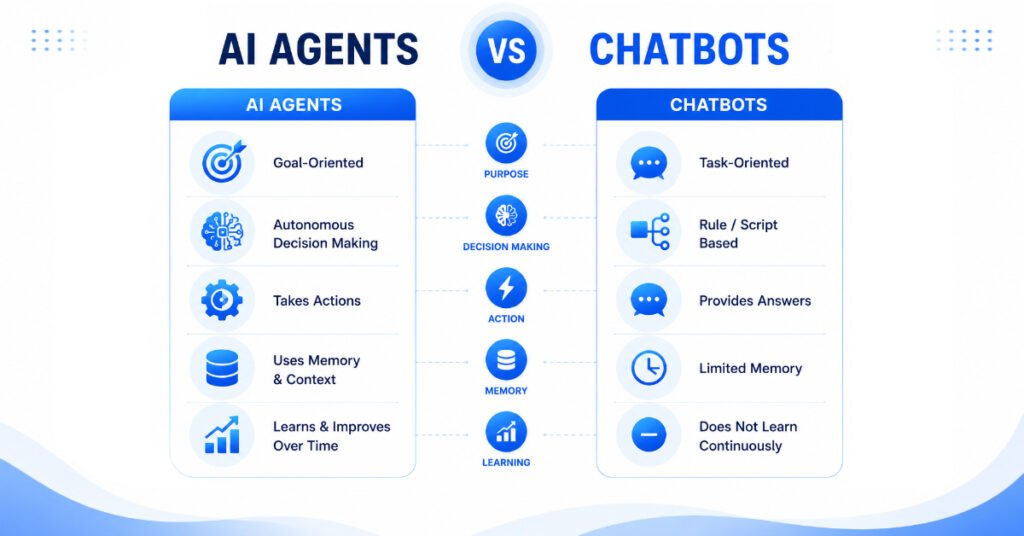
Traditional chatbots mainly respond to user prompts.
Modern AI agents can:
- automate workflows
- use external tools
- access databases
- coordinate systems
- and execute complex operations autonomously
AI Agents vs AI Copilots vs LLMs
People often use these terms interchangeably, but they solve different problems.
| Feature | LLMs | AI Copilots | AI Agents |
| Primary role | Generate content | Assist users | Perform tasks autonomously |
| Memory | Limited | Moderate | Advanced |
| Decision-making | Basic reasoning | Assisted decisions | Independent decisions |
| Tool usage | Sometimes | Frequently | Extensive |
| Task execution | Usually no | Partial | Yes |
| Human involvement | High | Medium | Lower |
| Example | Language generation model | Coding assistant | Autonomous customer service system |
In simple terms:
● LLMs generate intelligence
● AI copilots assist humans
● AI agents take actions and complete workflows
Legal professionals are also adopting AI-powered systems for research, document review, and workflow automation.
Real-World Applications of AI Agents
Healthcare
AI agents assist doctors with:
- medical imaging analysis
- disease prediction
- hospital workflow automation
- patient monitoring
Finance
Financial institutions use AI agents for:
- fraud detection
- algorithmic trading
- risk analysis
- financial forecasting
Cybersecurity
AI systems continuously monitor networks, detect threats, and respond to cyberattacks autonomously.
E-Commerce
Online businesses use AI agents for:
- recommendation systems
- inventory optimization
- customer support
- dynamic pricing
Software Development
AI coding agents can:
- generate code
- debug applications
- automate testing
- and improve software productivity
Construction
Construction companies increasingly use AI systems for:
- project scheduling
- safety monitoring
- resource allocation
- and operational optimization
Real Workflow Example: How an AI Agent Handles an E-commerce Refund Request
To understand how AI agents work in practice, imagine an online customer requesting a refund for a damaged product.
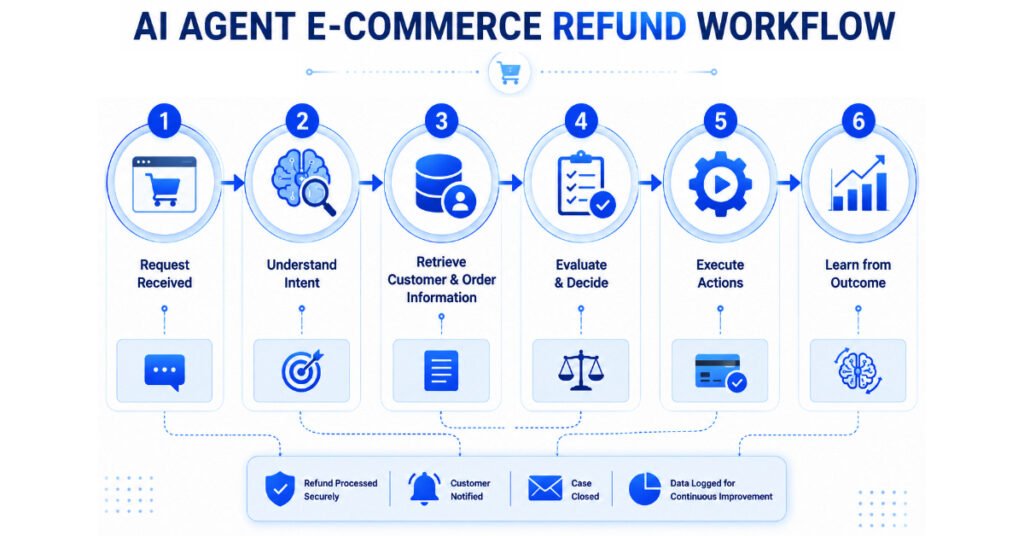
Step 1: Customer submits a request
The AI agent receives:
“I received a damaged item and want a refund.”
Step 2: Understand user intent
The agent identifies:
● refund request
● product issue
● customer sentiment
Step 3: Retrieve customer information
The system checks:
● order history
● purchase details
● shipping status
● refund policies
Step 4: Evaluate possible actions
The AI analyzes:
● whether the product qualifies for return
● whether evidence exists
● customer purchase history
Step 5: Execute actions
The system automatically:
● approves refund eligibility
● generates a return label
● updates CRM records
● sends customer notifications
Step 6: Learn from outcomes
The interaction data becomes feedback for future improvements.
This entire process may take seconds without requiring human intervention.
The Rise of Agentic AI in 2026
One of the biggest AI trends in 2026 is the rise of agentic AI.
Traditional AI systems mainly generated responses.
Modern AI agents can:
- plan tasks
- use software tools
- remember context
- collaborate with other systems
- and execute multi-step workflows autonomously
This transition is creating a new generation of intelligent digital workers.
Technologies from companies like OpenAI, Microsoft, NVIDIA, and Anthropic are accelerating the development of autonomous AI ecosystems.
Many experts believe agentic AI could reshape enterprise software in the same way cloud computing transformed IT infrastructure during the early 2000s.
Emerging AI Agent Trends in 2026
Several major trends are shaping the future of AI agents.
Autonomous Workflow Execution
AI agents are increasingly capable of handling complex multi-step workflows with minimal human supervision.
AI Agent Collaboration
Organizations are deploying specialized AI agents that coordinate tasks collaboratively within enterprise ecosystems.
Voice-Based AI Agents
Voice-powered assistants are evolving into autonomous systems capable of researching, planning, and executing tasks conversationally.
AI Copilots for Enterprises
Businesses are rapidly adopting AI copilots for:
- customer service
- coding
- analytics
- operations
- and workflow management
Agentic Software Development
AI coding agents are becoming capable of debugging, testing, documenting, and deploying software with limited human intervention.
Human-AI Collaboration
Rather than replacing humans entirely, many organizations are adopting hybrid collaboration models where human teams supervise and work alongside intelligent AI systems.
Benefits of AI Agents
Increased Automation
AI agents reduce repetitive manual work and improve operational efficiency. Businesses increasingly use various AI tools to automate routine tasks and improve productivity.
Faster Decision-Making
AI systems analyze massive amounts of data far faster than humans.
24/7 Availability
AI agents can operate continuously without downtime.
Reduced Operational Costs
Businesses can scale more efficiently using intelligent automation.
Personalized User Experiences
AI agents adapt interactions and recommendations based on user behavior.
Improved Productivity
Human employees can focus on strategic work while AI handles routine operational tasks.
What We Learned From Testing AI Agents
After observing how modern AI systems perform across customer support, workflow automation, and content tasks, several practical patterns repeatedly appear.
Key insights:
AI agents perform best with clear objectives
Broad instructions often produce inconsistent outcomes.
Instead of:
“Handle customer service”
More precise goals work better:
“Resolve refund requests under company policy.”
Memory significantly improves user experience
Agents that remember prior interactions create smoother and more personalized experiences.
Tool access matters more than model size
A smaller model connected to databases and APIs can sometimes outperform a larger standalone model.
Human supervision still matters
Fully autonomous systems work well for repetitive tasks, but human review remains valuable for sensitive decisions.
Multi-step workflows reveal strengths and weaknesses quickly
Simple tasks usually succeed, while long workflows expose issues such as missed context, reasoning errors, or tool failures.
Challenges and Limitations of AI Agents
Despite their advantages, AI agents also create important challenges.
Bias and Fairness
AI systems may inherit biases from training data.
Privacy Concerns
Many AI systems process highly sensitive information.
Hallucinations
Generative AI models can sometimes produce inaccurate or misleading outputs.
Security Risks
Autonomous systems introduce new cybersecurity vulnerabilities.
Infrastructure Costs
Advanced AI systems require significant computational resources.
Ethical Concerns
Questions around accountability, transparency, and responsible AI governance continue growing globally.
Frameworks such as the NIST AI Risk Management Framework are helping organizations establish responsible AI governance practices.
Challenges Businesses Face When Implementing AI Agents
While AI agents offer major benefits, real implementation can become difficult.
Common challenges include:
Data quality problems
AI systems depend heavily on clean and structured data.
Poor data often causes:
● inaccurate outputs
● inconsistent decisions
● reduced reliability
Integration complexity
Many organizations use multiple systems:
● CRM software
● databases
● analytics tools
● enterprise platforms
Connecting everything can require significant effort.
Cost management
Advanced AI systems may involve:
● cloud infrastructure costs
● API expenses
● storage requirements
● maintenance costs
Security and compliance concerns
Businesses handling sensitive information must consider:
● customer privacy
● regulatory requirements
● access controls
● audit systems
Change management
Employees may initially resist adopting AI systems because of uncertainty around workflows and responsibilities.
Successful implementations usually combine technology planning with employee education.
Comparison Table of AI Agent Types
| AI Agent Type | Memory | Learning Ability | Complexity | Best Use Case |
| Simple Reflex Agents | No | No | Low | Basic automation |
| Model-Based Agents | Yes | Limited | Medium | Robotics and navigation |
| Goal-Based Agents | Yes | Limited | Medium-High | Planning systems |
| Utility-Based Agents | Yes | Moderate | High | Optimization problems |
| Learning Agents | Yes | Advanced | High | Adaptive AI systems |
| Hierarchical Agents | Yes | Moderate | Very High | Enterprise automation |
| Multi-Agent Systems | Shared | Advanced | Very High | Collaborative AI ecosystems |
How to Choose the Right AI Agent
The best AI agent depends on the problem being solved.
Use this decision framework:
If your work follows fixed rules
Choose:
→ Simple Reflex Agents
Examples:
● sensor automation
● rule-based monitoring
If environments constantly change
Choose:
→ Model-Based Agents
Examples:
● robotics
● navigation systems
If you need planning and objectives
Choose:
→ Goal-Based Agents
Examples:
● scheduling
● workflow automation
If optimization matters most
Choose:
→ Utility-Based Agents
Examples:
● recommendation engines
● pricing systems
If systems must continuously improve
Choose:
→ Learning Agents
Examples:
● fraud detection
● predictive analytics
If multiple teams or systems must coordinate
Choose:
→ Hierarchical or Multi-Agent Systems
Examples:
● enterprise ecosystems
● smart infrastructure
Which Type of AI Agent Should Businesses Use?
The best AI agent architecture depends on business goals, scalability requirements, operational complexity, and industry needs.
Simple Reflex Agents
Best for:
- smart devices
- repetitive automation
- rule-based operational systems
Model-Based Agents
Best for:
- robotics
- navigation systems
- warehouse operations
- partially observable environments
Goal-Based Agents
Best for:
- workflow orchestration
- project management
- scheduling systems
- strategic planning
Utility-Based Agents
Best for:
- financial optimization
- recommendation engines
- dynamic pricing
- resource allocation
Learning Agents
Best for:
- adaptive AI systems
- predictive analytics
- fraud detection
- personalized experiences
Hierarchical Agents
Best for:
- enterprise-scale automation
- infrastructure coordination
- smart factories
- operational management
Multi-Agent Systems
Best for:
- distributed AI ecosystems
- collaborative robotics
- smart cities
- large-scale autonomous operations
Many enterprises increasingly combine multiple AI agent architectures to build scalable intelligent ecosystems.
How Beginners Can Start Learning AI Agents
Starting with AI agents can feel overwhelming because the ecosystem evolves rapidly. A structured approach makes learning easier.
Step 1: Understand AI fundamentals
Learn basic concepts such as:
- Machine learning
- Neural networks
- LLMs
- Prompts
Step 2: Explore AI agent frameworks
Popular tools include:
- LangChain
- CrewAI
- AutoGen
- Agent-based workflow platforms
Step 3: Build small projects
Begin with simple examples:
- FAQ assistants
- Scheduling bots
- Customer support systems
Step 4: Learn APIs and tool integration
Modern agents often connect with:
- Databases
- Web services
- Automation tools
Step 5: Experiment continuously
AI evolves quickly. Small practical experiments usually teach more than theory alone.
Common AI Agent Misconceptions
As AI agents become more popular, several misconceptions continue spreading.
| Myth | Reality |
| AI agents think like humans | AI agents identify patterns and make decisions using algorithms |
| AI agents are always autonomous | Many systems still require human supervision |
| Bigger models automatically mean better agents | Tools, memory, and workflows often matter more |
| AI agents replace all jobs | Most systems currently assist and automate specific tasks |
| AI agents never make mistakes | Hallucinations and errors can still occur |
Understanding these differences helps businesses make more realistic decisions.
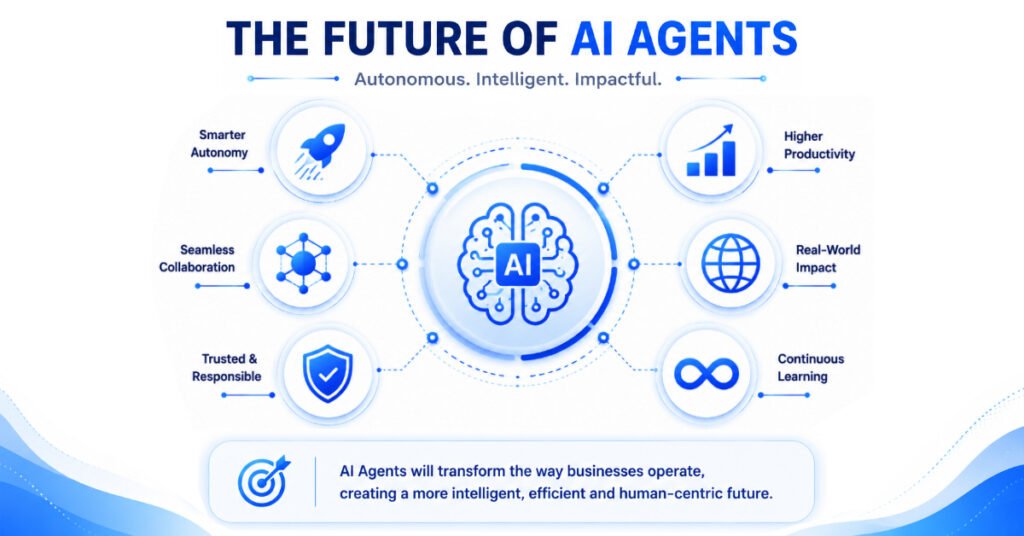
Future of AI Agents
AI agents are expected to become dramatically more advanced over the next decade.
Future AI systems may:
- collaborate autonomously
- perform advanced reasoning
- manage enterprise-scale operations
- coordinate software ecosystems
- and automate increasingly complex workflows
Instead of fully replacing humans, most organizations are expected to adopt hybrid human-AI collaboration models.
The future workplace will likely include teams of humans working alongside intelligent AI agents capable of handling repetitive, analytical, and operational tasks autonomously.
Expert Perspective: Why AI Agents Matter Now
During recent testing and observation of AI workflow systems, one pattern has become increasingly clear: businesses often gain the greatest value not from fully autonomous systems, but from combining AI automation with human oversight.
AI agents can handle repetitive and time-consuming work such as:
- Customer support
- Scheduling
- Information retrieval
- Workflow coordination
- Operational tasks
However, humans still provide critical judgment for strategy, ethics, and high-impact decision-making.
The current shift is not simply about replacing employees. It is increasingly about improving productivity, reducing operational friction, and allowing teams to focus more on higher-value work.
Conclusion
AI agents are rapidly evolving from simple automation tools into intelligent autonomous systems capable of reasoning, learning, collaboration, and decision-making.
From healthcare and finance to robotics, cybersecurity, and enterprise software, these systems are transforming how organizations operate in the digital age.
The seven major types of AI agents each serve different purposes:
- simple reflex agents handle lightweight automation
- model-based agents improve environmental awareness
- goal-based agents focus on achieving objectives
- utility-based agents optimize outcomes
- learning agents continuously improve through experience
- hierarchical agents coordinate complex enterprise systems
- and multi-agent systems enable collaborative intelligence at scale
As agentic AI continues advancing in 2026 and beyond, AI agents are expected to become foundational components of intelligent business infrastructure.
The transition from passive AI assistants to autonomous AI agents may become one of the most transformative technological shifts since the rise of cloud computing and the internet itself.
Organizations, developers, and professionals who understand AI agents today will be far better prepared for the next era of intelligent automation.
Frequently Asked Questions (FAQ)
1. What are the main types of AI agents?
The seven major types of AI agents are:
● Simple reflex agents
● Model-based reflex agents
● Goal-based agents
● Utility-based agents
● Learning agents
● Hierarchical agents
● And multi-agent systems
2. What is an AI agent in simple words?
An AI agent is an intelligent system that observes its environment, makes decisions, and performs actions autonomously to achieve goals.
3. What is the difference between AI agents and chatbots?
Traditional chatbots mainly answer questions, while AI agents can reason, use tools, automate workflows, and complete tasks autonomously.
4. Which type of AI agent is the most advanced?
Learning agents and multi-agent systems are currently among the most advanced AI architectures because they can adapt, collaborate, and improve continuously.
5. What industries use AI agents?
AI agents are widely used in:
● Healthcare
● Finance
● Cybersecurity
● Robotics
● E-commerce
● Transportation
● Education
● And software development
6. What is agentic AI?
Agentic AI refers to autonomous AI systems capable of reasoning, planning, memory management, tool usage, and multi-step workflow execution.
7. Are AI agents dangerous?
AI agents can create risks related to privacy, bias, misinformation, and cybersecurity if not developed and managed responsibly.
8. How do learning agents improve over time?
Learning agents analyze data, identify patterns, receive feedback, and continuously refine their decision-making processes.
9. What are real-world examples of AI agents?
Examples include:
● Recommendation systems
● Self-driving vehicles
● Fraud detection platforms
● AI customer support systems
● Autonomous robotics
● And intelligent enterprise copilots
10. Will AI agents replace human jobs?
AI agents will automate many repetitive tasks, but most experts believe future workplaces will involve collaboration between humans and intelligent AI systems rather than complete human replacement.
11. Can AI agents work without LLMs?
Yes. AI agents existed long before large language models became popular. Traditional agents often use rules, search algorithms, machine learning systems, or decision trees without relying on LLMs.
12. Are AI agents expensive?
Costs vary widely. Simple automation agents can be relatively affordable, while enterprise AI systems with advanced infrastructure, APIs, and large-scale processing may become expensive.
13. What programming languages are used for AI agents?
Common languages include:
● Python
● JavaScript
● Java
● C++
● Rust
Python remains one of the most widely used options because of its strong AI ecosystem.
14. Can small businesses use AI agents?
Yes. Small businesses increasingly use AI agents for customer support, marketing automation, scheduling, and workflow management without requiring enterprise-scale budgets.
15. What skills are required to build AI agents?
Useful skills include:
● Programming fundamentals
● Machine learning concepts
● API integration
● Prompt engineering
● Data handling
● Problem-solving
16. Are AI agents secure?
AI agents can be secure when implemented properly, but organizations should still apply:
● Encryption
● Access controls
● Monitoring systems
● Data governance policies
Security depends heavily on design and implementation practices.