Architecture, Process, Costs, Monetization & Best Practices
Software as a Service (SaaS) has transformed how modern businesses build, deliver, and scale software, redefining the cloud-based software delivery model. Instead of shipping boxed products or managing complex installations, companies now deploy cloud-based applications accessible anywhere with an internet connection.
From CRM platforms and collaboration tools to AI-powered analytics systems, SaaS is now the dominant software delivery model.
But creating a successful SaaS application isn’t just about development — it’s about strategy, architecture, security, user experience, and sustainable monetization.
This comprehensive guide breaks down everything you need to know about SaaS application development in 2026.
Quick Answers: SaaS Development at a Glance
What is SaaS?
Cloud-hosted software delivered via subscription.
Why do businesses prefer SaaS?
Lower upfront costs, scalability, automatic updates.
How long does development take?
2–4 months (MVP), 6–12+ months (full product).
What does it cost to build?
Typically $20,000 – $500,000+, depending on complexity.
Core features required?
Authentication, billing, analytics, APIs, admin controls.
Most critical success factor?
Product-market fit.
What is SaaS Application Development?
SaaS application development refers to building web-based or cloud-native software hosted centrally and accessed via browsers, mobile apps, or APIs. Software as a Service (SaaS Application Development)
Unlike traditional software:
| Traditional Software | SaaS Application |
| One-time purchase | Subscription / recurring revenue |
| Local installation | Cloud-hosted |
| Manual updates | Continuous automatic updates |
| Device dependent | Accessible globally |
Popular SaaS examples include Salesforce, Slack, and Zoom, which demonstrate how SaaS enables rapid scaling and continuous feature delivery.
Who This Guide is For
This guide is designed for:
- Startup founders validating a SaaS idea
- Developers building cloud applications
- Product managers planning features
- Businesses moving to subscription models
- Entrepreneurs exploring SaaS opportunities
Whether you’re launching an MVP or scaling an existing platform, the principles remain the same.
Why SaaS Continues to Dominate
The SaaS industry continues its aggressive growth trajectory. Market research consistently shows expansion driven by:
- Cloud-first infrastructure adoption
- Remote & hybrid work environments
- Reduced IT overhead
- Faster deployment cycles
- Continuous innovation
For businesses, SaaS converts heavy capital expenses into predictable operational costs — a major financial advantage.
Core Advantages of SaaS Applications
1. Lower Upfront Investment
No costly hardware, servers, or installations.
2. Seamless Scalability
Infrastructure grows with user demand.
3. Global Accessibility
Users log in from any location or device.
4. Continuous Updates
New features roll out instantly.
5. Predictable Revenue Streams
Subscription pricing supports long-term sustainability.
6. Centralized Maintenance
Bug fixes and patches deploy universally.
Key SaaS Architecture Models
Choosing the right architecture is foundational.
Single-Tenant Architecture
- Dedicated instance per customer
- Greater customization
- Higher infrastructure cost
Best suited for enterprise or compliance-heavy solutions.
Multi-Tenant Architecture (Most Common)
- Shared infrastructure
- Cost-efficient scaling
- Simplified updates
- Requires strict data isolation
Preferred for most SaaS startups.
Microservices Architecture
Increasingly dominant in modern SaaS:
- Independent service components
- Flexible scaling
- Faster deployments
- Improved fault isolation
Ideal for complex or rapidly evolving platforms.
Essential Features of a SaaS Product
Competitive SaaS platforms typically include:
- Secure authentication (OAuth / MFA)
- Subscription & billing management
- Role-based permissions
- Analytics dashboards
- API integrations
- Notifications system
- Admin controls
- Data security mechanisms
Missing these often leads to usability or scalability problems later.
Step-by-Step SaaS Development Process
Step 1: Idea Validation & Problem Definition
Before development:
- Identify a meaningful problem
- Define target audience
- Analyze competitors
- Clarify unique value proposition
Reality check: Many SaaS failures occur due to weak problem validation.
Step 2: Market & Competitive Research
Understand:
- Customer pain points
- Existing solutions
- Pricing benchmarks
- Feature gaps
Use surveys, interviews, community discussions, and keyword research.
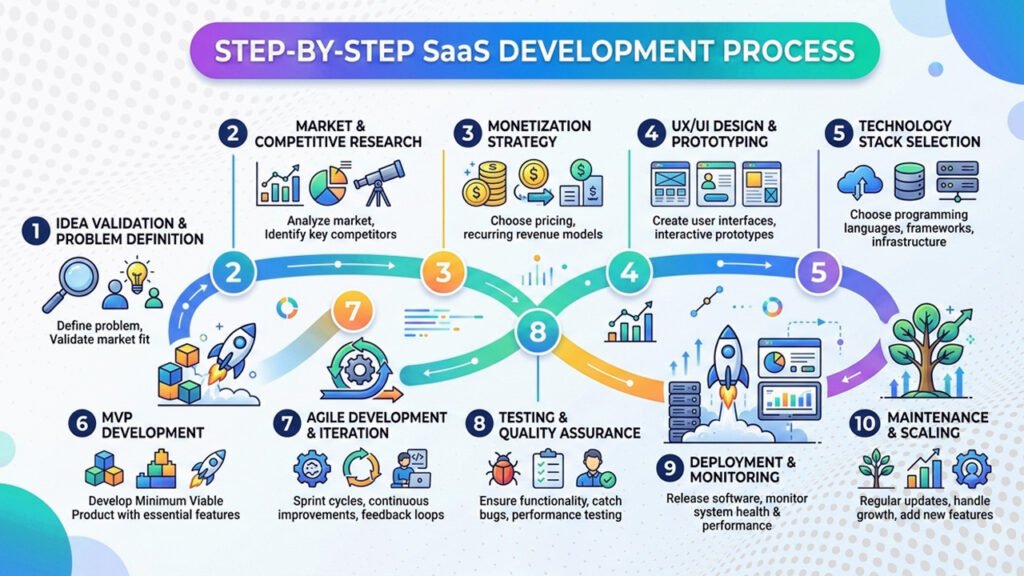
Step 3: Monetization Strategy
Common SaaS models:
- Subscription (monthly / annual)
- Tiered pricing
- Freemium
- Usage-based billing
- Enterprise licensing
Pricing strategy directly impacts growth and retention.
Step 4: UX/UI Design & Prototyping
Design:
- Wireframes
- User flows
- Clickable prototypes
A SaaS product should feel intuitive, not overwhelming.
Step 5: Technology Stack Selection
Typical choices:
Frontend: React, Vue, Next.js
Backend: Node.js, Django, Laravel
Database: PostgreSQL, MongoDB
Cloud: AWS, Azure, GCP
Select based on scalability, performance, and team expertise.
Step 6: MVP Development
Focus on:
- Core functionality
- Rapid launch
- Real user feedback
Avoid feature bloat.
Step 7: Agile Development & Iteration
- Short sprints
- Continuous releases
- Feedback-driven improvements
Step 8: Testing & Quality Assurance
Critical tests:
- Functional
- Security
- Load / stress
- Usability
Skipping QA increases long-term technical debt.
Step 9: Deployment & Monitoring
- CI/CD pipelines
- Performance monitoring
- Error tracking
- Backup systems
Step 10: Maintenance & Scaling
- Performance optimization
- Feature enhancements
- Security updates
SaaS is a continuous evolution, not a one-time launch.
How Much Does SaaS Development Cost?
Costs vary significantly:
| Complexity Level | Estimated Cost |
| Basic MVP | $20,000 – $60,000 |
| Mid-Level SaaS | $60,000 – $150,000 |
| Advanced Platform | $150,000 – $500,000+ |
Key cost drivers:
- Feature complexity
- Development timeline
- Team size
- Cloud infrastructure
- Compliance & security
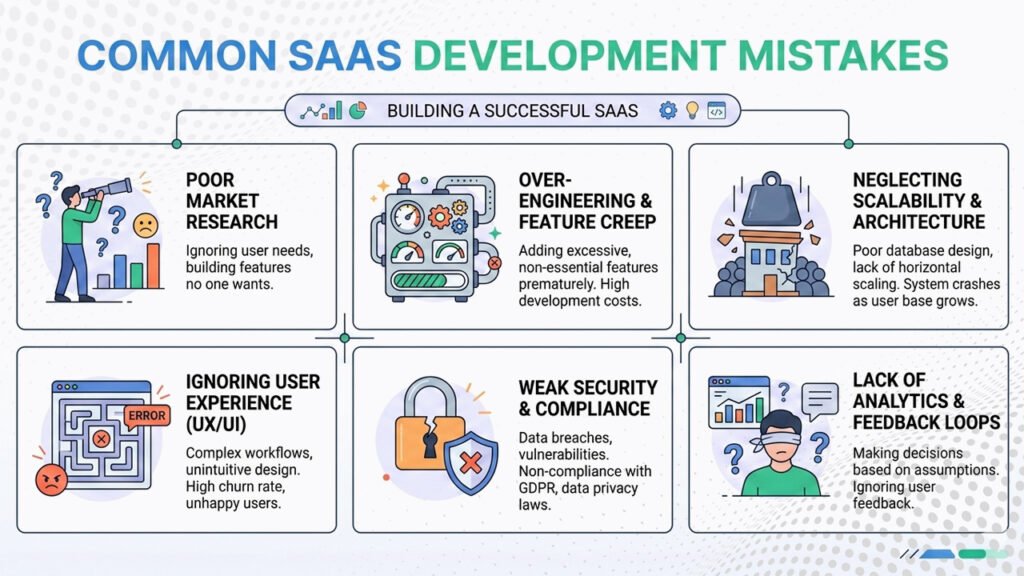
Common SaaS Development Mistakes
Avoid:
❌ Skipping validation
❌ Overbuilding pre-MVP
❌ Weak onboarding UX
❌ Poor pricing strategy
❌ Ignoring analytics
❌ Underestimating security
❌ Lack of customer support planning
Security & Compliance Essentials
Security failures can destroy trust instantly.
- Data encryption
- Secure APIs
- Access controls
- Compliance readiness (GDPR, HIPAA, SOC 2)
- Regular audits
Security must be designed in — not added later.
Emerging SaaS Trends (2026)
- AI-native SaaS features
- Vertical SaaS specialization
- Usage-based pricing
- API-first products
- Privacy-focused design
- Low-code integrations
Why Building a SaaS Product Still Makes Sense
- Recurring revenue
- High scalability
- Global reach
- Strong investor interest
- Long-term valuation potential
Success, however, depends on execution, not just ideas.
Frequently Asked Questions (FAQs)
How long does it take to build a SaaS application?
MVP: 2–4 months
Full product: 6–12+ months
Timeline depends on complexity and resources.
Can a solo developer build a SaaS product?
Yes. Many successful SaaS startups began as solo MVPs.
What is the most important SaaS success factor?
Product-market fit.
How do SaaS products make money?
Subscriptions
Tiered pricing
Freemium upgrades
Usage-based billing
What churn rate is acceptable?
Generally, below 5% monthly churn is considered healthy for early-stage SaaS.
What security features are mandatory?
Absolutely. SaaS reduces infrastructure and maintenance burdens.
Final Thoughts
SaaS application development offers extraordinary opportunities for founders, developers, and businesses — but only when approached strategically.
Focus on:
✔ Solving real problems
✔ Clean architecture
✔ Exceptional user experience
✔ Strong security
✔ Continuous improvement
In 2026, SaaS remains one of the most powerful and scalable digital business models.