Quick Answer
Executive buy-in for B2B Proof of Concept (POC) is achieved when decision-makers clearly understand three things: the business value, the risks involved, and the path from POC to production.
Executive buy-in for B2B POC is crucial, as it ensures the project aligns with strategic goals. In 2026, successful B2B POCs earn approval by addressing ROI, security, compliance, and stakeholder ownership before the POC begins—not after. Executive buy-in for B2B POC is essential for ensuring project success and alignment with strategic goals, making it a fundamental focus of the process.
Quick Take
- Executives approve POCs when risk feels controlled
- Security and compliance questions matter as much as ROI
- One executive sponsor is critical
- Clear success criteria accelerate decisions
- POCs fail when leadership feels uncertain, not unimpressed
If you’ve ever run a B2B POC where users were excited but leadership stayed silent, you’re not alone.
I’ve personally seen B2B POCs across SaaS, AI platforms, and enterprise tools where:
- The product worked
- Users were happy
- Early results looked strong
and yet the deal stalled.
Not because the product failed—but because executives didn’t feel safe approving it.
In 2025, executive buy-in isn’t about excitement.
It’s about risk, trust, and decision clarity.
This guide explains how to earn executive buy-in during a B2B POC by aligning security, ROI, and stakeholders the way enterprise leaders actually expect.
For the complete execution framework, you should also read our How to Build a Successful B2B POC in 2025 guide.
Why Most B2B POCs Stall at the Executive Level
Executives don’t experience your product the way end users do.
They don’t see:
- Feature elegance
- UI improvements
- Technical milestones
For a POC to be successful, securing executive buy-in for B2B POC should be prioritized from the outset.
They see:
Achieving effective executive buy-in for B2B POC requires clear communication and demonstrable value. The more stakeholders involved understand the implications and benefits, the more likely they are to support the initiative.
- Budget exposure
- Security risk
- Vendor dependency
- Long-term operational impact
If those concerns aren’t answered clearly, the safest response is delay.
And delayed POCs quietly die.
That’s why many technically successful POCs never convert into paid contracts.
Who Actually Approves a B2B POC in 2026
One of the biggest mistakes teams make is assuming there is one decision-maker.
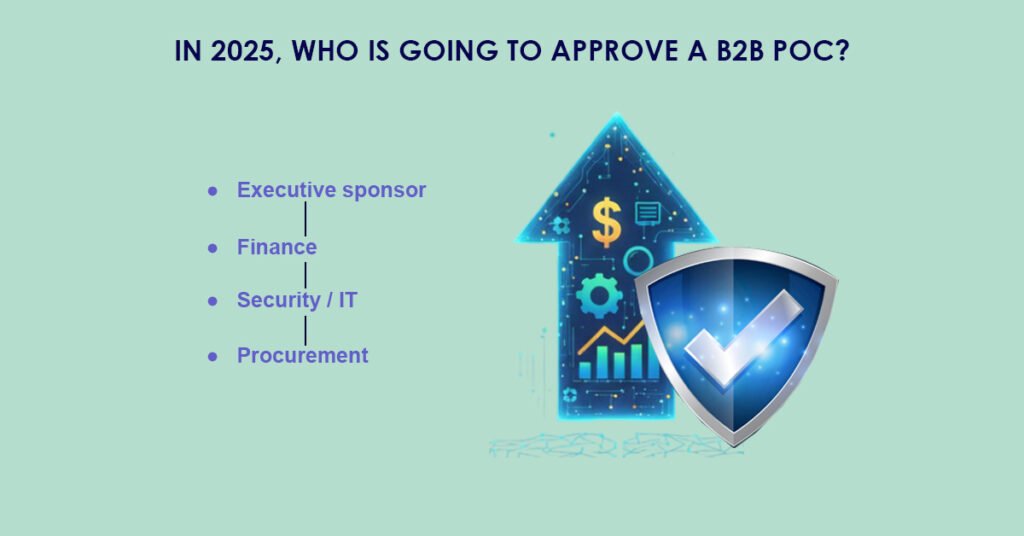
In reality, B2B POCs are usually approved by a small group:
- Executive sponsor (final accountability)
- Finance (ROI and budget logic)
- Security / IT (risk and compliance)
- Procurement (vendor and contract viability)
If even one group feels uncomfortable, approval slows—or stops entirely.
High-converting POCs align all four early, not reactively.
The Security & Compliance Questions Executives Always Ask
Security is no longer a post-sale discussion.
In 2026, it’s a POC-stage requirement.
Executives want clear answers to:
- What data is accessed?
- Where is it stored?
- Who can access it?
- What happens if something goes wrong?
Industry standards such as SOC 2 and ISO/IEC 27001 are now baseline expectations—even during POCs.
Best Practice
Provide a one-page POC security overview covering:
- Data scope and usage
- Access controls
- Retention policy
- Incident response plan
Without effective executive buy-in for B2B POC, projects are more likely to face hurdles, resulting in delays and misalignments in goals.
Clear documentation reduces friction and builds trust.
Ultimately, cultivating executive buy-in for B2B POC is about ensuring everyone is on the same page, which leads to smoother project execution.
Thus, the crux of executive buy-in for B2B POC lies not just in the presentation but in the proactive management of stakeholder expectations.
How to Align Stakeholders Before the POC Starts
Executive buy-in becomes much easier when alignment happens early.
It’s essential to remember that executive buy-in for B2B POC is not just a formality; it’s a critical component of project success.
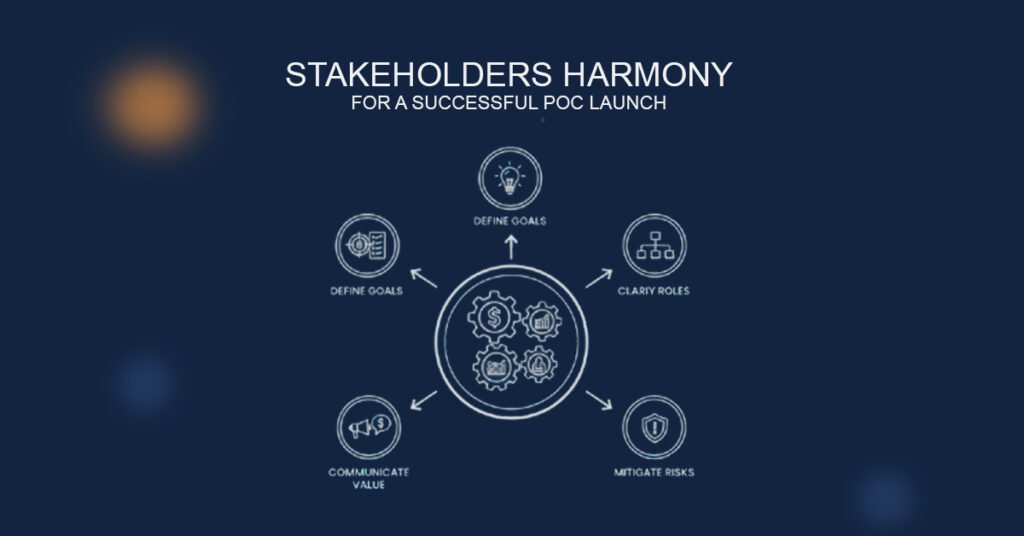
Before starting a POC, confirm:
- One named executive sponsor
- One clearly defined business problem
- One agreed set of success metrics
- One decision timeline
If success criteria are vague, approval will be vague.
This principle is central to our complete B2B POC framework because alignment is not optional—it’s foundational.
How Executives Evaluate POC Results (Hint: It’s Not Technical)
Executives rarely want long presentations.
What they want:
- Confidence
- Clarity
- A recommendation
The most effective POC close-out includes:
- Problem recap
- Before vs after results
- Risk assessment
- 12-month business impact
- Go / No-Go recommendation
ROI plays a major role here. If you want to frame metrics correctly, see How to Measure ROI in a B2B POC.
Executives don’t approve products.
They approve decisions that feel safe.
Common Executive Objections (And How to Address Them)
“What if this doesn’t scale?”
→ Show how rollout would work beyond the POC.
“What’s the downside if this fails?”
→ Explain rollback options and risk containment.
“Why should we act now?”
→ Tie results to current business urgency.
Objections are not rejection—they signal unresolved risk.
The Real Secret to Executive Buy-In
Here’s the truth most teams miss:
Executives don’t approve POCs because they’re impressive.
They approve them because they’re controlled, justified, and reversible.
When a POC:
- Limits risk
- Proves value
- Defines ownership
- Shows a clear next step
Approval becomes logical—not emotional.
Frequently Asked Questions (FAQ)
What is executive buy-in in a B2B POC?
Executive buy-in means leadership understands and supports the business case, risks, and rollout plan for the POC and is willing to approve next steps.
Who should sponsor a B2B POC?
A single executive sponsor with decision authority—not a committee—should own the POC outcome.
How long does executive approval usually take?
When alignment is clear, approvals often happen within days of the POC conclusion. Misaligned POCs can stall for months.
What security concerns do executives have during a POC?
Data access, compliance standards, access control, and incident response are the most common concerns.
Can a POC fail even if users like the product?
Yes. Many POCs fail because ROI or risk is unclear at the executive level—even when users are satisfied.
Final Thoughts: POCs Convert When Leaders Feel Safe
In 2026, B2B buyers are cautious—not resistant.
A well-structured POC:
Engaging with executives early on can significantly ease the path to securing executive buy-in for B2B POC.
- Builds trust
- Reduces uncertainty
- Aligns stakeholders
- Accelerates decisions
A poorly positioned one leaves leadership guessing.
If you treat executive buy-in as part of the POC—not an afterthought—you’ll close more deals with fewer stalled pilots.
For the full picture, revisit How to Build a Successful B2B POC in 2025 and use this article as the final piece of your content cluster.
In conclusion, without effective executive buy-in for B2B POC, projects may flounder, regardless of their technical merit.