Artificial Intelligence once sounded like science fiction.
Robots.
Flying cars.
Machines taking over the world.
But here’s the truth:
AI isn’t some distant future technology.
It’s already part of your everyday life.
It unlocks your smartphone.
It filters spam from your inbox.
It recommends movies on Netflix.
It powers voice assistants like Siri and Amazon Alexa.
You may not always see it, but AI is quietly working behind the scenes — every single day.
So let’s simplify everything and understand what AI really is.
Quick Answer: What Is AI?
Artificial Intelligence (AI) is technology that allows machines to learn from data, recognize patterns, and make decisions in ways that mimic human intelligence.
Unlike traditional software that follows fixed instructions, AI systems improve over time as they process more information.
In simple words:
AI helps computers learn, adapt, and make smarter decisions using data.
Now let’s break that down in a way that actually makes sense.
What Is Artificial Intelligence? (Simple Explanation)
Think about how humans learn.
We observe.
We practice.
We make mistakes.
We improve.
AI works in a similar way.
Artificial Intelligence is the simulation of human intelligence in machines — a concept also defined in academic research from Stanford University’s Human-Centered AI Institute.
- Learn from experience
- Understand language
- Recognize images and speech
- Solve problems
- Make predictions
A calculator only performs what it’s programmed to do.
AI, on the other hand, learns from examples. The more data it processes, the better it performs.
That learning ability is what makes AI different from traditional software.
How Does AI Work? (Step-by-Step Without Confusion)
AI may seem complex, but the process behind it is surprisingly structured.
Let’s walk through it together.
1. Data Collection
Everything starts with data.
AI systems need large amounts of information to learn. This can include:
- User behavior
- Images and videos
- Text
- Audio
- Sensor readings
If data is the fuel, AI is the engine.
No data → No learning.
2. Data Preparation
Raw data isn’t always clean or organized.
Before AI can learn, the data must be:
- Filtered
- Structured
- Checked for errors
Poor-quality data leads to poor decisions. That’s why this step is crucial.
3. Machine Learning
This is where intelligence begins.
Machine Learning (ML) is a subset of AI that allows systems to identify patterns without being explicitly programmed for every scenario.
For example:
If an AI analyzes thousands of pictures of cats, it begins to understand common features — like ear shape, fur texture, and facial structure.
Eventually, it can recognize a new cat image it has never seen before.
That’s learning.
4. Neural Networks & Algorithms
Many advanced AI systems use neural networks — models inspired by how the human brain works.
These networks contain layers that process information step by step:
- The first layer might detect edges in an image
- The next layer identifies shapes
- The final layer recognizes objects
Behind the scenes, algorithms adjust millions of parameters during training to improve accuracy.
It sounds technical, but the core idea is simple:
AI learns by analyzing patterns and correcting itself over time.
Research from MIT has extensively explored how neural networks mimic certain aspects of human brain function to process complex data patterns.
5. Prediction and Decision-Making
Once trained, AI can:
- Detect fraud in banking transactions
- Recommend products you might like
- Recognize your face to unlock your phone
- Predict traffic patterns
- Answer customer queries
If your bank blocks a suspicious transaction within seconds, there’s a strong chance AI is working in the background.
And the more data it processes, the smarter it becomes.
Types of Artificial Intelligence
Not all AI systems are the same.
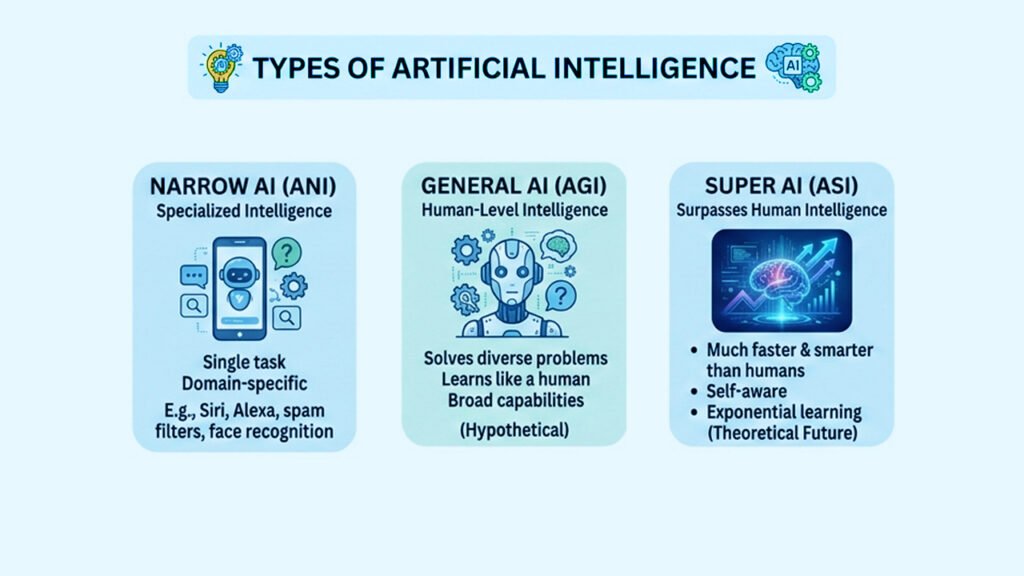
There are three main categories.
1. Narrow AI (Weak AI)
This is the type of AI we use today.
It is designed to perform one specific task and cannot operate outside its programmed purpose.
Examples include:
- Voice assistants
- Chatbots
- Recommendation engines
- Facial recognition systems
Almost every AI system you interact with today is Narrow AI.
2. General AI (Strong AI)
General AI would be capable of understanding and performing any intellectual task that a human can.
It doesn’t exist yet.
Researchers are still exploring whether it’s even achievable.
3. Superintelligence
Superintelligence refers to AI that surpasses human intelligence in all areas.
Movies like Her explore this idea, but in reality, it remains theoretical.
We are nowhere near that stage.
Real-World Applications of AI
AI isn’t limited to tech companies. It’s transforming industries globally.
Healthcare
- AI systems assist in early cancer detection
- Medical imaging analysis improves diagnosis accuracy
- Drug discovery is becoming faster
Finance
- Fraud detection systems analyze millions of transactions in real time
- AI evaluates credit risk
- Algorithmic trading systems execute high-speed market decisions
Retail
- Personalized product recommendations
- Demand forecasting
- AI-powered customer service chatbots
Think about the last time an online store suggested something you actually liked. That wasn’t random — it was AI analyzing your behavior.
Many small companies are already adopting practical AI tools for small businesses to automate marketing, customer service, and operations.
Even property professionals are adopting AI tools for real estate agents to automate listings and client communication.
Transportation
- Autonomous vehicle development
- Route optimization
- Real-time traffic prediction
According to PwC’s global AI report, AI could contribute $15.7 trillion to the global economy by 2030 — making it one of the largest economic opportunities in modern history.
10 Important Facts About AI
- AI systems can detect certain cancers earlier than human radiologists in controlled studies.
- Self-driving vehicles process millions of data inputs per second.
- AI can generate text, code, music, and artwork.
Students are increasingly relying on AI writing tools for students to improve research, grammar, and productivity. - Banks use AI to prevent billions of dollars in fraud annually.
- AI improves crop monitoring using satellite data.
- Cybersecurity systems monitor billions of signals daily to identify threats.
- Billions of users interact with AI assistants worldwide.
- AI supports climate research through predictive modeling.
- Smart grids use AI to reduce energy waste.
- The global AI market is projected to reach $1.8 trillion by 2030, according to Statista.
AI isn’t slowing down. It’s accelerating.
Benefits of Artificial Intelligence
So why are businesses investing heavily in AI?
Because the benefits are powerful:
- Automates repetitive work
- Improves accuracy
- Speeds up decision-making
- Reduces operational costs
- Drives innovation
In the legal field, AI tools for lawyers in India are helping professionals analyze documents and speed up case research.
It allows humans to focus more on creativity, strategy, and problem-solving instead of routine tasks.
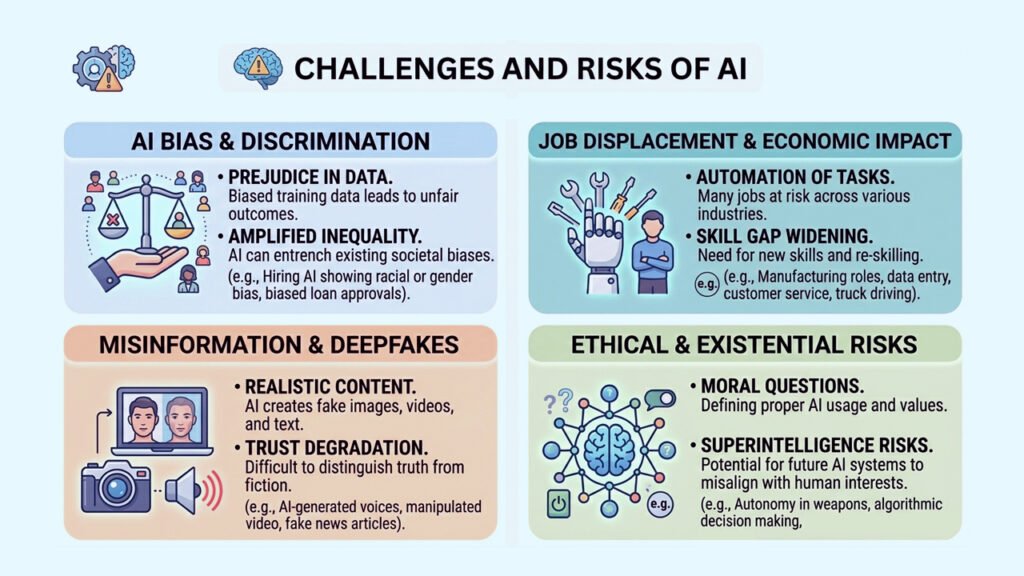
Challenges and Risks of AI
With great innovation comes responsibility.
AI also raises concerns:
- Job displacement
- Data privacy risks
- Algorithm bias
- Ethical misuse
- High implementation costs
Governments and organizations worldwide are working on responsible AI frameworks and regulations. The goal isn’t to stop AI — but to guide it wisely.
International organizations such as the OECD have also developed AI policy frameworks to promote responsible and ethical development.
Frequently Asked Questions
What is the difference between AI and Machine Learning?
Artificial Intelligence is the broader concept of machines performing intelligent tasks.
Machine Learning is a subset of AI that enables systems to learn from data and improve automatically.
Can AI replace humans?
AI can automate repetitive tasks, but it is more likely to assist humans rather than completely replace them.
In many cases, AI creates new opportunities instead of eliminating them.
Is AI dangerous?
AI itself is not inherently dangerous.
However, misuse, bias, or lack of proper oversight can create risks. Responsible development is essential.
Why Understanding AI Matters in 2026
AI is becoming as fundamental as electricity or the internet.
Businesses rely on it to stay competitive.
Students use it to learn faster.
Governments use it to optimize systems.
Creators use it to innovate.
Understanding AI is no longer optional.
It’s becoming a basic digital skill.
The World Economic Forum has repeatedly highlighted AI as one of the most transformative technologies shaping global industries.
The Future of AI
AI is moving toward:
- Smarter healthcare diagnostics
- Climate change solutions
- AI-powered creative tools
- Advanced automation
- Integration with quantum computing
We are still in the early stages of this transformation.
What we see today is just the beginning.
Explore More AI Guides on WebWorldSolution
If you’re ready to go deeper, explore related guides on WebWorldSolution:
- AI tools for small businesses
- AI in construction and project management
- AI code review tools for developers
This article gives you the foundation.
The next step is applying that knowledge.
Conclusion
Artificial Intelligence is not just another tech trend.
It is reshaping how we live, work, and make decisions.
Yes, there are challenges.
But the opportunities are enormous.
The question is no longer:
Will AI change the world?
It already is.
The real question is:
How will you adapt and grow in a world powered by Artificial Intelligence?